

164
2
General Synthetic Methods
3.2.2 Anomeric O-Deacylation
Deprotection of the anomeric acyl group in acylated sugars can be effected in a number of
manners including chemical and enzymatic methods.
Enzymic Deacylation Both furanose and pyranose sugars can be efficiently deacetylated by
suitable lipases under proper reaction conditions. The removal of the 1-O-acetyl group of
glucose pentaacetate by Aspergillus niger lipase was reported after 20% conversion [432].
More recently it was found that the regioselectivity could be enhanced in the pyranose case
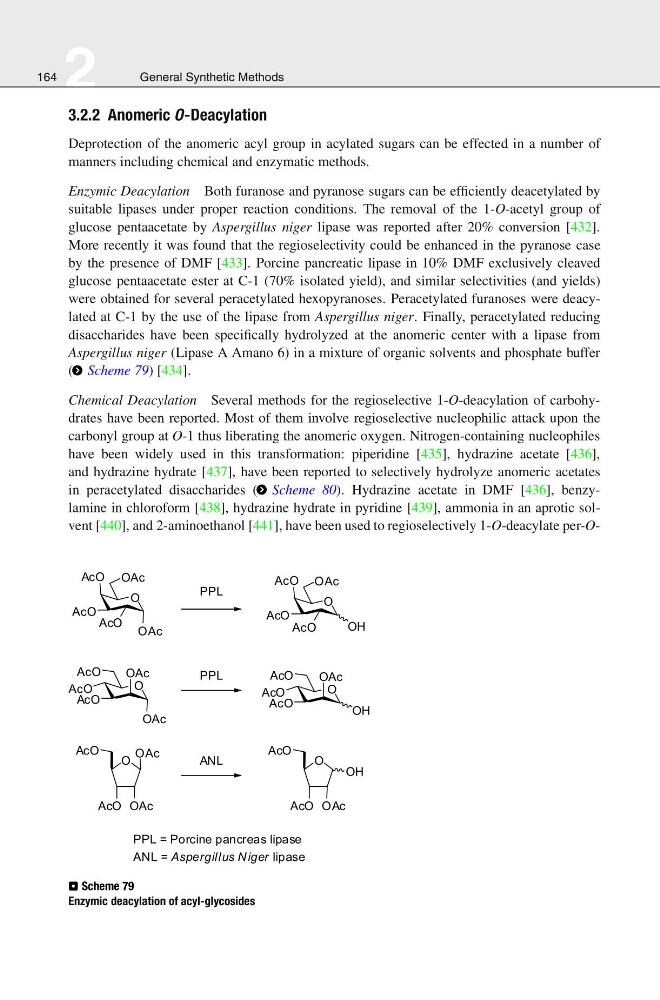
by the presence of DMF [433]. Porcine pancreatic lipase in 10% DMF exclusively cleaved
glucose pentaacetate ester at C-1 (70% isolated yield), and similar selectivities (and yields)
were obtained for several peracetylated hexopyranoses. Peracetylated furanoses were deacylated at C-1 by the use of the lipase from Aspergillus niger. Finally, peracetylated reducing
disaccharides have been specifically hydrolyzed at the anomeric center with a lipase from
Aspergillus niger (Lipase A Amano 6) in a mixture of organic solvents and phosphate buffer
( > Scheme 79) [434].
Chemical Deacylation Several methods for the regioselective 1-O-deacylation of carbohydrates have been reported. Most of them involve regioselective nucleophilic attack upon the
carbonyl group at O-1 thus liberating the anomeric oxygen. Nitrogen-containing nucleophiles
have been widely used in this transformation: piperidine [435], hydrazine acetate [436],
and hydrazine hydrate [437], have been reported to selectively hydrolyze anomeric acetates
in peracetylated disaccharides ( > Scheme 80). Hydrazine acetate in DMF [436], benzylamine in chloroform [438], hydrazine hydrate in pyridine [439], ammonia in an aprotic solvent [440], and 2-aminoethanol [441], have been used to regioselectively 1-O-deacylate per-O⊡ Scheme 79
Enzymic deacylation of acyl-glycosides
2
General Synthetic Methods
3.2.2 Anomeric O-Deacylation
Deprotection of the anomeric acyl group in acylated sugars can be effected in a number of
manners including chemical and enzymatic methods.
Enzymic Deacylation Both furanose and pyranose sugars can be efficiently deacetylated by
suitable lipases under proper reaction conditions. The removal of the 1-O-acetyl group of
glucose pentaacetate by Aspergillus niger lipase was reported after 20% conversion [432].
More recently it was found that the regioselectivity could be enhanced in the pyranose case
by the presence of DMF [433]. Porcine pancreatic lipase in 10% DMF exclusively cleaved
glucose pentaacetate ester at C-1 (70% isolated yield), and similar selectivities (and yields)
were obtained for several peracetylated hexopyranoses. Peracetylated furanoses were deacylated at C-1 by the use of the lipase from Aspergillus niger. Finally, peracetylated reducing
disaccharides have been specifically hydrolyzed at the anomeric center with a lipase from
Aspergillus niger (Lipase A Amano 6) in a mixture of organic solvents and phosphate buffer
( > Scheme 79) [434].
Chemical Deacylation Several methods for the regioselective 1-O-deacylation of carbohydrates have been reported. Most of them involve regioselective nucleophilic attack upon the
carbonyl group at O-1 thus liberating the anomeric oxygen. Nitrogen-containing nucleophiles
have been widely used in this transformation: piperidine [435], hydrazine acetate [436],
and hydrazine hydrate [437], have been reported to selectively hydrolyze anomeric acetates
in peracetylated disaccharides ( > Scheme 80). Hydrazine acetate in DMF [436], benzylamine in chloroform [438], hydrazine hydrate in pyridine [439], ammonia in an aprotic solvent [440], and 2-aminoethanol [441], have been used to regioselectively 1-O-deacylate per-O⊡ Scheme 79
Enzymic deacylation of acyl-glycosides