

152
2
General Synthetic Methods
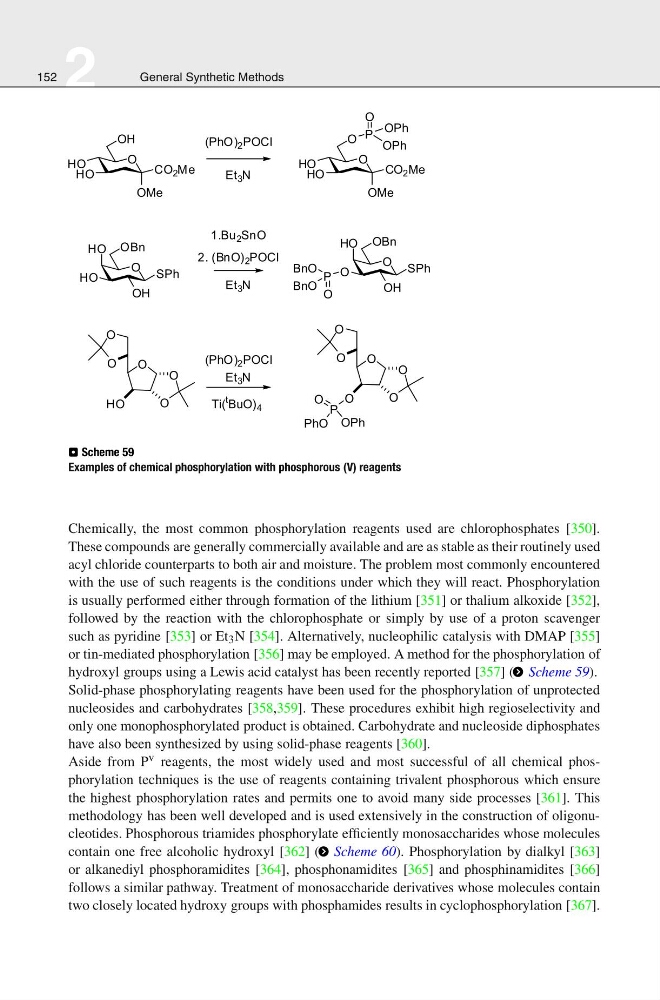
⊡ Scheme 59
Examples of chemical phosphorylation with phosphorous (V) reagents
Chemically, the most common phosphorylation reagents used are chlorophosphates [350].
These compounds are generally commercially available and are as stable as their routinely used
acyl chloride counterparts to both air and moisture. The problem most commonly encountered
with the use of such reagents is the conditions under which they will react. Phosphorylation
is usually performed either through formation of the lithium [351] or thalium alkoxide [352],
followed by the reaction with the chlorophosphate or simply by use of a proton scavenger
such as pyridine [353] or Et 3 N [354]. Alternatively, nucleophilic catalysis with DMAP [355]
or tin-mediated phosphorylation [356] may be employed. A method for the phosphorylation of
hydroxyl groups using a Lewis acid catalyst has been recently reported [357] ( > Scheme 59).
Solid-phase phosphorylating reagents have been used for the phosphorylation of unprotected
nucleosides and carbohydrates [358,359]. These procedures exhibit high regioselectivity and
only one monophosphorylated product is obtained. Carbohydrate and nucleoside diphosphates
have also been synthesized by using solid-phase reagents [360].
Aside from P v reagents, the most widely used and most successful of all chemical phosphorylation techniques is the use of reagents containing trivalent phosphorous which ensure
the highest phosphorylation rates and permits one to avoid many side processes [361]. This
methodology has been well developed and is used extensively in the construction of oligonucleotides. Phosphorous triamides phosphorylate efficiently monosaccharides whose molecules
contain one free alcoholic hydroxyl [362] ( > Scheme 60). Phosphorylation by dialkyl [363]
or alkanediyl phosphoramidites [364], phosphonamidites [365] and phosphinamidites [366]
follows a similar pathway. Treatment of monosaccharide derivatives whose molecules contain
two closely located hydroxy groups with phosphamides results in cyclophosphorylation [367].
2
General Synthetic Methods
⊡ Scheme 59
Examples of chemical phosphorylation with phosphorous (V) reagents
Chemically, the most common phosphorylation reagents used are chlorophosphates [350].
These compounds are generally commercially available and are as stable as their routinely used
acyl chloride counterparts to both air and moisture. The problem most commonly encountered
with the use of such reagents is the conditions under which they will react. Phosphorylation
is usually performed either through formation of the lithium [351] or thalium alkoxide [352],
followed by the reaction with the chlorophosphate or simply by use of a proton scavenger
such as pyridine [353] or Et 3 N [354]. Alternatively, nucleophilic catalysis with DMAP [355]
or tin-mediated phosphorylation [356] may be employed. A method for the phosphorylation of
hydroxyl groups using a Lewis acid catalyst has been recently reported [357] ( > Scheme 59).
Solid-phase phosphorylating reagents have been used for the phosphorylation of unprotected
nucleosides and carbohydrates [358,359]. These procedures exhibit high regioselectivity and
only one monophosphorylated product is obtained. Carbohydrate and nucleoside diphosphates
have also been synthesized by using solid-phase reagents [360].
Aside from P v reagents, the most widely used and most successful of all chemical phosphorylation techniques is the use of reagents containing trivalent phosphorous which ensure
the highest phosphorylation rates and permits one to avoid many side processes [361]. This
methodology has been well developed and is used extensively in the construction of oligonucleotides. Phosphorous triamides phosphorylate efficiently monosaccharides whose molecules
contain one free alcoholic hydroxyl [362] ( > Scheme 60). Phosphorylation by dialkyl [363]
or alkanediyl phosphoramidites [364], phosphonamidites [365] and phosphinamidites [366]
follows a similar pathway. Treatment of monosaccharide derivatives whose molecules contain
two closely located hydroxy groups with phosphamides results in cyclophosphorylation [367].