

140
2
General Synthetic Methods
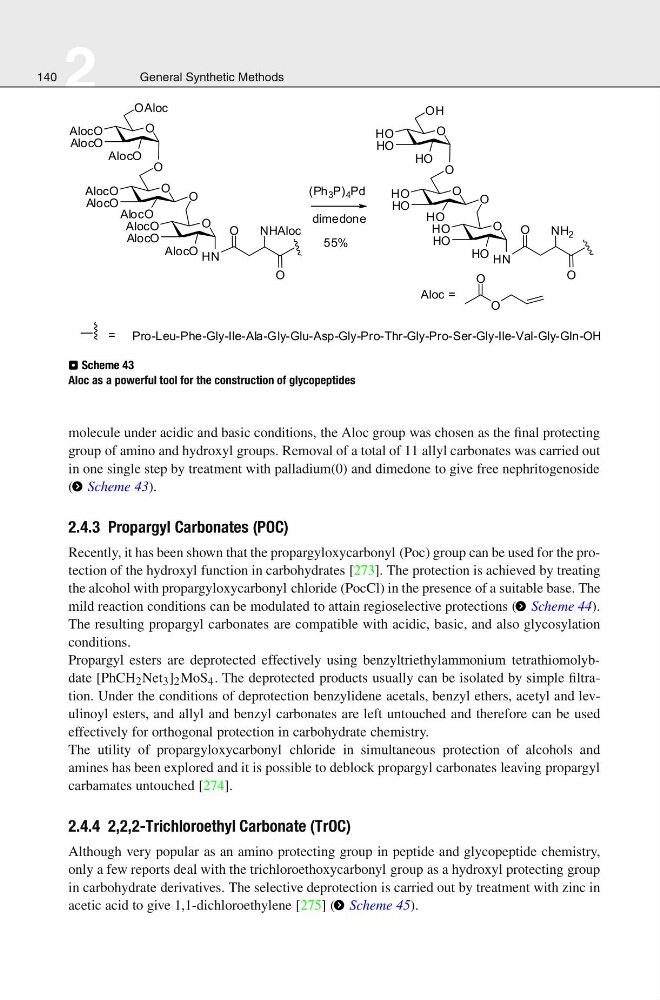
⊡ Scheme 43
Aloc as a powerful tool for the construction of glycopeptides
molecule under acidic and basic conditions, the Aloc group was chosen as the final protecting
group of amino and hydroxyl groups. Removal of a total of 11 allyl carbonates was carried out
in one single step by treatment with palladium(0) and dimedone to give free nephritogenoside
( > Scheme 43).
2.4.3 Propargyl Carbonates (POC)
Recently, it has been shown that the propargyloxycarbonyl (Poc) group can be used for the protection of the hydroxyl function in carbohydrates [273]. The protection is achieved by treating
the alcohol with propargyloxycarbonyl chloride (PocCl) in the presence of a suitable base. The
mild reaction conditions can be modulated to attain regioselective protections ( > Scheme 44).
The resulting propargyl carbonates are compatible with acidic, basic, and also glycosylation
conditions.
Propargyl esters are deprotected effectively using benzyltriethylammonium tetrathiomolybdate [PhCH 2 Net 3 ] 2 MoS 4 . The deprotected products usually can be isolated by simple filtration. Under the conditions of deprotection benzylidene acetals, benzyl ethers, acetyl and levulinoyl esters, and allyl and benzyl carbonates are left untouched and therefore can be used
effectively for orthogonal protection in carbohydrate chemistry.
The utility of propargyloxycarbonyl chloride in simultaneous protection of alcohols and
amines has been explored and it is possible to deblock propargyl carbonates leaving propargyl
carbamates untouched [274].
2.4.4 2,2,2-Trichloroethyl Carbonate (TrOC)
Although very popular as an amino protecting group in peptide and glycopeptide chemistry,
only a few reports deal with the trichloroethoxycarbonyl group as a hydroxyl protecting group
in carbohydrate derivatives. The selective deprotection is carried out by treatment with zinc in
acetic acid to give 1,1-dichloroethylene [275] ( > Scheme 45).
2
General Synthetic Methods
⊡ Scheme 43
Aloc as a powerful tool for the construction of glycopeptides
molecule under acidic and basic conditions, the Aloc group was chosen as the final protecting
group of amino and hydroxyl groups. Removal of a total of 11 allyl carbonates was carried out
in one single step by treatment with palladium(0) and dimedone to give free nephritogenoside
( > Scheme 43).
2.4.3 Propargyl Carbonates (POC)
Recently, it has been shown that the propargyloxycarbonyl (Poc) group can be used for the protection of the hydroxyl function in carbohydrates [273]. The protection is achieved by treating
the alcohol with propargyloxycarbonyl chloride (PocCl) in the presence of a suitable base. The
mild reaction conditions can be modulated to attain regioselective protections ( > Scheme 44).
The resulting propargyl carbonates are compatible with acidic, basic, and also glycosylation
conditions.
Propargyl esters are deprotected effectively using benzyltriethylammonium tetrathiomolybdate [PhCH 2 Net 3 ] 2 MoS 4 . The deprotected products usually can be isolated by simple filtration. Under the conditions of deprotection benzylidene acetals, benzyl ethers, acetyl and levulinoyl esters, and allyl and benzyl carbonates are left untouched and therefore can be used
effectively for orthogonal protection in carbohydrate chemistry.
The utility of propargyloxycarbonyl chloride in simultaneous protection of alcohols and
amines has been explored and it is possible to deblock propargyl carbonates leaving propargyl
carbamates untouched [274].
2.4.4 2,2,2-Trichloroethyl Carbonate (TrOC)
Although very popular as an amino protecting group in peptide and glycopeptide chemistry,
only a few reports deal with the trichloroethoxycarbonyl group as a hydroxyl protecting group
in carbohydrate derivatives. The selective deprotection is carried out by treatment with zinc in
acetic acid to give 1,1-dichloroethylene [275] ( > Scheme 45).