

Reactions at Oxygen Atoms
2.1
131
tion [216] or InCl 3 [217] with acetic anhydride under microwave conditions has been reported
for the acetylation of carbohydrates. A few reports have also appeared on the acetylation of
carbohydrates using ionic liquids as solvents and catalysts [218,219].
Zemplén deacylation is the most commonly used deblocking reaction for the removal of ester
protecting groups [220]. Using this transesterification reaction, OH-functions can be regenerated under mild conditions, in methanol with a catalytic amount of sodium methoxide at room
temperature. The difference in the rate of benzoate and acetate solvolysis is sufficient to enable
removal of acetates in the presence of benzoates. Typical conditions for this selective cleavage
include ammonia in MeOH.
Regioselective Acylation Regioselective esterification of carbohydrates may be achieved in
part by making use of the differing reactivities of hydroxyl groups. While the selective protection of primary hydroxy groups with sterically demanding acyl residues (e. g. by pivaloylation)
is rather easily achieved, it is more difficult to protect one of a number of secondary hydroxy
groups. Factors determining the regioselectivity of the acylation of secondary hydroxy groups
in carbohydrates have been studied [221]; the most important ones being steric hindrance,
intramolecular hydrogen bonding, and the configuration of the hydroxy groups. For instance,
the presence of vicinal axial heteroatoms, such as O and S, enhances the nucleophilicity of the
corresponding vicinal equatorial OH.
Regioselective acetylations have been promoted by different reagents such as alumina in
refluxing ethyl acetate [222,223], silica gel-supported lanthanide chlorides and methylorthoacetate [224], a hindered base and acetyl chloride at low temperature [225], iminophosphorane
bases and vinylacetate [226], NaH and 3-acetyl-thiazolidine-2-thiones [227], PPh 3 /CBr 4 in
ethyl acetate at high temperatures [228]. Recently, it has been shown that the rate and the
selectivity of an acetylation reaction can be controlled by the counterion of the acetylating
agent under nucleophilic catalysis. The team play of reagent, catalyst, and auxiliary base is
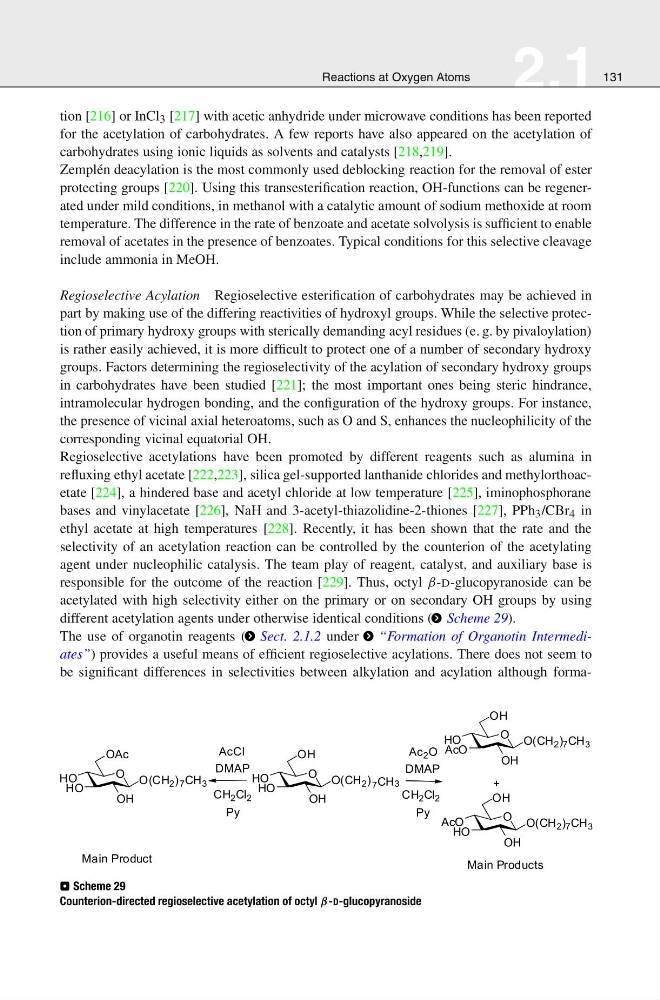
responsible for the outcome of the reaction [229]. Thus, octyl β-D-glucopyranoside can be
acetylated with high selectivity either on the primary or on secondary OH groups by using
different acetylation agents under otherwise identical conditions ( > Scheme 29).
The use of organotin reagents ( > Sect. 2.1.2 under > “Formation of Organotin Intermediates”) provides a useful means of efficient regioselective acylations. There does not seem to
be significant differences in selectivities between alkylation and acylation although forma⊡ Scheme 29
Counterion-directed regioselective acetylation of octyl β-D-glucopyranoside
2.1
131
tion [216] or InCl 3 [217] with acetic anhydride under microwave conditions has been reported
for the acetylation of carbohydrates. A few reports have also appeared on the acetylation of
carbohydrates using ionic liquids as solvents and catalysts [218,219].
Zemplén deacylation is the most commonly used deblocking reaction for the removal of ester
protecting groups [220]. Using this transesterification reaction, OH-functions can be regenerated under mild conditions, in methanol with a catalytic amount of sodium methoxide at room
temperature. The difference in the rate of benzoate and acetate solvolysis is sufficient to enable
removal of acetates in the presence of benzoates. Typical conditions for this selective cleavage
include ammonia in MeOH.
Regioselective Acylation Regioselective esterification of carbohydrates may be achieved in
part by making use of the differing reactivities of hydroxyl groups. While the selective protection of primary hydroxy groups with sterically demanding acyl residues (e. g. by pivaloylation)
is rather easily achieved, it is more difficult to protect one of a number of secondary hydroxy
groups. Factors determining the regioselectivity of the acylation of secondary hydroxy groups
in carbohydrates have been studied [221]; the most important ones being steric hindrance,
intramolecular hydrogen bonding, and the configuration of the hydroxy groups. For instance,
the presence of vicinal axial heteroatoms, such as O and S, enhances the nucleophilicity of the
corresponding vicinal equatorial OH.
Regioselective acetylations have been promoted by different reagents such as alumina in
refluxing ethyl acetate [222,223], silica gel-supported lanthanide chlorides and methylorthoacetate [224], a hindered base and acetyl chloride at low temperature [225], iminophosphorane
bases and vinylacetate [226], NaH and 3-acetyl-thiazolidine-2-thiones [227], PPh 3 /CBr 4 in
ethyl acetate at high temperatures [228]. Recently, it has been shown that the rate and the
selectivity of an acetylation reaction can be controlled by the counterion of the acetylating
agent under nucleophilic catalysis. The team play of reagent, catalyst, and auxiliary base is
responsible for the outcome of the reaction [229]. Thus, octyl β-D-glucopyranoside can be
acetylated with high selectivity either on the primary or on secondary OH groups by using
different acetylation agents under otherwise identical conditions ( > Scheme 29).
The use of organotin reagents ( > Sect. 2.1.2 under > “Formation of Organotin Intermediates”) provides a useful means of efficient regioselective acylations. There does not seem to
be significant differences in selectivities between alkylation and acylation although forma⊡ Scheme 29
Counterion-directed regioselective acetylation of octyl β-D-glucopyranoside