

130
2
General Synthetic Methods
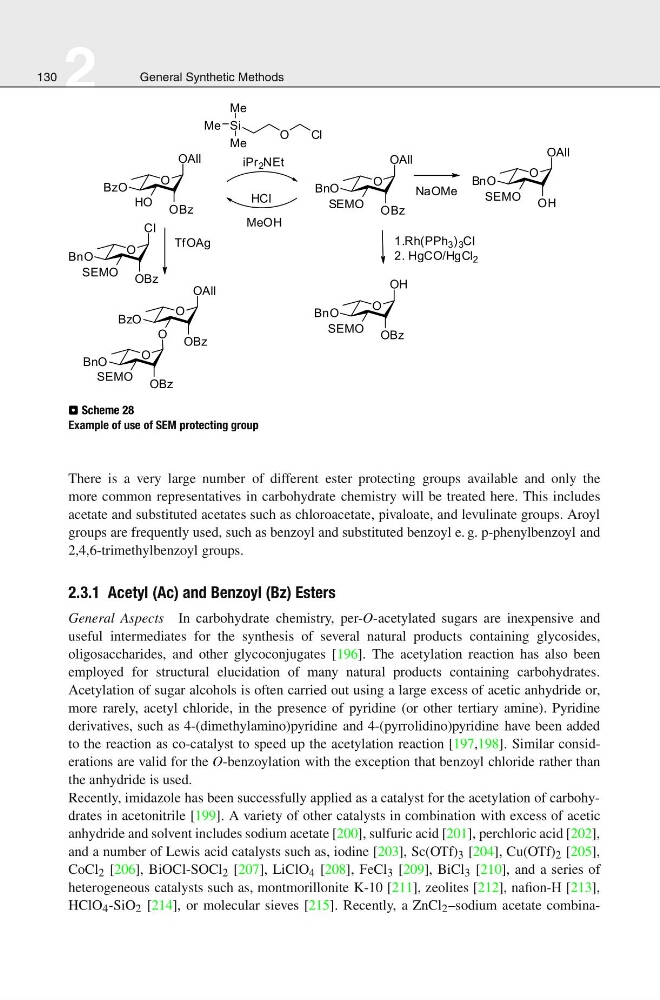
⊡ Scheme 28
Example of use of SEM protecting group
There is a very large number of different ester protecting groups available and only the
more common representatives in carbohydrate chemistry will be treated here. This includes
acetate and substituted acetates such as chloroacetate, pivaloate, and levulinate groups. Aroyl
groups are frequently used, such as benzoyl and substituted benzoyl e. g. p-phenylbenzoyl and
2,4,6-trimethylbenzoyl groups.
2.3.1 Acetyl (Ac) and Benzoyl (Bz) Esters
General Aspects In carbohydrate chemistry, per-O-acetylated sugars are inexpensive and
useful intermediates for the synthesis of several natural products containing glycosides,
oligosaccharides, and other glycoconjugates [196]. The acetylation reaction has also been
employed for structural elucidation of many natural products containing carbohydrates.
Acetylation of sugar alcohols is often carried out using a large excess of acetic anhydride or,
more rarely, acetyl chloride, in the presence of pyridine (or other tertiary amine). Pyridine
derivatives, such as 4-(dimethylamino)pyridine and 4-(pyrrolidino)pyridine have been added
to the reaction as co-catalyst to speed up the acetylation reaction [197,198]. Similar considerations are valid for the O-benzoylation with the exception that benzoyl chloride rather than
the anhydride is used.
Recently, imidazole has been successfully applied as a catalyst for the acetylation of carbohydrates in acetonitrile [199]. A variety of other catalysts in combination with excess of acetic
anhydride and solvent includes sodium acetate [200], sulfuric acid [201], perchloric acid [202],
and a number of Lewis acid catalysts such as, iodine [203], Sc(OTf) 3 [204], Cu(OTf) 2 [205],
CoCl 2 [206], BiOCl-SOCl 2 [207], LiClO 4 [208], FeCl 3 [209], BiCl 3 [210], and a series of
heterogeneous catalysts such as, montmorillonite K-10 [211], zeolites [212], nafion-H [213],
HClO 4 -SiO 2 [214], or molecular sieves [215]. Recently, a ZnCl 2 –sodium acetate combina-
2
General Synthetic Methods
⊡ Scheme 28
Example of use of SEM protecting group
There is a very large number of different ester protecting groups available and only the
more common representatives in carbohydrate chemistry will be treated here. This includes
acetate and substituted acetates such as chloroacetate, pivaloate, and levulinate groups. Aroyl
groups are frequently used, such as benzoyl and substituted benzoyl e. g. p-phenylbenzoyl and
2,4,6-trimethylbenzoyl groups.
2.3.1 Acetyl (Ac) and Benzoyl (Bz) Esters
General Aspects In carbohydrate chemistry, per-O-acetylated sugars are inexpensive and
useful intermediates for the synthesis of several natural products containing glycosides,
oligosaccharides, and other glycoconjugates [196]. The acetylation reaction has also been
employed for structural elucidation of many natural products containing carbohydrates.
Acetylation of sugar alcohols is often carried out using a large excess of acetic anhydride or,
more rarely, acetyl chloride, in the presence of pyridine (or other tertiary amine). Pyridine
derivatives, such as 4-(dimethylamino)pyridine and 4-(pyrrolidino)pyridine have been added
to the reaction as co-catalyst to speed up the acetylation reaction [197,198]. Similar considerations are valid for the O-benzoylation with the exception that benzoyl chloride rather than
the anhydride is used.
Recently, imidazole has been successfully applied as a catalyst for the acetylation of carbohydrates in acetonitrile [199]. A variety of other catalysts in combination with excess of acetic
anhydride and solvent includes sodium acetate [200], sulfuric acid [201], perchloric acid [202],
and a number of Lewis acid catalysts such as, iodine [203], Sc(OTf) 3 [204], Cu(OTf) 2 [205],
CoCl 2 [206], BiOCl-SOCl 2 [207], LiClO 4 [208], FeCl 3 [209], BiCl 3 [210], and a series of
heterogeneous catalysts such as, montmorillonite K-10 [211], zeolites [212], nafion-H [213],
HClO 4 -SiO 2 [214], or molecular sieves [215]. Recently, a ZnCl 2 –sodium acetate combina-