

112
2
General Synthetic Methods
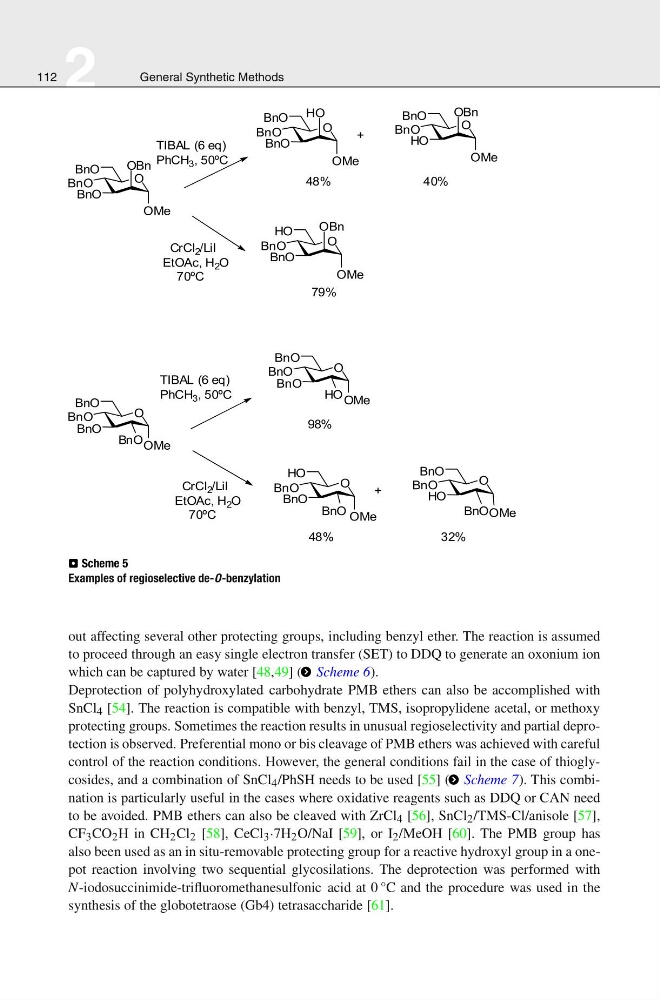
⊡ Scheme 5
Examples of regioselective de-O-benzylation
out affecting several other protecting groups, including benzyl ether. The reaction is assumed
to proceed through an easy single electron transfer (SET) to DDQ to generate an oxonium ion
which can be captured by water [48,49] ( > Scheme 6).
Deprotection of polyhydroxylated carbohydrate PMB ethers can also be accomplished with
SnCl 4 [54]. The reaction is compatible with benzyl, TMS, isopropylidene acetal, or methoxy
protecting groups. Sometimes the reaction results in unusual regioselectivity and partial deprotection is observed. Preferential mono or bis cleavage of PMB ethers was achieved with careful
control of the reaction conditions. However, the general conditions fail in the case of thioglycosides, and a combination of SnCl 4 /PhSH needs to be used [55] ( > Scheme 7). This combination is particularly useful in the cases where oxidative reagents such as DDQ or CAN need
to be avoided. PMB ethers can also be cleaved with ZrCl 4 [56], SnCl 2 /TMS-Cl/anisole [57],
CF 3 CO 2 H in CH 2 Cl 2 [58], CeCl 3 ·7H 2 O/NaI [59], or I 2 /MeOH [60]. The PMB group has
also been used as an in situ-removable protecting group for a reactive hydroxyl group in a onepot reaction involving two sequential glycosilations. The deprotection was performed with
N-iodosuccinimide-trifluoromethanesulfonic acid at 0 °C and the procedure was used in the
synthesis of the globotetraose (Gb4) tetrasaccharide [61].
2
General Synthetic Methods
⊡ Scheme 5
Examples of regioselective de-O-benzylation
out affecting several other protecting groups, including benzyl ether. The reaction is assumed
to proceed through an easy single electron transfer (SET) to DDQ to generate an oxonium ion
which can be captured by water [48,49] ( > Scheme 6).
Deprotection of polyhydroxylated carbohydrate PMB ethers can also be accomplished with
SnCl 4 [54]. The reaction is compatible with benzyl, TMS, isopropylidene acetal, or methoxy
protecting groups. Sometimes the reaction results in unusual regioselectivity and partial deprotection is observed. Preferential mono or bis cleavage of PMB ethers was achieved with careful
control of the reaction conditions. However, the general conditions fail in the case of thioglycosides, and a combination of SnCl 4 /PhSH needs to be used [55] ( > Scheme 7). This combination is particularly useful in the cases where oxidative reagents such as DDQ or CAN need
to be avoided. PMB ethers can also be cleaved with ZrCl 4 [56], SnCl 2 /TMS-Cl/anisole [57],
CF 3 CO 2 H in CH 2 Cl 2 [58], CeCl 3 ·7H 2 O/NaI [59], or I 2 /MeOH [60]. The PMB group has
also been used as an in situ-removable protecting group for a reactive hydroxyl group in a onepot reaction involving two sequential glycosilations. The deprotection was performed with
N-iodosuccinimide-trifluoromethanesulfonic acid at 0 °C and the procedure was used in the
synthesis of the globotetraose (Gb4) tetrasaccharide [61].