

Reactions at Oxygen Atoms
2.1
111
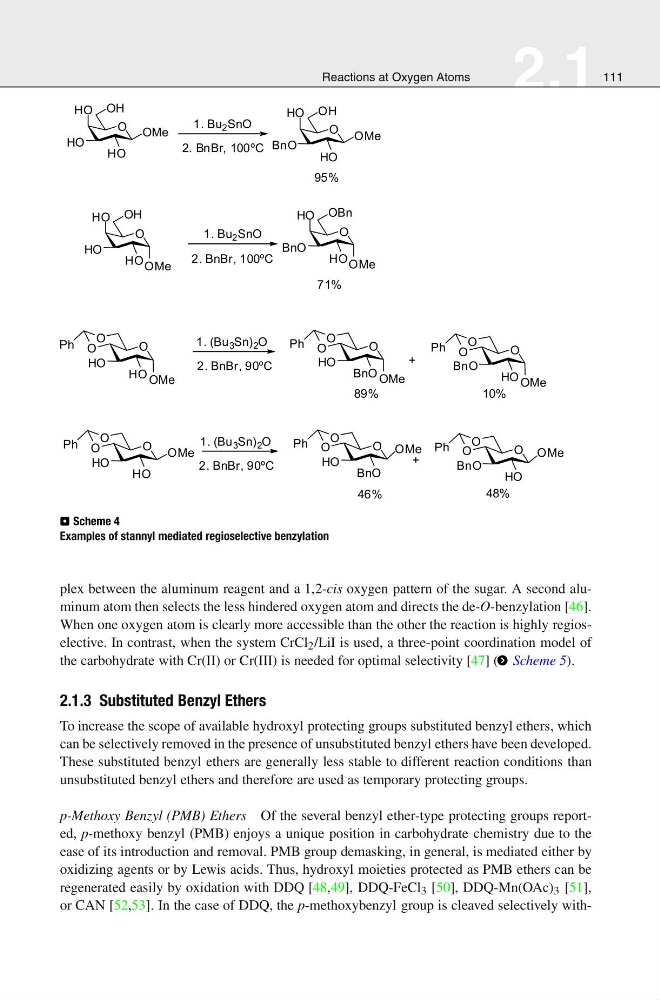
⊡ Scheme 4
Examples of stannyl mediated regioselective benzylation
plex between the aluminum reagent and a 1,2-cis oxygen pattern of the sugar. A second aluminum atom then selects the less hindered oxygen atom and directs the de-O-benzylation [46].
When one oxygen atom is clearly more accessible than the other the reaction is highly regioselective. In contrast, when the system CrCl 2 /LiI is used, a three-point coordination model of
the carbohydrate with Cr(II) or Cr(III) is needed for optimal selectivity [47] ( > Scheme 5).
2.1.3 Substituted Benzyl Ethers
To increase the scope of available hydroxyl protecting groups substituted benzyl ethers, which
can be selectively removed in the presence of unsubstituted benzyl ethers have been developed.
These substituted benzyl ethers are generally less stable to different reaction conditions than
unsubstituted benzyl ethers and therefore are used as temporary protecting groups.
p-Methoxy Benzyl (PMB) Ethers Of the several benzyl ether-type protecting groups reported, p-methoxy benzyl (PMB) enjoys a unique position in carbohydrate chemistry due to the
ease of its introduction and removal. PMB group demasking, in general, is mediated either by
oxidizing agents or by Lewis acids. Thus, hydroxyl moieties protected as PMB ethers can be
regenerated easily by oxidation with DDQ [48,49], DDQ-FeCl 3 [50], DDQ-Mn(OAc) 3 [51],
or CAN [52,53]. In the case of DDQ, the p-methoxybenzyl group is cleaved selectively with-
2.1
111
⊡ Scheme 4
Examples of stannyl mediated regioselective benzylation
plex between the aluminum reagent and a 1,2-cis oxygen pattern of the sugar. A second aluminum atom then selects the less hindered oxygen atom and directs the de-O-benzylation [46].
When one oxygen atom is clearly more accessible than the other the reaction is highly regioselective. In contrast, when the system CrCl 2 /LiI is used, a three-point coordination model of
the carbohydrate with Cr(II) or Cr(III) is needed for optimal selectivity [47] ( > Scheme 5).
2.1.3 Substituted Benzyl Ethers
To increase the scope of available hydroxyl protecting groups substituted benzyl ethers, which
can be selectively removed in the presence of unsubstituted benzyl ethers have been developed.
These substituted benzyl ethers are generally less stable to different reaction conditions than
unsubstituted benzyl ethers and therefore are used as temporary protecting groups.
p-Methoxy Benzyl (PMB) Ethers Of the several benzyl ether-type protecting groups reported, p-methoxy benzyl (PMB) enjoys a unique position in carbohydrate chemistry due to the
ease of its introduction and removal. PMB group demasking, in general, is mediated either by
oxidizing agents or by Lewis acids. Thus, hydroxyl moieties protected as PMB ethers can be
regenerated easily by oxidation with DDQ [48,49], DDQ-FeCl 3 [50], DDQ-Mn(OAc) 3 [51],
or CAN [52,53]. In the case of DDQ, the p-methoxybenzyl group is cleaved selectively with-