

Reactions at Oxygen Atoms
2.1
109
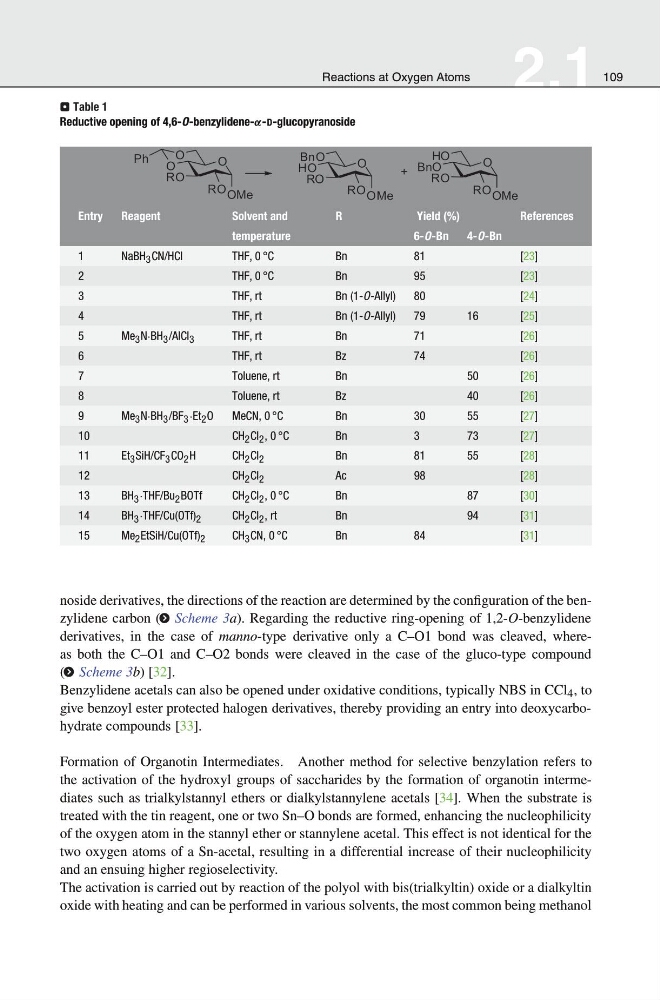
⊡ Table 1
Reductive opening of 4,6-O-benzylidene-α-D-glucopyranoside
Entry
Reagent
Solvent and
R
Yield (%)
References
temperature
6-O-Bn
4-O-Bn
1
N a B H 3 CN/HCl
THF, 0 °C
Bn
81
[23]
2
T H F , 0 ° C
B n
9 5
[ 23]
3
T H F , r t
B n ( 1 - O-Allyl)
80
[24]
4
T H F , r t
B n ( 1 - O-Allyl)
79
16
[25]
5
M e 3 N·BH 3 /AlCl 3
THF, rt
Bn
71
[26]
6
T H F , r t
B z
7 4
[ 26]
7
Toluene, rt
Bn
50
[26]
8
Toluene, rt
Bz
40
[26]
9
M e 3 N·BH 3 /BF 3 ·Et 2 O
M e C N ,0° C
B n
3 0
5 5
[ 27]
10
CH 2 Cl 2 , 0 °C
Bn
3
73
[27]
11
Et 3 SiH/CF 3 CO 2 H
C H 2 Cl 2
Bn
81
55
[28]
12
CH 2 Cl 2
Ac
98
[28]
13
BH 3 ·THF/Bu 2 BOTf
CH 2 Cl 2 , 0 °C
Bn
87
[30]
14
BH 3 ·THF/Cu(OTf) 2
CH 2 Cl 2 , rt
Bn
94
[31]
15
Me 2 EtSiH/Cu(OTf) 2
CH 3 CN, 0 °C
Bn
84
[31]
noside derivatives, the directions of the reaction are determined by the configuration of the benzylidene carbon ( > Scheme 3a). Regarding the reductive ring-opening of 1,2-O-benzylidene
derivatives, in the case of manno-type derivative only a C–O1 bond was cleaved, whereas both the C–O1 and C–O2 bonds were cleaved in the case of the gluco-type compound
( > Scheme 3b) [32].
Benzylidene acetals can also be opened under oxidative conditions, typically NBS in CCl 4 , to
give benzoyl ester protected halogen derivatives, thereby providing an entry into deoxycarbohydrate compounds [33].
Formation of Organotin Intermediates. Another method for selective benzylation refers to
the activation of the hydroxyl groups of saccharides by the formation of organotin intermediates such as trialkylstannyl ethers or dialkylstannylene acetals [34]. When the substrate is
treated with the tin reagent, one or two Sn–O bonds are formed, enhancing the nucleophilicity
of the oxygen atom in the stannyl ether or stannylene acetal. This effect is not identical for the
two oxygen atoms of a Sn-acetal, resulting in a differential increase of their nucleophilicity
and an ensuing higher regioselectivity.
The activation is carried out by reaction of the polyol with bis(trialkyltin) oxide or a dialkyltin
oxide with heating and can be performed in various solvents, the most common being methanol
2.1
109
⊡ Table 1
Reductive opening of 4,6-O-benzylidene-α-D-glucopyranoside
Entry
Reagent
Solvent and
R
Yield (%)
References
temperature
6-O-Bn
4-O-Bn
1
N a B H 3 CN/HCl
THF, 0 °C
Bn
81
[23]
2
T H F , 0 ° C
B n
9 5
[ 23]
3
T H F , r t
B n ( 1 - O-Allyl)
80
[24]
4
T H F , r t
B n ( 1 - O-Allyl)
79
16
[25]
5
M e 3 N·BH 3 /AlCl 3
THF, rt
Bn
71
[26]
6
T H F , r t
B z
7 4
[ 26]
7
Toluene, rt
Bn
50
[26]
8
Toluene, rt
Bz
40
[26]
9
M e 3 N·BH 3 /BF 3 ·Et 2 O
M e C N ,0° C
B n
3 0
5 5
[ 27]
10
CH 2 Cl 2 , 0 °C
Bn
3
73
[27]
11
Et 3 SiH/CF 3 CO 2 H
C H 2 Cl 2
Bn
81
55
[28]
12
CH 2 Cl 2
Ac
98
[28]
13
BH 3 ·THF/Bu 2 BOTf
CH 2 Cl 2 , 0 °C
Bn
87
[30]
14
BH 3 ·THF/Cu(OTf) 2
CH 2 Cl 2 , rt
Bn
94
[31]
15
Me 2 EtSiH/Cu(OTf) 2
CH 3 CN, 0 °C
Bn
84
[31]
noside derivatives, the directions of the reaction are determined by the configuration of the benzylidene carbon ( > Scheme 3a). Regarding the reductive ring-opening of 1,2-O-benzylidene
derivatives, in the case of manno-type derivative only a C–O1 bond was cleaved, whereas both the C–O1 and C–O2 bonds were cleaved in the case of the gluco-type compound
( > Scheme 3b) [32].
Benzylidene acetals can also be opened under oxidative conditions, typically NBS in CCl 4 , to
give benzoyl ester protected halogen derivatives, thereby providing an entry into deoxycarbohydrate compounds [33].
Formation of Organotin Intermediates. Another method for selective benzylation refers to
the activation of the hydroxyl groups of saccharides by the formation of organotin intermediates such as trialkylstannyl ethers or dialkylstannylene acetals [34]. When the substrate is
treated with the tin reagent, one or two Sn–O bonds are formed, enhancing the nucleophilicity
of the oxygen atom in the stannyl ether or stannylene acetal. This effect is not identical for the
two oxygen atoms of a Sn-acetal, resulting in a differential increase of their nucleophilicity
and an ensuing higher regioselectivity.
The activation is carried out by reaction of the polyol with bis(trialkyltin) oxide or a dialkyltin
oxide with heating and can be performed in various solvents, the most common being methanol