

108
2
General Synthetic Methods
ether adjacent to a hydroxyl group in carbohydrate substrates was accomplished with (diacetoxyiodo)benzene (DIB) and I 2 under irradiative conditions ( > Scheme 1). In this step, the
methoxy protecting group was transformed into a mixture of acetals (methylenedioxy acetal
or O-methyl acetate) which upon basic hydrolysis provides the diol [9,10].
2.1.2 Benzyl (Bn) Ethers
The classical permanent protecting group of carbohydrate hydroxyl functions is probably the
benzyl ether. It is very stable and can be readily removed under essentially neutral conditions.
For this reason, numerous benzylation and O-debenzylation procedures have been described.
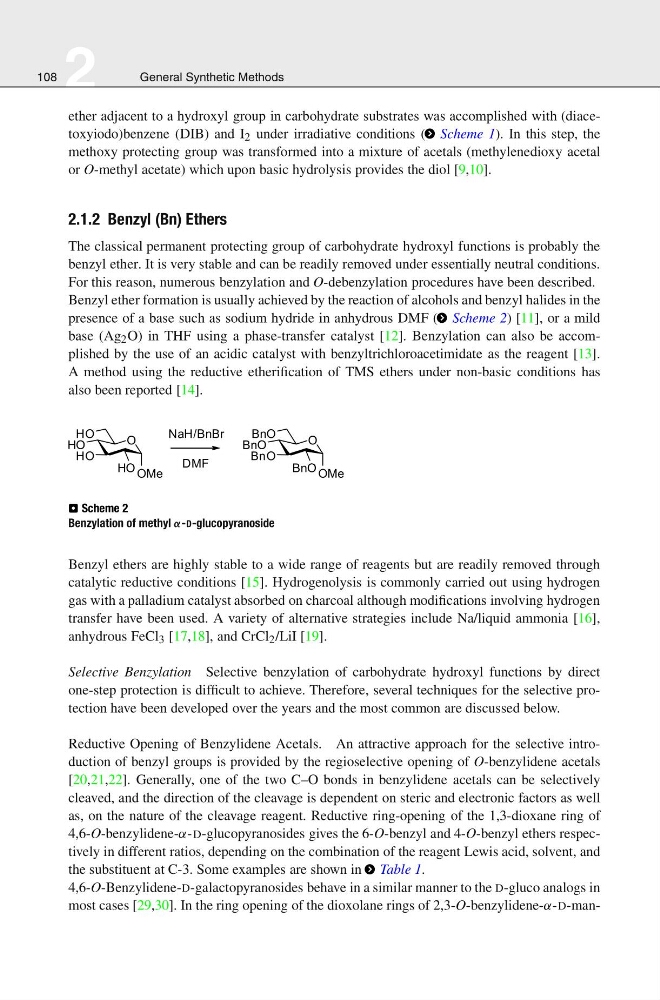
Benzyl ether formation is usually achieved by the reaction of alcohols and benzyl halides in the
presence of a base such as sodium hydride in anhydrous DMF ( > Scheme 2) [11], or a mild
base (Ag 2 O) in THF using a phase-transfer catalyst [12]. Benzylation can also be accomplished by the use of an acidic catalyst with benzyltrichloroacetimidate as the reagent [13].
A method using the reductive etherification of TMS ethers under non-basic conditions has
also been reported [14].
⊡ Scheme 2
Benzylation of methyl α-D-glucopyranoside
Benzyl ethers are highly stable to a wide range of reagents but are readily removed through
catalytic reductive conditions [15]. Hydrogenolysis is commonly carried out using hydrogen
gas with a palladium catalyst absorbed on charcoal although modifications involving hydrogen
transfer have been used. A variety of alternative strategies include Na/liquid ammonia [16],
anhydrous FeCl 3 [17,18], and CrCl 2 /LiI [19].
Selective Benzylation Selective benzylation of carbohydrate hydroxyl functions by direct
one-step protection is difficult to achieve. Therefore, several techniques for the selective protection have been developed over the years and the most common are discussed below.
Reductive Opening of Benzylidene Acetals. An attractive approach for the selective introduction of benzyl groups is provided by the regioselective opening of O-benzylidene acetals
[20,21,22]. Generally, one of the two C–O bonds in benzylidene acetals can be selectively
cleaved, and the direction of the cleavage is dependent on steric and electronic factors as well
as, on the nature of the cleavage reagent. Reductive ring-opening of the 1,3-dioxane ring of
4,6-O-benzylidene-α-D-glucopyranosides gives the 6-O-benzyl and 4-O-benzyl ethers respectively in different ratios, depending on the combination of the reagent Lewis acid, solvent, and
the substituent at C-3. Some examples are shown in > Table 1.
4,6-O-Benzylidene-D-galactopyranosides behave in a similar manner to the D-gluco analogs in
most cases [29,30]. In the ring opening of the dioxolane rings of 2,3-O-benzylidene-α-D-man-
2
General Synthetic Methods
ether adjacent to a hydroxyl group in carbohydrate substrates was accomplished with (diacetoxyiodo)benzene (DIB) and I 2 under irradiative conditions ( > Scheme 1). In this step, the
methoxy protecting group was transformed into a mixture of acetals (methylenedioxy acetal
or O-methyl acetate) which upon basic hydrolysis provides the diol [9,10].
2.1.2 Benzyl (Bn) Ethers
The classical permanent protecting group of carbohydrate hydroxyl functions is probably the
benzyl ether. It is very stable and can be readily removed under essentially neutral conditions.
For this reason, numerous benzylation and O-debenzylation procedures have been described.
Benzyl ether formation is usually achieved by the reaction of alcohols and benzyl halides in the
presence of a base such as sodium hydride in anhydrous DMF ( > Scheme 2) [11], or a mild
base (Ag 2 O) in THF using a phase-transfer catalyst [12]. Benzylation can also be accomplished by the use of an acidic catalyst with benzyltrichloroacetimidate as the reagent [13].
A method using the reductive etherification of TMS ethers under non-basic conditions has
also been reported [14].
⊡ Scheme 2
Benzylation of methyl α-D-glucopyranoside
Benzyl ethers are highly stable to a wide range of reagents but are readily removed through
catalytic reductive conditions [15]. Hydrogenolysis is commonly carried out using hydrogen
gas with a palladium catalyst absorbed on charcoal although modifications involving hydrogen
transfer have been used. A variety of alternative strategies include Na/liquid ammonia [16],
anhydrous FeCl 3 [17,18], and CrCl 2 /LiI [19].
Selective Benzylation Selective benzylation of carbohydrate hydroxyl functions by direct
one-step protection is difficult to achieve. Therefore, several techniques for the selective protection have been developed over the years and the most common are discussed below.
Reductive Opening of Benzylidene Acetals. An attractive approach for the selective introduction of benzyl groups is provided by the regioselective opening of O-benzylidene acetals
[20,21,22]. Generally, one of the two C–O bonds in benzylidene acetals can be selectively
cleaved, and the direction of the cleavage is dependent on steric and electronic factors as well
as, on the nature of the cleavage reagent. Reductive ring-opening of the 1,3-dioxane ring of
4,6-O-benzylidene-α-D-glucopyranosides gives the 6-O-benzyl and 4-O-benzyl ethers respectively in different ratios, depending on the combination of the reagent Lewis acid, solvent, and
the substituent at C-3. Some examples are shown in > Table 1.
4,6-O-Benzylidene-D-galactopyranosides behave in a similar manner to the D-gluco analogs in
most cases [29,30]. In the ring opening of the dioxolane rings of 2,3-O-benzylidene-α-D-man-