

General Properties, Occurrence, and Preparation
1.2
93
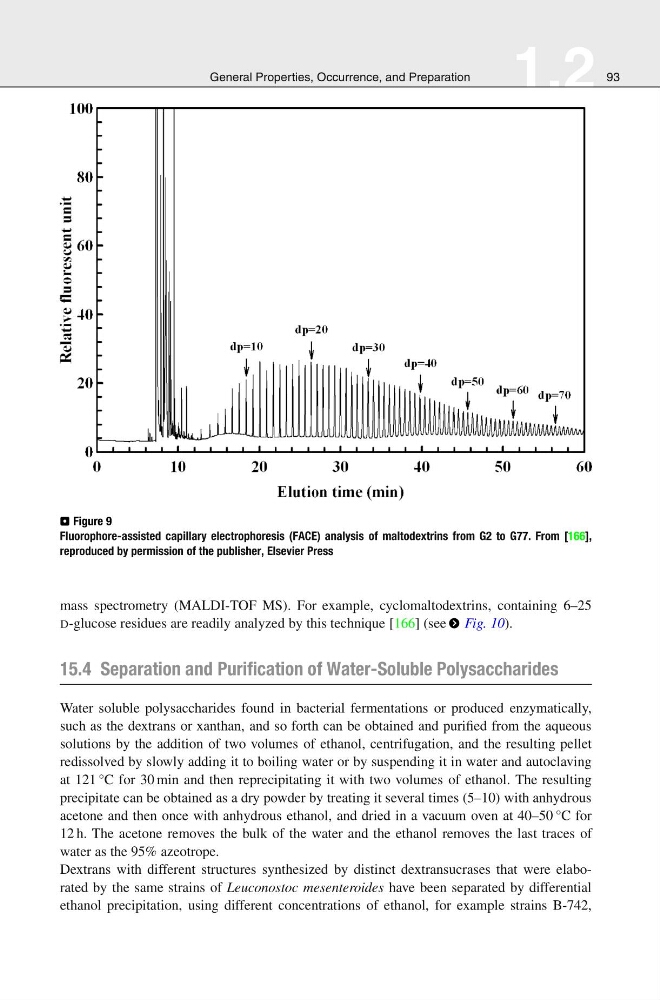
⊡ Figure 9
Fluorophore-assisted capillary electrophoresis (FACE) analysis of maltodextrins from G2 to G77. From [166],
reproduced by permission of the publisher, Elsevier Press
mass spectrometry (MALDI-TOF MS). For example, cyclomaltodextrins, containing 6–25
D-glucose residues are readily analyzed by this technique [166] (see > Fig. 10).
15.4 Separation and Purification of Water-Soluble Polysaccharides
Water soluble polysaccharides found in bacterial fermentations or produced enzymatically,
such as the dextrans or xanthan, and so forth can be obtained and purified from the aqueous
solutions by the addition of two volumes of ethanol, centrifugation, and the resulting pellet
redissolved by slowly adding it to boiling water or by suspending it in water and autoclaving
at 121 °C for 30 min and then reprecipitating it with two volumes of ethanol. The resulting
precipitate can be obtained as a dry powder by treating it several times (5–10) with anhydrous
acetone and then once with anhydrous ethanol, and dried in a vacuum oven at 40–50 °C for
12 h. The acetone removes the bulk of the water and the ethanol removes the last traces of
water as the 95% azeotrope.
Dextrans with different structures synthesized by distinct dextransucrases that were elaborated by the same strains of Leuconostoc mesenteroides have been separated by differential
ethanol precipitation, using different concentrations of ethanol, for example strains B-742,
1.2
93
⊡ Figure 9
Fluorophore-assisted capillary electrophoresis (FACE) analysis of maltodextrins from G2 to G77. From [166],
reproduced by permission of the publisher, Elsevier Press
mass spectrometry (MALDI-TOF MS). For example, cyclomaltodextrins, containing 6–25
D-glucose residues are readily analyzed by this technique [166] (see > Fig. 10).
15.4 Separation and Purification of Water-Soluble Polysaccharides
Water soluble polysaccharides found in bacterial fermentations or produced enzymatically,
such as the dextrans or xanthan, and so forth can be obtained and purified from the aqueous
solutions by the addition of two volumes of ethanol, centrifugation, and the resulting pellet
redissolved by slowly adding it to boiling water or by suspending it in water and autoclaving
at 121 °C for 30 min and then reprecipitating it with two volumes of ethanol. The resulting
precipitate can be obtained as a dry powder by treating it several times (5–10) with anhydrous
acetone and then once with anhydrous ethanol, and dried in a vacuum oven at 40–50 °C for
12 h. The acetone removes the bulk of the water and the ethanol removes the last traces of
water as the 95% azeotrope.
Dextrans with different structures synthesized by distinct dextransucrases that were elaborated by the same strains of Leuconostoc mesenteroides have been separated by differential
ethanol precipitation, using different concentrations of ethanol, for example strains B-742,