

92
1
General Principles
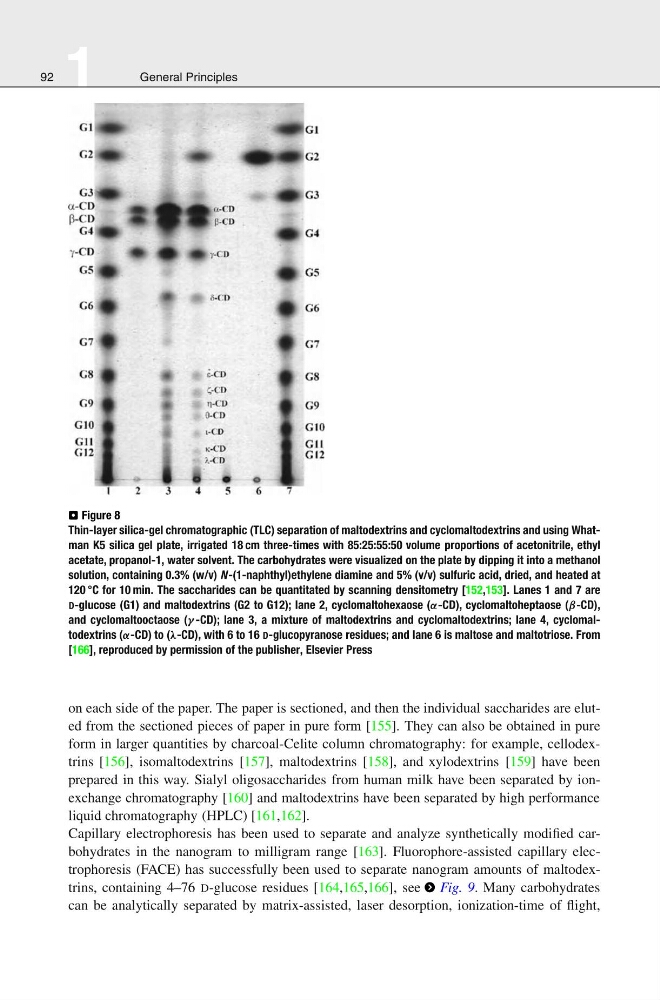
⊡ Figure 8
Thin-layer silica-gel chromatographic (TLC) separation of maltodextrins and cyclomaltodextrins and using Whatman K5 silica gel plate, irrigated 18 cm three-times with 85:25:55:50 volume proportions of acetonitrile, ethyl
acetate, propanol-1, water solvent. The carbohydrates were visualized on the plate by dipping it into a methanol
solution, containing 0.3% (w/v) N -(1-naphthyl)ethylene diamine and 5% (v/v) sulfuric acid, dried, and heated at
120 °C for 10 min. The saccharides can be quantitated by scanning densitometry [152,153]. Lanes 1 and 7 are
D-glucose (G1) and maltodextrins (G2 to G12); lane 2, cyclomaltohexaose (α-CD), cyclomaltoheptaose (β-CD),
and cyclomaltooctaose (γ -CD); lane 3, a mixture of maltodextrins and cyclomaltodextrins; lane 4, cyclomaltodextrins (α-CD) to (λ-CD), with 6 to 16 D-glucopyranose residues; and lane 6 is maltose and maltotriose. From
[166], reproduced by permission of the publisher, Elsevier Press
on each side of the paper. The paper is sectioned, and then the individual saccharides are eluted from the sectioned pieces of paper in pure form [155]. They can also be obtained in pure
form in larger quantities by charcoal-Celite column chromatography: for example, cellodextrins [156], isomaltodextrins [157], maltodextrins [158], and xylodextrins [159] have been
prepared in this way. Sialyl oligosaccharides from human milk have been separated by ionexchange chromatography [160] and maltodextrins have been separated by high performance
liquid chromatography (HPLC) [161,162].
Capillary electrophoresis has been used to separate and analyze synthetically modified carbohydrates in the nanogram to milligram range [163]. Fluorophore-assisted capillary electrophoresis (FACE) has successfully been used to separate nanogram amounts of maltodextrins, containing 4–76 D-glucose residues [164,165,166], see > Fig. 9. Many carbohydrates
can be analytically separated by matrix-assisted, laser desorption, ionization-time of flight,
1
General Principles
⊡ Figure 8
Thin-layer silica-gel chromatographic (TLC) separation of maltodextrins and cyclomaltodextrins and using Whatman K5 silica gel plate, irrigated 18 cm three-times with 85:25:55:50 volume proportions of acetonitrile, ethyl
acetate, propanol-1, water solvent. The carbohydrates were visualized on the plate by dipping it into a methanol
solution, containing 0.3% (w/v) N -(1-naphthyl)ethylene diamine and 5% (v/v) sulfuric acid, dried, and heated at
120 °C for 10 min. The saccharides can be quantitated by scanning densitometry [152,153]. Lanes 1 and 7 are
D-glucose (G1) and maltodextrins (G2 to G12); lane 2, cyclomaltohexaose (α-CD), cyclomaltoheptaose (β-CD),
and cyclomaltooctaose (γ -CD); lane 3, a mixture of maltodextrins and cyclomaltodextrins; lane 4, cyclomaltodextrins (α-CD) to (λ-CD), with 6 to 16 D-glucopyranose residues; and lane 6 is maltose and maltotriose. From
[166], reproduced by permission of the publisher, Elsevier Press
on each side of the paper. The paper is sectioned, and then the individual saccharides are eluted from the sectioned pieces of paper in pure form [155]. They can also be obtained in pure
form in larger quantities by charcoal-Celite column chromatography: for example, cellodextrins [156], isomaltodextrins [157], maltodextrins [158], and xylodextrins [159] have been
prepared in this way. Sialyl oligosaccharides from human milk have been separated by ionexchange chromatography [160] and maltodextrins have been separated by high performance
liquid chromatography (HPLC) [161,162].
Capillary electrophoresis has been used to separate and analyze synthetically modified carbohydrates in the nanogram to milligram range [163]. Fluorophore-assisted capillary electrophoresis (FACE) has successfully been used to separate nanogram amounts of maltodextrins, containing 4–76 D-glucose residues [164,165,166], see > Fig. 9. Many carbohydrates
can be analytically separated by matrix-assisted, laser desorption, ionization-time of flight,