

General Properties, Occurrence, and Preparation
1.2
89
α-D-mannopyranose residues attached to the two terminal D-mannopyranose residues of the
core pentasaccharide. These residues are linked α-(1→3) and α-(1→6). Substitution is terminated by α-(1→2) linkages of the D-mannopyranose residues. An example of this type of
N-glycoside is found attached to ovalbumin.
The second family of N-linked oligosaccharides are called the “lactosamine family” in which
the D-mannose residues of the core pentasaccharide are substituted 1→2 by lactosamine,
which is a lactose analogue with N-acetyl-D-glucosamine substituted for D-glucopyranose
at the reducing-end of lactose. The lactosamine is frequently substituted by N-acetyl-D-neuraminic acid (for the structure of N-acetyl-D-neuraminic acid, see the monomer residue in
colominic acid, > Sect. 8.2 and > Fig. 7) linked 2→3 or 2→6 [142,143]. The third family has
a mixed structure of the high mannose and lactosamine families [144,145,146,147].
The O-linked saccharides are not as common as the N-linked saccharides. A relatively simple
saccharide is that attached to L-threonine of the highly glyosylated (1 out of every 3 amino acid
residues), antifreeze protein found in the blood sera of fish living in the Arctic and Antarctic
waters. This glycoside is a disaccharide, β-D-Galp-(1→3)-α-D-GalNAc p [147].
Lactosamine and isolactosamine (lactosamine analogue with D-galactopyranose linked
β-(1→6) to N-acetyl-D-glucosamine) are a well characterized set of O-linked oligosaccharides that make up the ABO human blood group substances [148]. They are on the surface
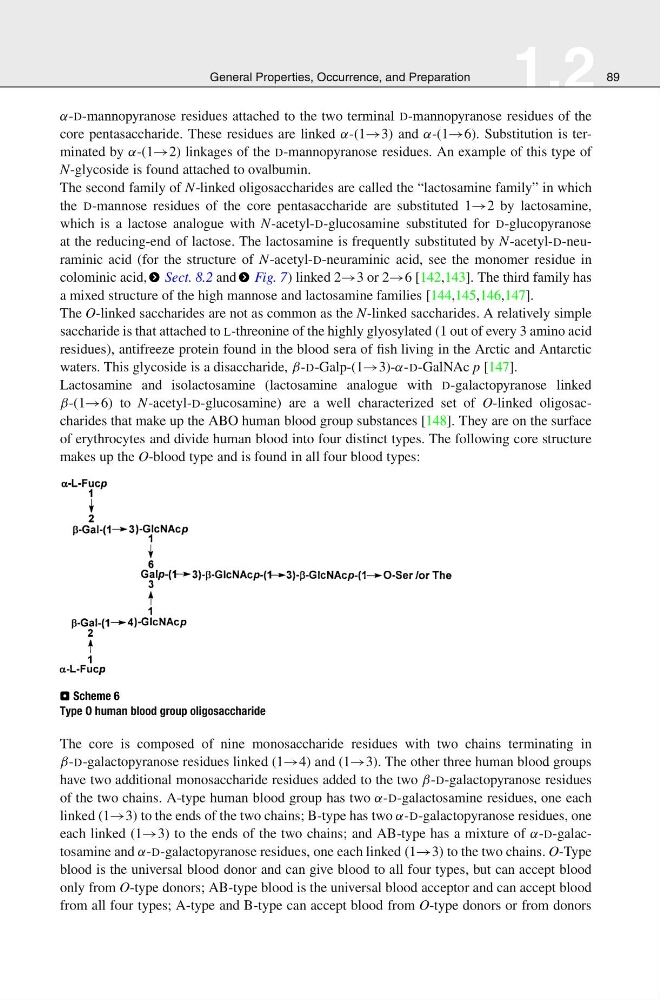
of erythrocytes and divide human blood into four distinct types. The following core structure
makes up the O-blood type and is found in all four blood types:
⊡ Scheme 6
Type O human blood group oligosaccharide
The core is composed of nine monosaccharide residues with two chains terminating in
β-D-galactopyranose residues linked (1→4) and (1→3). The other three human blood groups
have two additional monosaccharide residues added to the two β-D-galactopyranose residues
of the two chains. A-type human blood group has two α-D-galactosamine residues, one each
linked (1→3) to the ends of the two chains; B-type has two α-D-galactopyranose residues, one
each linked (1→3) to the ends of the two chains; and AB-type has a mixture of α-D-galactosamine and α-D-galactopyranose residues, one each linked (1→3) to the two chains. O-Type
blood is the universal blood donor and can give blood to all four types, but can accept blood
only from O-type donors; AB-type blood is the universal blood acceptor and can accept blood
from all four types; A-type and B-type can accept blood from O-type donors or from donors
1.2
89
α-D-mannopyranose residues attached to the two terminal D-mannopyranose residues of the
core pentasaccharide. These residues are linked α-(1→3) and α-(1→6). Substitution is terminated by α-(1→2) linkages of the D-mannopyranose residues. An example of this type of
N-glycoside is found attached to ovalbumin.
The second family of N-linked oligosaccharides are called the “lactosamine family” in which
the D-mannose residues of the core pentasaccharide are substituted 1→2 by lactosamine,
which is a lactose analogue with N-acetyl-D-glucosamine substituted for D-glucopyranose
at the reducing-end of lactose. The lactosamine is frequently substituted by N-acetyl-D-neuraminic acid (for the structure of N-acetyl-D-neuraminic acid, see the monomer residue in
colominic acid, > Sect. 8.2 and > Fig. 7) linked 2→3 or 2→6 [142,143]. The third family has
a mixed structure of the high mannose and lactosamine families [144,145,146,147].
The O-linked saccharides are not as common as the N-linked saccharides. A relatively simple
saccharide is that attached to L-threonine of the highly glyosylated (1 out of every 3 amino acid
residues), antifreeze protein found in the blood sera of fish living in the Arctic and Antarctic
waters. This glycoside is a disaccharide, β-D-Galp-(1→3)-α-D-GalNAc p [147].
Lactosamine and isolactosamine (lactosamine analogue with D-galactopyranose linked
β-(1→6) to N-acetyl-D-glucosamine) are a well characterized set of O-linked oligosaccharides that make up the ABO human blood group substances [148]. They are on the surface
of erythrocytes and divide human blood into four distinct types. The following core structure
makes up the O-blood type and is found in all four blood types:
⊡ Scheme 6
Type O human blood group oligosaccharide
The core is composed of nine monosaccharide residues with two chains terminating in
β-D-galactopyranose residues linked (1→4) and (1→3). The other three human blood groups
have two additional monosaccharide residues added to the two β-D-galactopyranose residues
of the two chains. A-type human blood group has two α-D-galactosamine residues, one each
linked (1→3) to the ends of the two chains; B-type has two α-D-galactopyranose residues, one
each linked (1→3) to the ends of the two chains; and AB-type has a mixture of α-D-galactosamine and α-D-galactopyranose residues, one each linked (1→3) to the two chains. O-Type
blood is the universal blood donor and can give blood to all four types, but can accept blood
only from O-type donors; AB-type blood is the universal blood acceptor and can accept blood
from all four types; A-type and B-type can accept blood from O-type donors or from donors