

88
1
General Principles
α-acarviosine-(1→6)-cellobiose and α-acarviosine-(1→6)-lactose, which act as inhibitors
of β-glucosidases and β-galactosidase [138]; and α-maltohexaose-(1→4)-acarbose and
α-maltododecaose-(1→4)-acarbose, which are potent inhibitors of α-amylases in the nM
range [139]. Four naturally occurring 3,6-dideoxy sugars appear in the different Salmonella
sp. O-antigen capsular polysaccharides, see > Sect. 10.2, for their names and structures. Four
2,6-dideoxy sugars (2,6-dideoxy-D-ribo-hexaose [D-digitoxose]; 2,6-dideoxy-3-O-methylD-ribo-hexose [D-cymarose]; 2,6-dideoxy-D-xylo-hexose [D-boivinose]; and 2,6-dideoxy3-O-methyl-D-xylo-hexose [D-sarmentose]) are found in a number of plants, as the carbohydrate component of the so-called cardiac glycosides [140].
14 Properties and Occurrence of Carbohydrates in Glycoproteins
Glycoproteins make up a large class of important biological compounds. It is estimated that
over 75% of the known (∼3,000) proteins are glycosylated. The carbohydrates are believed
to mediate a number of biological functions: (1) the correct folding of a protein tertiary structure after biosynthesis, (2) establishment and stabilization of protein conformation, (3) secretion of proteins through membranes, (4) control of protein turnover, (5) protection of proteins
from proteinase hydrolysis, (6) increase in protein water-solubility, (7) biological recognition
involved in growth, cell differentiation, organ formation, fertilization, processes of bacterial
and viral infections, formation of tumors, tumor metastasis, allergies, and autoimmune diseases.
Carbohydrates are primarily attached to proteins in two ways: (1) by linkage of C1 to the
amide nitrogen of L-asparagine, giving N-linked carbohydrate proteins and (2) by formation
of acetal linkages with the hydroxyl group of L-serine or L-threonine, giving O-linked carbohydrate proteins. The carbohydrate can be a single monosaccharide residue or it can be
an oligosaccharide, containing several monosaccharide residues. There are six major carbohydrates involved in glycoproteins; they are N-acetyl-D-glucosamine, N-acetyl-D-galactosamine,
D-mannopyranose, D-galactopyranose, L-fucose, and N-acetyl-D-neuraminic acid [141].
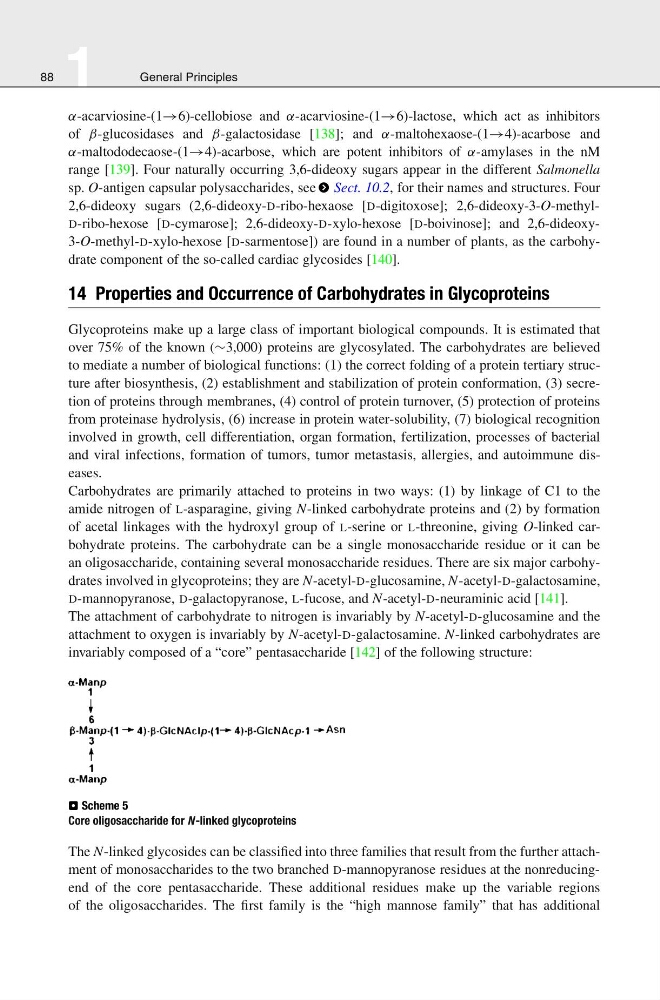
The attachment of carbohydrate to nitrogen is invariably by N-acetyl-D-glucosamine and the
attachment to oxygen is invariably by N-acetyl-D-galactosamine. N-linked carbohydrates are
invariably composed of a “core” pentasaccharide [142] of the following structure:
⊡ Scheme 5
Core oligosaccharide for N -linked glycoproteins
The N-linked glycosides can be classified into three families that result from the further attachment of monosaccharides to the two branched D-mannopyranose residues at the nonreducingend of the core pentasaccharide. These additional residues make up the variable regions
of the oligosaccharides. The first family is the “high mannose family” that has additional
1
General Principles
α-acarviosine-(1→6)-cellobiose and α-acarviosine-(1→6)-lactose, which act as inhibitors
of β-glucosidases and β-galactosidase [138]; and α-maltohexaose-(1→4)-acarbose and
α-maltododecaose-(1→4)-acarbose, which are potent inhibitors of α-amylases in the nM
range [139]. Four naturally occurring 3,6-dideoxy sugars appear in the different Salmonella
sp. O-antigen capsular polysaccharides, see > Sect. 10.2, for their names and structures. Four
2,6-dideoxy sugars (2,6-dideoxy-D-ribo-hexaose [D-digitoxose]; 2,6-dideoxy-3-O-methylD-ribo-hexose [D-cymarose]; 2,6-dideoxy-D-xylo-hexose [D-boivinose]; and 2,6-dideoxy3-O-methyl-D-xylo-hexose [D-sarmentose]) are found in a number of plants, as the carbohydrate component of the so-called cardiac glycosides [140].
14 Properties and Occurrence of Carbohydrates in Glycoproteins
Glycoproteins make up a large class of important biological compounds. It is estimated that
over 75% of the known (∼3,000) proteins are glycosylated. The carbohydrates are believed
to mediate a number of biological functions: (1) the correct folding of a protein tertiary structure after biosynthesis, (2) establishment and stabilization of protein conformation, (3) secretion of proteins through membranes, (4) control of protein turnover, (5) protection of proteins
from proteinase hydrolysis, (6) increase in protein water-solubility, (7) biological recognition
involved in growth, cell differentiation, organ formation, fertilization, processes of bacterial
and viral infections, formation of tumors, tumor metastasis, allergies, and autoimmune diseases.
Carbohydrates are primarily attached to proteins in two ways: (1) by linkage of C1 to the
amide nitrogen of L-asparagine, giving N-linked carbohydrate proteins and (2) by formation
of acetal linkages with the hydroxyl group of L-serine or L-threonine, giving O-linked carbohydrate proteins. The carbohydrate can be a single monosaccharide residue or it can be
an oligosaccharide, containing several monosaccharide residues. There are six major carbohydrates involved in glycoproteins; they are N-acetyl-D-glucosamine, N-acetyl-D-galactosamine,
D-mannopyranose, D-galactopyranose, L-fucose, and N-acetyl-D-neuraminic acid [141].
The attachment of carbohydrate to nitrogen is invariably by N-acetyl-D-glucosamine and the
attachment to oxygen is invariably by N-acetyl-D-galactosamine. N-linked carbohydrates are
invariably composed of a “core” pentasaccharide [142] of the following structure:
⊡ Scheme 5
Core oligosaccharide for N -linked glycoproteins
The N-linked glycosides can be classified into three families that result from the further attachment of monosaccharides to the two branched D-mannopyranose residues at the nonreducingend of the core pentasaccharide. These additional residues make up the variable regions
of the oligosaccharides. The first family is the “high mannose family” that has additional