

4.4 Interpolation and Differentiation Practices
77
as well as in the streamwise direction, a particularly serious type of error.
Peaks or rapid variations in the variables will be smeared out and, since the
rate of error reduction is only first order, very fine grids are required to obtain
accurate solutions.
4.4.2 Linear Interpolation (CDS)
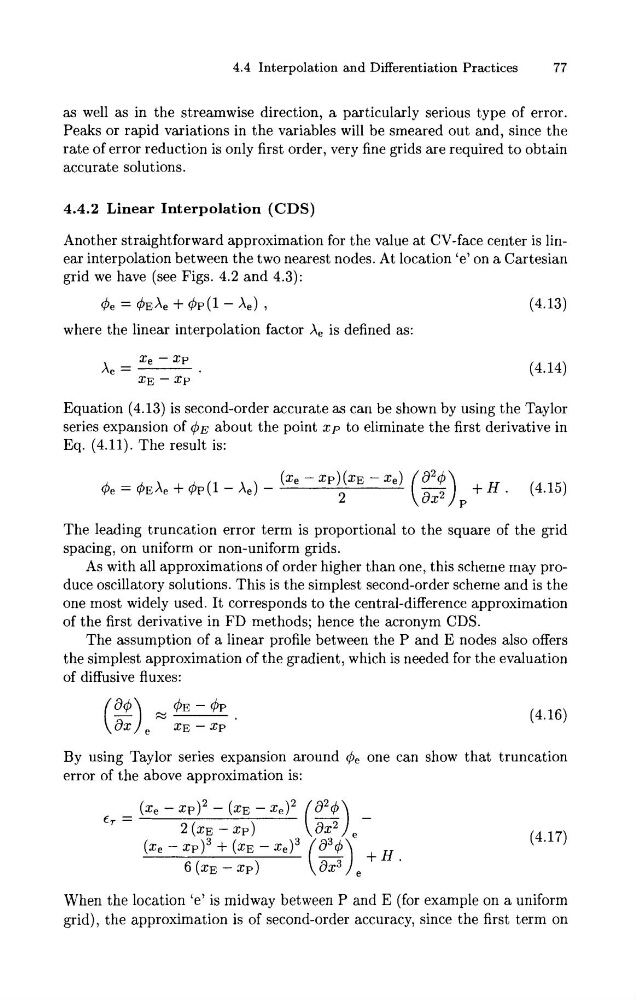
Another straightforward approximation for the value at CV-face center is linear interpolation between the two nearest nodes. At location 'e' on a Cartesian
grid we have (see Figs. 4.2 and 4.3):
where the linear interpolation factor Xe is defined as:
Equation (4.13) is second-order accurate as can be shown by using the Taylor
series expansion of 4E about the point xp to eliminate the first derivative in
Eq. (4.11). The result is:
The leading truncation error term is proportional to the square of the grid
spacing, on uniform or non-uniform grids.
As with all approximations of order higher than one, this scheme may produce oscillatory solutions. This is the simplest second-order scheme and is the
one most widely used. It corresponds to the central-difference approximation
of the first derivative in FD methods; hence the acronym CDS.
The assumption of a linear profile between the P and E nodes also offers
the simplest approximation of the gradient, which is needed for the evaluation
of diffusive fluxes:
By using Taylor series expansion around 4, one can show that truncation
error of the above approximation is:
When the location 'e' is midway between P and E (for example on a uniform
grid), the approximation is of second-order accuracy, since the first term on
77
as well as in the streamwise direction, a particularly serious type of error.
Peaks or rapid variations in the variables will be smeared out and, since the
rate of error reduction is only first order, very fine grids are required to obtain
accurate solutions.
4.4.2 Linear Interpolation (CDS)
Another straightforward approximation for the value at CV-face center is linear interpolation between the two nearest nodes. At location 'e' on a Cartesian
grid we have (see Figs. 4.2 and 4.3):
where the linear interpolation factor Xe is defined as:
Equation (4.13) is second-order accurate as can be shown by using the Taylor
series expansion of 4E about the point xp to eliminate the first derivative in
Eq. (4.11). The result is:
The leading truncation error term is proportional to the square of the grid
spacing, on uniform or non-uniform grids.
As with all approximations of order higher than one, this scheme may produce oscillatory solutions. This is the simplest second-order scheme and is the
one most widely used. It corresponds to the central-difference approximation
of the first derivative in FD methods; hence the acronym CDS.
The assumption of a linear profile between the P and E nodes also offers
the simplest approximation of the gradient, which is needed for the evaluation
of diffusive fluxes:
By using Taylor series expansion around 4, one can show that truncation
error of the above approximation is:
When the location 'e' is midway between P and E (for example on a uniform
grid), the approximation is of second-order accuracy, since the first term on