

64
3. Finite Difference Methods
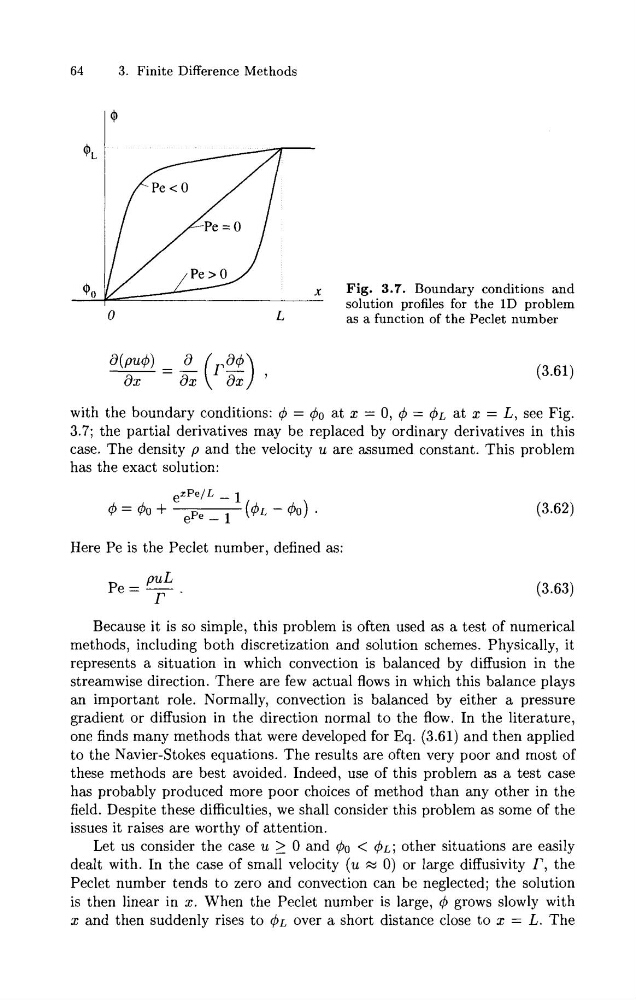
Fig. 3.7. Boundary conditions and
solution profiles for the 1D problem
as a function of the Peclet number
with the boundary conditions: $ = $0 at x = 0, 4 = $ L at x = L, see Fig.
3.7; the partial derivatives may be replaced by ordinary derivatives in this
case. The density p and the velocity u are assumed constant. This problem
has the exact solution:
Here Pe is the Peclet number, defined as:
Because it is so simple, this problem is often used as a test of numerical
methods, including both discretization and solution schemes. Physically, it
represents a situation in which convection is balanced by diffusion in the
streamwise direction. There are few actual flows in which this balance plays
an important role. Normally, convection is balanced by either a pressure
gradient or diffusion in the direction normal to the flow. In the literature,
one finds many methods that were developed for Eq. (3.61) and then applied
to the Navier-Stokes equations. The results are often very poor and most of
these methods are best avoided. Indeed, use of this problem as a test case
has probably produced more poor choices of method than any other in the
field. Despite these difficulties, we shall consider this problem as some of the
issues it raises are worthy of attention.
Let us consider the case u 2 0 and $0 < $ L ; other situations are easily
dealt with. In the case of small velocity ( u x 0) or large diffusivity f, the
Peclet number tends to zero and convection can be neglected; the solution
is then linear in x. When the Peclet number is large, $ grows slowly with
x and then suddenly rises to $ L over a short distance close to x = L. The
3. Finite Difference Methods
Fig. 3.7. Boundary conditions and
solution profiles for the 1D problem
as a function of the Peclet number
with the boundary conditions: $ = $0 at x = 0, 4 = $ L at x = L, see Fig.
3.7; the partial derivatives may be replaced by ordinary derivatives in this
case. The density p and the velocity u are assumed constant. This problem
has the exact solution:
Here Pe is the Peclet number, defined as:
Because it is so simple, this problem is often used as a test of numerical
methods, including both discretization and solution schemes. Physically, it
represents a situation in which convection is balanced by diffusion in the
streamwise direction. There are few actual flows in which this balance plays
an important role. Normally, convection is balanced by either a pressure
gradient or diffusion in the direction normal to the flow. In the literature,
one finds many methods that were developed for Eq. (3.61) and then applied
to the Navier-Stokes equations. The results are often very poor and most of
these methods are best avoided. Indeed, use of this problem as a test case
has probably produced more poor choices of method than any other in the
field. Despite these difficulties, we shall consider this problem as some of the
issues it raises are worthy of attention.
Let us consider the case u 2 0 and $0 < $ L ; other situations are easily
dealt with. In the case of small velocity ( u x 0) or large diffusivity f, the
Peclet number tends to zero and convection can be neglected; the solution
is then linear in x. When the Peclet number is large, $ grows slowly with
x and then suddenly rises to $ L over a short distance close to x = L. The