

3.9 Discretization Errors
59
This equation states that the truncation error acts as a source of the discretization error, which is convected and diffused by the operator Lh. Exact
analysis is not possible for non-linear equations, but we expect similar behavior; in any case, if the error is small enough, we can locally linearize about
the exact solution and what we will say in this section is valid. Information
about the magnitude and distribution of the truncation error can be used as
a guide for grid refinement and can help achieve the goal of having the same
level of the discretization error everywhere in the solution domain. However,
as the exact solution @ is not known, the truncation error cannot be calculated exactly. An approximation to it may be obtained by using a solution
from another (finer or coarser) grid. The estimate of the truncation error
thus obtained is not always accurate but it serves the purpose of pointing to
regions that have large errors and need finer grids.
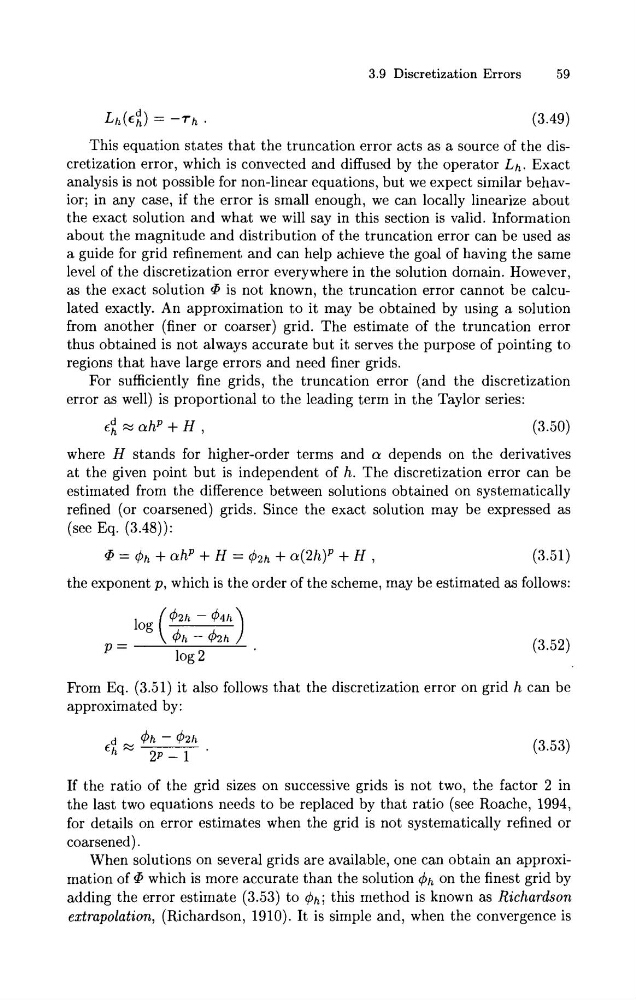
For sufficiently fine grids, the truncation error (and the discretization
error as well) is proportional to the leading term in the Taylor series:
where H stands for higher-order terms and a depends on the derivatives
at the given point but is independent of h. The discretization error can be
estimated from the difference between solutions obtained on systematically
refined (or coarsened) grids. Since the exact solution may be expressed as
(see Eq. (3.48)):
the exponent p, which is the order of the scheme, may be estimated as follows:
From Eq. (3.51) it also follows that the discretization error on grid h can be
approximated by:
If the ratio of the grid sizes on successive grids is not two, the factor 2 in
the last two equations needs to be replaced by that ratio (see Roache, 1994,
for details on error estimates when the grid is not systematically refined or
coarsened).
When solutions on several grids are available, one can obtain an approximation of @ which is more accurate than the solution +h on the finest grid by
adding the error estimate (3.53) to dh; this method is known as Richardson
extrapolation, (Richardson, 1910). It is simple and, when the convergence is
59
This equation states that the truncation error acts as a source of the discretization error, which is convected and diffused by the operator Lh. Exact
analysis is not possible for non-linear equations, but we expect similar behavior; in any case, if the error is small enough, we can locally linearize about
the exact solution and what we will say in this section is valid. Information
about the magnitude and distribution of the truncation error can be used as
a guide for grid refinement and can help achieve the goal of having the same
level of the discretization error everywhere in the solution domain. However,
as the exact solution @ is not known, the truncation error cannot be calculated exactly. An approximation to it may be obtained by using a solution
from another (finer or coarser) grid. The estimate of the truncation error
thus obtained is not always accurate but it serves the purpose of pointing to
regions that have large errors and need finer grids.
For sufficiently fine grids, the truncation error (and the discretization
error as well) is proportional to the leading term in the Taylor series:
where H stands for higher-order terms and a depends on the derivatives
at the given point but is independent of h. The discretization error can be
estimated from the difference between solutions obtained on systematically
refined (or coarsened) grids. Since the exact solution may be expressed as
(see Eq. (3.48)):
the exponent p, which is the order of the scheme, may be estimated as follows:
From Eq. (3.51) it also follows that the discretization error on grid h can be
approximated by:
If the ratio of the grid sizes on successive grids is not two, the factor 2 in
the last two equations needs to be replaced by that ratio (see Roache, 1994,
for details on error estimates when the grid is not systematically refined or
coarsened).
When solutions on several grids are available, one can obtain an approximation of @ which is more accurate than the solution +h on the finest grid by
adding the error estimate (3.53) to dh; this method is known as Richardson
extrapolation, (Richardson, 1910). It is simple and, when the convergence is