

58
3. Finite Difference Methods
ordering of points, each node is identified with an index 1, which is also the
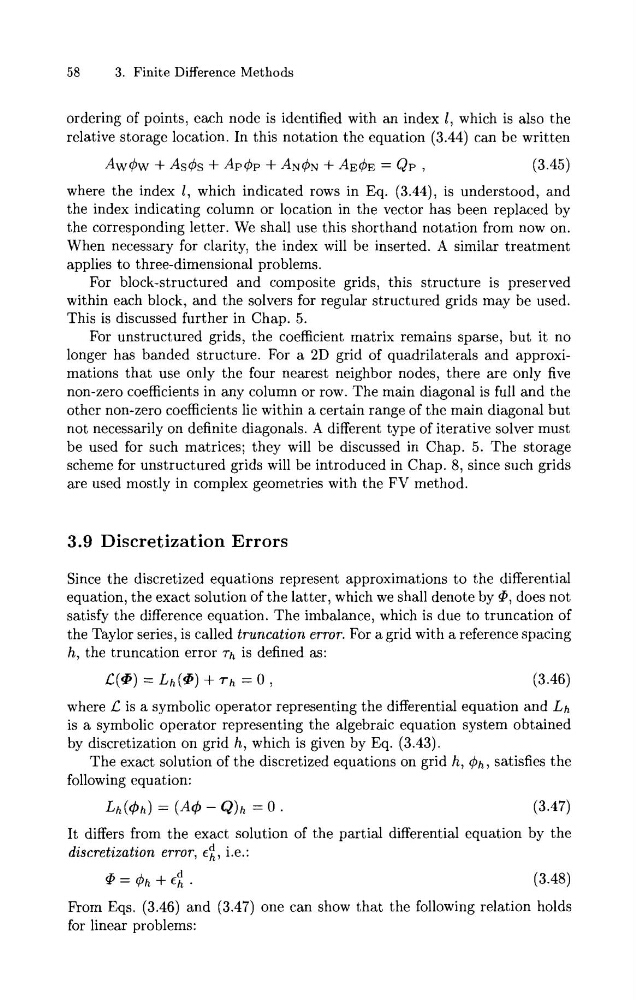
relative storage location. In this notation the equation (3.44) can be written
where the index 1, which indicated rows in Eq. (3.44), is understood, and
the index indicating column or location in the vector has been replaced by
the corresponding letter. We shall use this shorthand notation from now on.
When necessary for clarity, the index will be inserted. A similar treatment
applies to three-dimensional problems.
For block-structured and composite grids, this structure is preserved
within each block, and the solvers for regular structured grids may be used.
This is discussed further in Chap. 5.
For unstructured grids, the coefficient matrix remains sparse, but it no
longer has banded structure. For a 2D grid of quadrilaterals and approximations that use only the four nearest neighbor nodes, there are only five
non-zero coefficients in any column or row. The main diagonal is full and the
other non-zero coefficients lie within a certain range of the main diagonal but
not necessarily on definite diagonals. A different type of iterative solver must
be used for such matrices; they will be discussed in Chap. 5. The storage
scheme for unstructured grids will be introduced in Chap. 8, since such grids
are used mostly in complex geometries with the FV method.
3.9 Discretization Errors
Since the discretized equations represent approximations to the differential
equation, the exact solution of the latter, which we shall denote by @, does not
satisfy the difference equation. The imbalance, which is due to truncation of
the Taylor series, is called truncation error. For a grid with a reference spacing
h, the truncation error r h is defined as:
C(@) = Lh(@) + r h = 0
(3.46)
where C is a symbolic operator representing the differential equation and Lh
is a symbolic operator representing the algebraic equation system obtained
by discretization on grid h, which is given by Eq. (3.43).
The exact solution of the discretized equations on grid h, qhh, satisfies the
following equation:
Lh(4h) = (4 - Q)h = 0 .
(3.47)
It differs from the exact solution of the partial differential equation by the
discretization error, E:, i.e.:
@ = ( b h + c ; .
(3.48)
From Eqs. (3.46) and (3.47) one can show that the following relation holds
for linear problems:
3. Finite Difference Methods
ordering of points, each node is identified with an index 1, which is also the
relative storage location. In this notation the equation (3.44) can be written
where the index 1, which indicated rows in Eq. (3.44), is understood, and
the index indicating column or location in the vector has been replaced by
the corresponding letter. We shall use this shorthand notation from now on.
When necessary for clarity, the index will be inserted. A similar treatment
applies to three-dimensional problems.
For block-structured and composite grids, this structure is preserved
within each block, and the solvers for regular structured grids may be used.
This is discussed further in Chap. 5.
For unstructured grids, the coefficient matrix remains sparse, but it no
longer has banded structure. For a 2D grid of quadrilaterals and approximations that use only the four nearest neighbor nodes, there are only five
non-zero coefficients in any column or row. The main diagonal is full and the
other non-zero coefficients lie within a certain range of the main diagonal but
not necessarily on definite diagonals. A different type of iterative solver must
be used for such matrices; they will be discussed in Chap. 5. The storage
scheme for unstructured grids will be introduced in Chap. 8, since such grids
are used mostly in complex geometries with the FV method.
3.9 Discretization Errors
Since the discretized equations represent approximations to the differential
equation, the exact solution of the latter, which we shall denote by @, does not
satisfy the difference equation. The imbalance, which is due to truncation of
the Taylor series, is called truncation error. For a grid with a reference spacing
h, the truncation error r h is defined as:
C(@) = Lh(@) + r h = 0
(3.46)
where C is a symbolic operator representing the differential equation and Lh
is a symbolic operator representing the algebraic equation system obtained
by discretization on grid h, which is given by Eq. (3.43).
The exact solution of the discretized equations on grid h, qhh, satisfies the
following equation:
Lh(4h) = (4 - Q)h = 0 .
(3.47)
It differs from the exact solution of the partial differential equation by the
discretization error, E:, i.e.:
@ = ( b h + c ; .
(3.48)
From Eqs. (3.46) and (3.47) one can show that the following relation holds
for linear problems: