

396
12. Special Topics
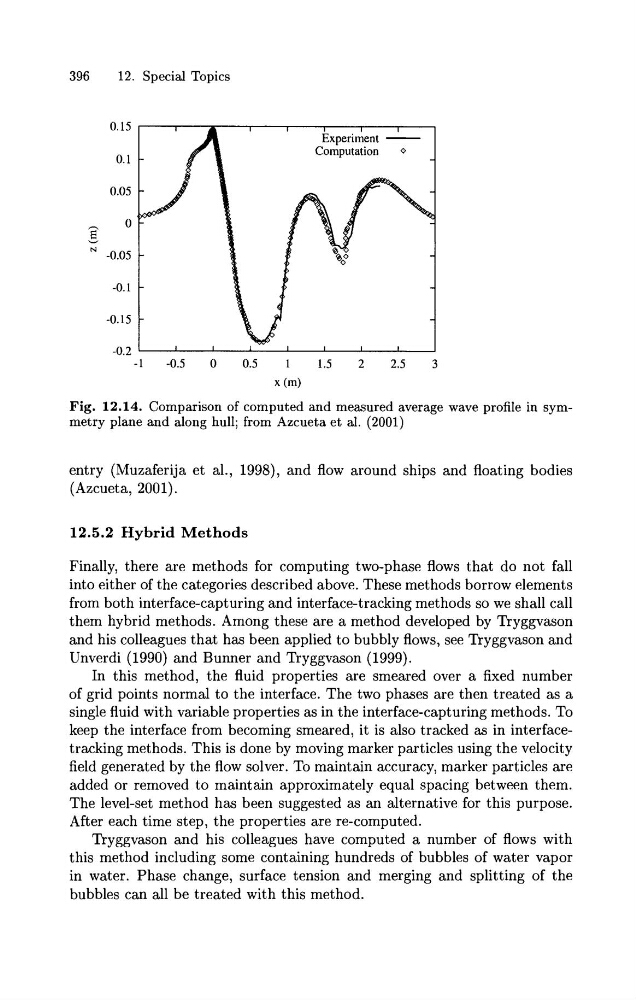
Fig. 12.14. Comparison of computed and measured average wave profile in symmetry plane and along hull; from Azcueta et al. (2001)
entry (Muzaferija et al., 1998), and flow around ships and floating bodies
(Azcueta, 2001).
12.5.2 Hybrid Methods
Finally, there are methods for computing two-phase flows that do not fall
into either of the categories described above. These methods borrow elements
from both interface-capturing and interface-tracking methods so we shall call
them hybrid methods. Among these are a method developed by Tryggvason
and his colleagues that has been applied to bubbly flows, see Tryggvason and
Unverdi (1990) and Bunner and Tryggvason (1999).
In this method, the fluid properties are smeared over a fixed number
of grid points normal to the interface. The two phases are then treated as a
single fluid with variable properties as in the interface-capturing methods. To
keep the interface from becoming smeared, it is also tracked as in interfacetracking methods. This is done by moving marker particles using the velocity
field generated by the flow solver. To maintain accuracy, marker particles are
added or removed to maintain approximately equal spacing between them.
The level-set method has been suggested as an alternative for this purpose.
After each time step, the properties are re-computed.
Tryggvason and his colleagues have computed a number of flows with
this method including some containing hundreds of bubbles of water vapor
in water. Phase change, surface tension and merging and splitting of the
bubbles can all be treated with this method.
12. Special Topics
Fig. 12.14. Comparison of computed and measured average wave profile in symmetry plane and along hull; from Azcueta et al. (2001)
entry (Muzaferija et al., 1998), and flow around ships and floating bodies
(Azcueta, 2001).
12.5.2 Hybrid Methods
Finally, there are methods for computing two-phase flows that do not fall
into either of the categories described above. These methods borrow elements
from both interface-capturing and interface-tracking methods so we shall call
them hybrid methods. Among these are a method developed by Tryggvason
and his colleagues that has been applied to bubbly flows, see Tryggvason and
Unverdi (1990) and Bunner and Tryggvason (1999).
In this method, the fluid properties are smeared over a fixed number
of grid points normal to the interface. The two phases are then treated as a
single fluid with variable properties as in the interface-capturing methods. To
keep the interface from becoming smeared, it is also tracked as in interfacetracking methods. This is done by moving marker particles using the velocity
field generated by the flow solver. To maintain accuracy, marker particles are
added or removed to maintain approximately equal spacing between them.
The level-set method has been suggested as an alternative for this purpose.
After each time step, the properties are re-computed.
Tryggvason and his colleagues have computed a number of flows with
this method including some containing hundreds of bubbles of water vapor
in water. Phase change, surface tension and merging and splitting of the
bubbles can all be treated with this method.