

372
12. Special Topics
In the general case, temperature variations are significant. They affect
the flow in two ways. The first is through the variation of the transport
properties with temperature. These can be very large and must be taken
into account but are not difficult to handle numerically. The important issue
is that the energy and momentum equations are now coupled and must be
solved simultaneously. Fortunately, the coupling is not usually so strong as
to prevent solution of the equations in sequential fashion. On each outer
iteration, the momentum equations are first solved using transport properties
computed from the 'old' temperature field. The temperature field is updated
after the solution of the momentum equations has been obtained for the new
outer iteration and the properties are updated. This technique is very similar
to the one for solving the momentum equations with a turbulence model
described in Chapter 9.
Another effect of temperature variation is that density variation interacting with gravity, produces a body force that may modify the flow considerably
and may be the principal driving force in the flow. In the latter case, we talk of
buoyancy-driven or natural convection flow. The relative importance of forced
convection and buoyancy effects is measured by the ratio of the Rayleigh and
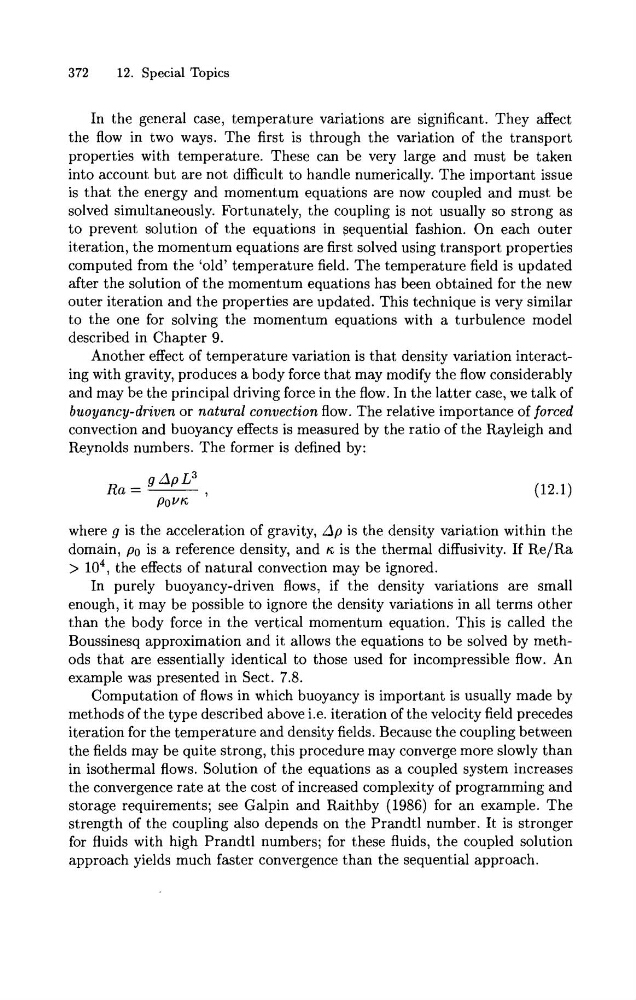
Reynolds numbers. The former is defined by:
where g is the acceleration of gravity, b p is the density variation within the
domain, po is a reference density, and n is the thermal diffusivity. If Re/Ra
> lo4, the effects of natural convection may be ignored.
In purely buoyancy-driven flows, if the density variations are small
enough, it may be possible to ignore the density variations in all terms other
than the body force in the vertical momentum equation. This is called the
Boussinesq approximation and it allows the equations to be solved by methods that are essentially identical to those used for incompressible flow. An
example was presented in Sect. 7.8.
Computation of flows in which buoyancy is important is usually made by
methods of the type described above i.e. iteration of the velocity field precedes
iteration for the temperature and density fields. Because the coupling between
the fields may be quite strong, this procedure may converge more slowly than
in isothermal flows. Solution of the equations as a coupled system increases
the convergence rate a t the cost of increased complexity of programming and
storage requirements; see Galpin and Raithby (1986) for an example. The
strength of t,he coupling also depends on the Prandtl number. It is stronger
for fluids with high Prandtl numbers; for these fluids, the coupled solution
approach yields much faster convergence than the sequential approach.
12. Special Topics
In the general case, temperature variations are significant. They affect
the flow in two ways. The first is through the variation of the transport
properties with temperature. These can be very large and must be taken
into account but are not difficult to handle numerically. The important issue
is that the energy and momentum equations are now coupled and must be
solved simultaneously. Fortunately, the coupling is not usually so strong as
to prevent solution of the equations in sequential fashion. On each outer
iteration, the momentum equations are first solved using transport properties
computed from the 'old' temperature field. The temperature field is updated
after the solution of the momentum equations has been obtained for the new
outer iteration and the properties are updated. This technique is very similar
to the one for solving the momentum equations with a turbulence model
described in Chapter 9.
Another effect of temperature variation is that density variation interacting with gravity, produces a body force that may modify the flow considerably
and may be the principal driving force in the flow. In the latter case, we talk of
buoyancy-driven or natural convection flow. The relative importance of forced
convection and buoyancy effects is measured by the ratio of the Rayleigh and
Reynolds numbers. The former is defined by:
where g is the acceleration of gravity, b p is the density variation within the
domain, po is a reference density, and n is the thermal diffusivity. If Re/Ra
> lo4, the effects of natural convection may be ignored.
In purely buoyancy-driven flows, if the density variations are small
enough, it may be possible to ignore the density variations in all terms other
than the body force in the vertical momentum equation. This is called the
Boussinesq approximation and it allows the equations to be solved by methods that are essentially identical to those used for incompressible flow. An
example was presented in Sect. 7.8.
Computation of flows in which buoyancy is important is usually made by
methods of the type described above i.e. iteration of the velocity field precedes
iteration for the temperature and density fields. Because the coupling between
the fields may be quite strong, this procedure may converge more slowly than
in isothermal flows. Solution of the equations as a coupled system increases
the convergence rate a t the cost of increased complexity of programming and
storage requirements; see Galpin and Raithby (1986) for an example. The
strength of t,he coupling also depends on the Prandtl number. It is stronger
for fluids with high Prandtl numbers; for these fluids, the coupled solution
approach yields much faster convergence than the sequential approach.