

11.3 Multigrid Methods for Flow Calculation
347
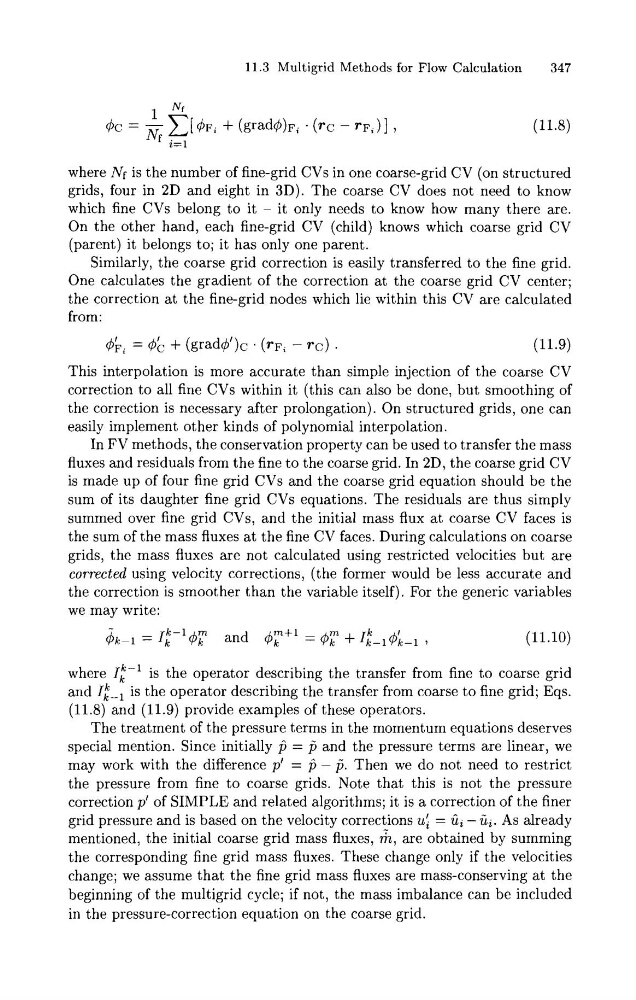
where Nf is the number of fine-grid CVs in one coarse-grid CV (on structured
grids, four in 2D and eight in 3D). The coarse CV does not need to know
which fine CVs belong to it - it only needs to know how many there are.
On the other hand, each fine-grid CV (child) knows which coarse grid CV
(parent) it belongs to; it has only one parent.
Similarly, the coarse grid correction is easily transferred to the fine grid.
One calculates the gradient of the correction at the coarse grid CV center;
the correction at the fine-grid nodes which lie within this CV are calculated
from:
This interpolation is more accurate than simple injection of the coarse CV
correction to all fine CVs within it (this can also be done, but smoothing of
the correction is necessary after prolongation). On structured grids, one can
easily implement other kinds of polynomial interpolation.
In FV methods, the conservation property can be used to transfer the mass
fluxes and residuals from the fine to the coarse grid. In 2D, the coarse grid CV
is made up of four fine grid CVs and the coarse grid equation should be the
sum of its daughter fine grid CVs equations. The residuals are thus simply
summed over fine grid CVs, and the initial mass flux at coarse CV faces is
the sum of the mass fluxes at the fine CV faces. During calculations on coarse
grids, the mass fluxes are not calculated using restricted velocities but are
corrected using velocity corrections, (the former would be less accurate and
the correction is smoother than the variable itself). For the generic variables
we may write:
- 1 I
and 47" =47+1t-,4;-, ,
(11.10)
where I:-' is the operator describing the transfer from fine to coarse grid
and It-, is the operator describing the transfer from coarse to fine grid; Eqs.
(11.8) and (11.9) provide examples of these operators.
The treatment of the pressure terms in the momentum equations deserves
special mention. Since initially p = p and the pressure terms are linear, we
may work with the difference p' = p - 5. Then we do not need to restrict
the pressure from fine to coarse grids. Note that this is not the pressure
correction p' of SIMPLE and related algorithms; it is a correction of the finer
grid pressure and is based on the velocity corrections ui = iii - iii. As already
mentioned, the initial coarse grid mass fluxes, A, are obtained by summing
the corresponding fine grid mass fluxes. These change only if the velocities
change; we assume that the fine grid mass fluxes are mass-conserving at the
beginning of the multigrid cycle; if not, the mass imbalance can be included
in the pressure-correction equation on the coarse grid.
347
where Nf is the number of fine-grid CVs in one coarse-grid CV (on structured
grids, four in 2D and eight in 3D). The coarse CV does not need to know
which fine CVs belong to it - it only needs to know how many there are.
On the other hand, each fine-grid CV (child) knows which coarse grid CV
(parent) it belongs to; it has only one parent.
Similarly, the coarse grid correction is easily transferred to the fine grid.
One calculates the gradient of the correction at the coarse grid CV center;
the correction at the fine-grid nodes which lie within this CV are calculated
from:
This interpolation is more accurate than simple injection of the coarse CV
correction to all fine CVs within it (this can also be done, but smoothing of
the correction is necessary after prolongation). On structured grids, one can
easily implement other kinds of polynomial interpolation.
In FV methods, the conservation property can be used to transfer the mass
fluxes and residuals from the fine to the coarse grid. In 2D, the coarse grid CV
is made up of four fine grid CVs and the coarse grid equation should be the
sum of its daughter fine grid CVs equations. The residuals are thus simply
summed over fine grid CVs, and the initial mass flux at coarse CV faces is
the sum of the mass fluxes at the fine CV faces. During calculations on coarse
grids, the mass fluxes are not calculated using restricted velocities but are
corrected using velocity corrections, (the former would be less accurate and
the correction is smoother than the variable itself). For the generic variables
we may write:
- 1 I
and 47" =47+1t-,4;-, ,
(11.10)
where I:-' is the operator describing the transfer from fine to coarse grid
and It-, is the operator describing the transfer from coarse to fine grid; Eqs.
(11.8) and (11.9) provide examples of these operators.
The treatment of the pressure terms in the momentum equations deserves
special mention. Since initially p = p and the pressure terms are linear, we
may work with the difference p' = p - 5. Then we do not need to restrict
the pressure from fine to coarse grids. Note that this is not the pressure
correction p' of SIMPLE and related algorithms; it is a correction of the finer
grid pressure and is based on the velocity corrections ui = iii - iii. As already
mentioned, the initial coarse grid mass fluxes, A, are obtained by summing
the corresponding fine grid mass fluxes. These change only if the velocities
change; we assume that the fine grid mass fluxes are mass-conserving at the
beginning of the multigrid cycle; if not, the mass imbalance can be included
in the pressure-correction equation on the coarse grid.