

328
10. Compressible Flow
equivalent) that can be used with them. As usual, the limitation takes the
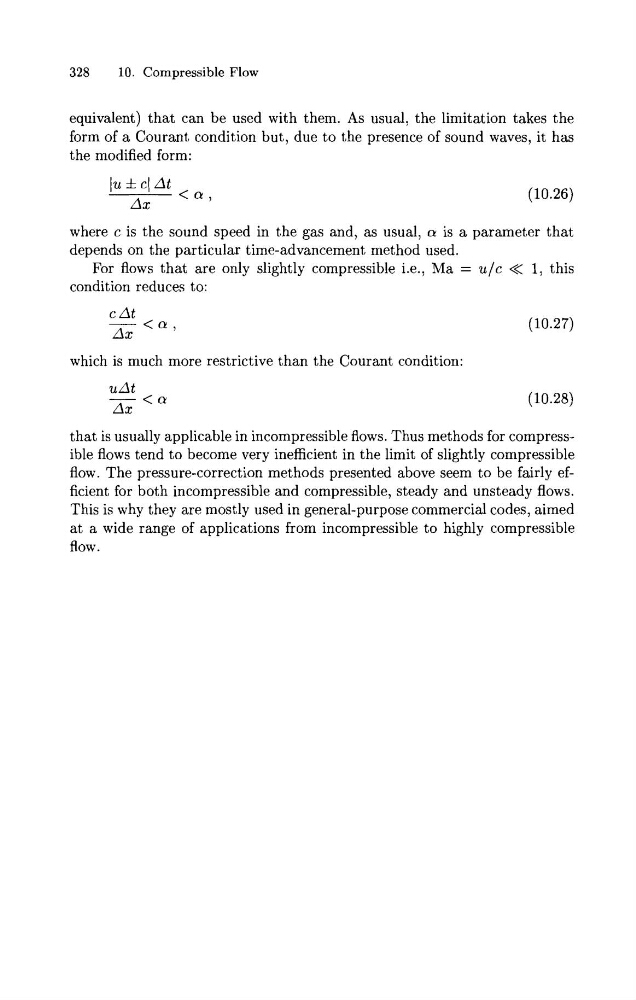
form of a Courant condition but, due to the presence of sound waves, it has
the modified form:
where c is the sound speed in the gas and, as usual, a is a parameter that
depends on the particular time-advancement method used.
For flows that are only slightly compressible i.e., Ma = u / c < 1, this
condition reduces to:
which is much more restrictive than the Courant condition:
u n t
- < a
Ax
that is usually applicable in incompressible flows. Thus methods for compressible flows tend to become very inefficient in the limit of slightly compressible
flow. The pressure-correction methods presented above seem to be fairly efficient for both incompressible and compressible, steady and unsteady flows.
This is why they are mostly used in general-purpose commercial codes, aimed
at a wide range of applications from incompressible to highly compressible
flow.
10. Compressible Flow
equivalent) that can be used with them. As usual, the limitation takes the
form of a Courant condition but, due to the presence of sound waves, it has
the modified form:
where c is the sound speed in the gas and, as usual, a is a parameter that
depends on the particular time-advancement method used.
For flows that are only slightly compressible i.e., Ma = u / c < 1, this
condition reduces to:
which is much more restrictive than the Courant condition:
u n t
- < a
Ax
that is usually applicable in incompressible flows. Thus methods for compressible flows tend to become very inefficient in the limit of slightly compressible
flow. The pressure-correction methods presented above seem to be fairly efficient for both incompressible and compressible, steady and unsteady flows.
This is why they are mostly used in general-purpose commercial codes, aimed
at a wide range of applications from incompressible to highly compressible
flow.