

10.3 Methods Designed for Compressible Flow
327
Still more sophisticated methods are based on similar ideas and are generally referred t o as flux limiters. The concept is to limit the flux of the
conserved quantity into a control volume to a level that will not produce a
local maximum or minimum of the profile of that quantity in that control
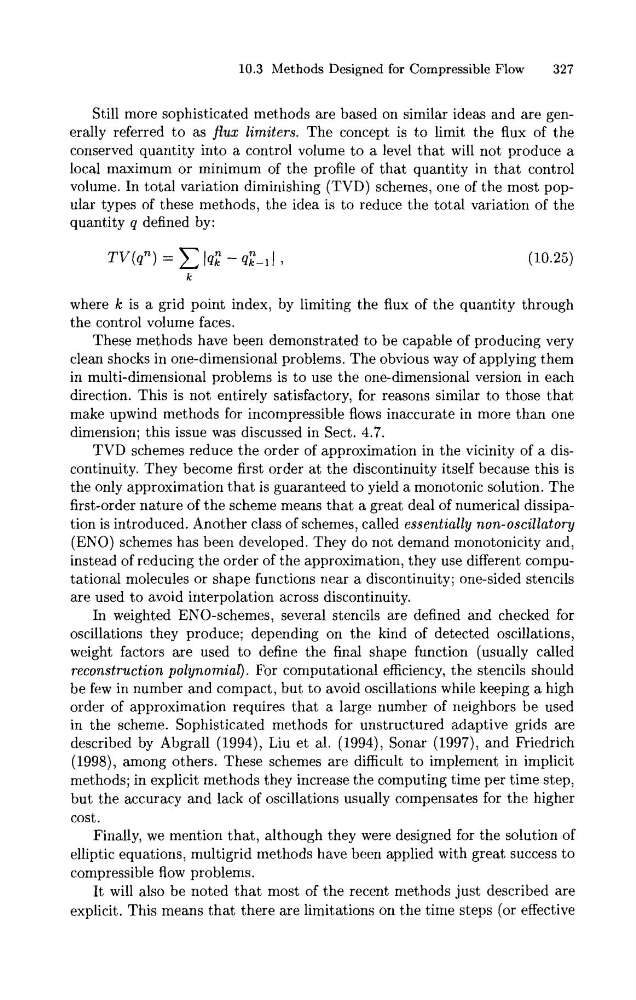
volume. In total variation diminishing (TVD) schemes, one of the most popular types of these methods, the idea is to reduce the total variation of the
quantity q defined by:
where k is a grid point index, by limiting the flux of the quantity through
the control volume faces.
These methods have been demonstrated to be capable of producing very
clean shocks in one-dimensional problems. The obvious way of applying them
in multi-dimensional problems is to use the one-dimensional version in each
direction. This is not entirely satisfactory, for reasons similar to those that
make upwind methods for incompressible flows inaccurate in more than one
dimension; this issue was discussed in Sect. 4.7.
TVD schemes reduce the order of approximation in the vicinity of a discontinuity. They become first order at the discontinuity itself because this is
the only approximation that is guaranteed to yield a monotonic solution. The
first-order nature of the scheme means that a great deal of numerical dissipation is introduced. Another class of schemes, called essentially non-oscillatory
(ENO) schemes has been developed. They do not demand monotonicity and,
instead of reducing the order of the approximation, they use different computational molecules or shape functions near a discontinuity; one-sided stencils
are used to avoid interpolation across discontinuity.
In weighted ENO-schemes, several stencils are defined and checked for
oscillations they produce; depending on the kind of detected oscillations,
weight factors are used to define the final shape function (usually called
reconstruction polynomial). For computational efficiency, the stencils should
be few in number and compact, but to avoid oscillations while keeping a high
order of approximation requires that a large number of neighbors be used
in the scheme. Sophisticated methods for unstructured adaptive grids are
described by Abgrall (1994), Liu et al. (1994), Sonar (1997), and Friedrich
(1998), anlong others. These schemes are difficult to implement in implicit
methods; in explicit methods they increase the computing time per time step,
but the accuracy and lack of oscillations usually compensates for the higher
cost.
Finally, we mention that, although they were designed for the solution of
elliptic equations, multigrid methods have been applied with great success to
compressible flow problems.
It will also be noted that most of the recent methods just described are
explicit. This means that there are limitations on the tirne steps (or effective
327
Still more sophisticated methods are based on similar ideas and are generally referred t o as flux limiters. The concept is to limit the flux of the
conserved quantity into a control volume to a level that will not produce a
local maximum or minimum of the profile of that quantity in that control
volume. In total variation diminishing (TVD) schemes, one of the most popular types of these methods, the idea is to reduce the total variation of the
quantity q defined by:
where k is a grid point index, by limiting the flux of the quantity through
the control volume faces.
These methods have been demonstrated to be capable of producing very
clean shocks in one-dimensional problems. The obvious way of applying them
in multi-dimensional problems is to use the one-dimensional version in each
direction. This is not entirely satisfactory, for reasons similar to those that
make upwind methods for incompressible flows inaccurate in more than one
dimension; this issue was discussed in Sect. 4.7.
TVD schemes reduce the order of approximation in the vicinity of a discontinuity. They become first order at the discontinuity itself because this is
the only approximation that is guaranteed to yield a monotonic solution. The
first-order nature of the scheme means that a great deal of numerical dissipation is introduced. Another class of schemes, called essentially non-oscillatory
(ENO) schemes has been developed. They do not demand monotonicity and,
instead of reducing the order of the approximation, they use different computational molecules or shape functions near a discontinuity; one-sided stencils
are used to avoid interpolation across discontinuity.
In weighted ENO-schemes, several stencils are defined and checked for
oscillations they produce; depending on the kind of detected oscillations,
weight factors are used to define the final shape function (usually called
reconstruction polynomial). For computational efficiency, the stencils should
be few in number and compact, but to avoid oscillations while keeping a high
order of approximation requires that a large number of neighbors be used
in the scheme. Sophisticated methods for unstructured adaptive grids are
described by Abgrall (1994), Liu et al. (1994), Sonar (1997), and Friedrich
(1998), anlong others. These schemes are difficult to implement in implicit
methods; in explicit methods they increase the computing time per time step,
but the accuracy and lack of oscillations usually compensates for the higher
cost.
Finally, we mention that, although they were designed for the solution of
elliptic equations, multigrid methods have been applied with great success to
compressible flow problems.
It will also be noted that most of the recent methods just described are
explicit. This means that there are limitations on the tirne steps (or effective