

322
10. Compressible Flow
shocks does not change with grid refinement - only the steepness is improved
(this was observed in many applications). The conservation properties of the
FV method used and the dominant role of CDS approximations is probably
responsible for this feature.
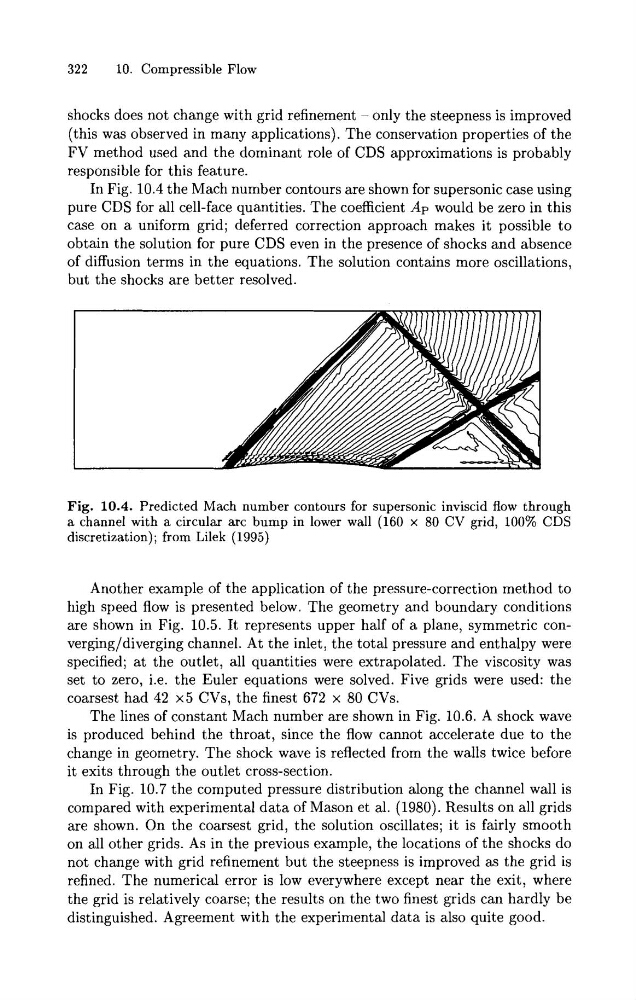
In Fig. 10.4 the Mach number contours are shown for supersonic case using
pure CDS for all cell-face quantities. The coefficient Ap would be zero in this
case on a uniform grid; deferred correction approach makes it possible t o
obtain the solution for pure CDS even in the presence of shocks and absence
of diffusion terms in the equations. The solution contains more oscillations,
but the shocks are better resolved.
Fig. 10.4. Predicted Mach number contours for supersonic inviscid flow through
a channel with a circular arc bump in lower wall (160 x 80 CV grid, 100% CDS
discretization); from Lilek (1995)
Another example of the application of the pressure-correction method to
high speed flow is presented below. The geometry and boundary conditions
are shown in Fig. 10.5. It represents upper half of a plane, symmetric converging/diverging channel. At the inlet, the total pressure and enthalpy were
specified; at the outlet, all quantities were extrapolated. The viscosity was
set to zero, i.e. the Euler equations were solved. Five grids were used: the
coarsest had 42 x 5 CVs, the finest 672 x 80 CVs.
The lines of constant Mach number are shown in Fig. 10.6. A shock wave
is produced behind the throat, since the flow cannot accelerate due to the
change in geometry. The shock wave is reflected from the walls twice before
it exits through the outlet cross-section.
In Fig. 10.7 the computed pressure distribution along the channel wall is
compared with experimental data of Mason et al. (1980). Results on all grids
are shown. On the coarsest grid, the solution oscillates; it is fairly smooth
on all other grids. As in the previous example, the locations of the shocks do
not change with grid refinement but the steepness is improved as the grid is
refined. The numerical error is low everywhere except near the exit, where
the grid is relatively coarse; the results on the two finest grids can hardly be
distinguished. Agreement with the experimental data is also quite good.
10. Compressible Flow
shocks does not change with grid refinement - only the steepness is improved
(this was observed in many applications). The conservation properties of the
FV method used and the dominant role of CDS approximations is probably
responsible for this feature.
In Fig. 10.4 the Mach number contours are shown for supersonic case using
pure CDS for all cell-face quantities. The coefficient Ap would be zero in this
case on a uniform grid; deferred correction approach makes it possible t o
obtain the solution for pure CDS even in the presence of shocks and absence
of diffusion terms in the equations. The solution contains more oscillations,
but the shocks are better resolved.
Fig. 10.4. Predicted Mach number contours for supersonic inviscid flow through
a channel with a circular arc bump in lower wall (160 x 80 CV grid, 100% CDS
discretization); from Lilek (1995)
Another example of the application of the pressure-correction method to
high speed flow is presented below. The geometry and boundary conditions
are shown in Fig. 10.5. It represents upper half of a plane, symmetric converging/diverging channel. At the inlet, the total pressure and enthalpy were
specified; at the outlet, all quantities were extrapolated. The viscosity was
set to zero, i.e. the Euler equations were solved. Five grids were used: the
coarsest had 42 x 5 CVs, the finest 672 x 80 CVs.
The lines of constant Mach number are shown in Fig. 10.6. A shock wave
is produced behind the throat, since the flow cannot accelerate due to the
change in geometry. The shock wave is reflected from the walls twice before
it exits through the outlet cross-section.
In Fig. 10.7 the computed pressure distribution along the channel wall is
compared with experimental data of Mason et al. (1980). Results on all grids
are shown. On the coarsest grid, the solution oscillates; it is fairly smooth
on all other grids. As in the previous example, the locations of the shocks do
not change with grid refinement but the steepness is improved as the grid is
refined. The numerical error is low everywhere except near the exit, where
the grid is relatively coarse; the results on the two finest grids can hardly be
distinguished. Agreement with the experimental data is also quite good.