

10.2 Pressure-Correction Methods for Arbitrary Mach Number
321
- - - - - - -
- - - - - - - -
2 8 X 7 CV
- - - - - - - - - - .
56 X 14 CV
1 1 2 x 2 8 CV
Lower side
U p p e r side
l
/
l
I
I
l
l
I
!
l
l
l
l
l
l
l
l
l
!
l
l
l
I
/
l
l
l
I
I
0
.5
1
1.5
2
2.5
, 3
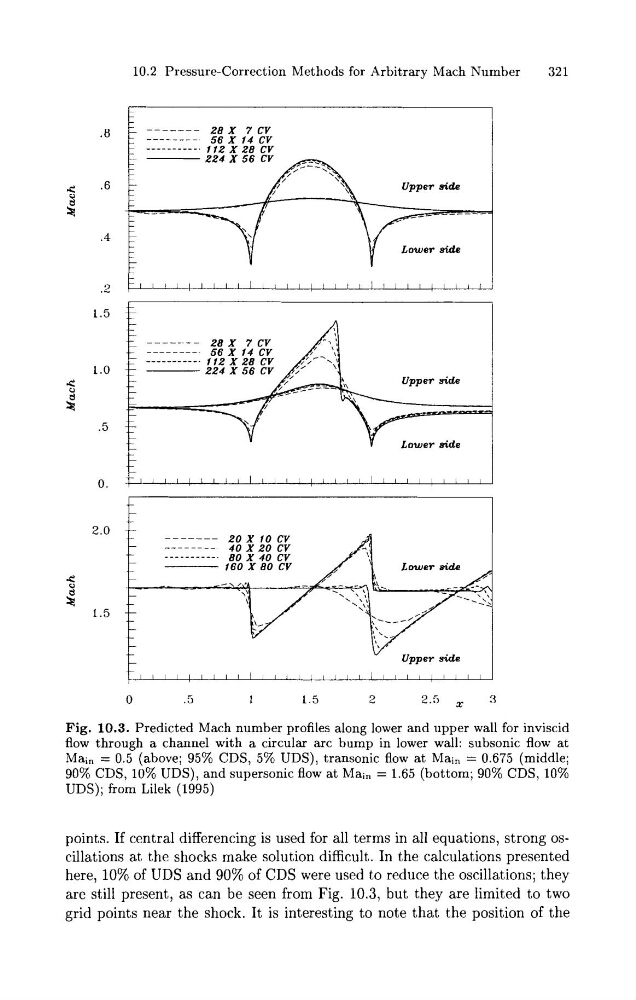
Fig. 10.3. Predicted Mach number profiles along lower and upper wall for inviscid
flow through a channel with a circular arc bump in lower wall: subsonic flow at
Ma;, = 0.5 (above; 95% CDS, 5% UDS), transonic flow at Ma;, = 0.675 (middle;
90% CDS, 10% UDS), and supersonic flow at Main = 1.65 (bottom; 90% CDS, 10%
UDS); from Lilek (1995)
points. If central differencing is used for all terms in all equations, strong oscillations at the shocks make solution difficult. In the calculations presented
here, 10% of UDS and 90% of CDS were used to reduce the oscillations; they
are still present, as can be seen from Fig. 10.3, but they are limited to two
grid points near the shock. It is interesting to note that the position of the
321
- - - - - - -
- - - - - - - -
2 8 X 7 CV
- - - - - - - - - - .
56 X 14 CV
1 1 2 x 2 8 CV
Lower side
U p p e r side
l
/
l
I
I
l
l
I
!
l
l
l
l
l
l
l
l
l
!
l
l
l
I
/
l
l
l
I
I
0
.5
1
1.5
2
2.5
, 3
Fig. 10.3. Predicted Mach number profiles along lower and upper wall for inviscid
flow through a channel with a circular arc bump in lower wall: subsonic flow at
Ma;, = 0.5 (above; 95% CDS, 5% UDS), transonic flow at Ma;, = 0.675 (middle;
90% CDS, 10% UDS), and supersonic flow at Main = 1.65 (bottom; 90% CDS, 10%
UDS); from Lilek (1995)
points. If central differencing is used for all terms in all equations, strong oscillations at the shocks make solution difficult. In the calculations presented
here, 10% of UDS and 90% of CDS were used to reduce the oscillations; they
are still present, as can be seen from Fig. 10.3, but they are limited to two
grid points near the shock. It is interesting to note that the position of the