

310
10. Compressible Flow
shocks have been constructed. These include simple upwind methods, flux
blending methods, essentially non-oscillatory (ENO) methods, and total variation diminishing (TVD) methods. These will not be described here but may
be found in a number of other books, e.g. Anderson et al. (1984) and Hirsch
(1991).
10.2 Pressure-Correction Methods for Arbitrary Mach
Number
To compute compressible flows, it is necessary to solve not only the continuity
and momentum equations but also a conservation equation for the thermal
energy (or one for the total energy) and an equation of state. The latter is a
thermodynamic relation connecting the density, temperature, and pressure.
The energy equation was given in Chap. 1; for incompressible flows it reduces
to a scalar transport equation for the temperature and only the convection
and heat conduction are important. In compressible flows, viscous dissipation
may be a significant heat source and conversion of internal energy to kinetic
energy (and vice versa) by means of flow dilatation is also important. All
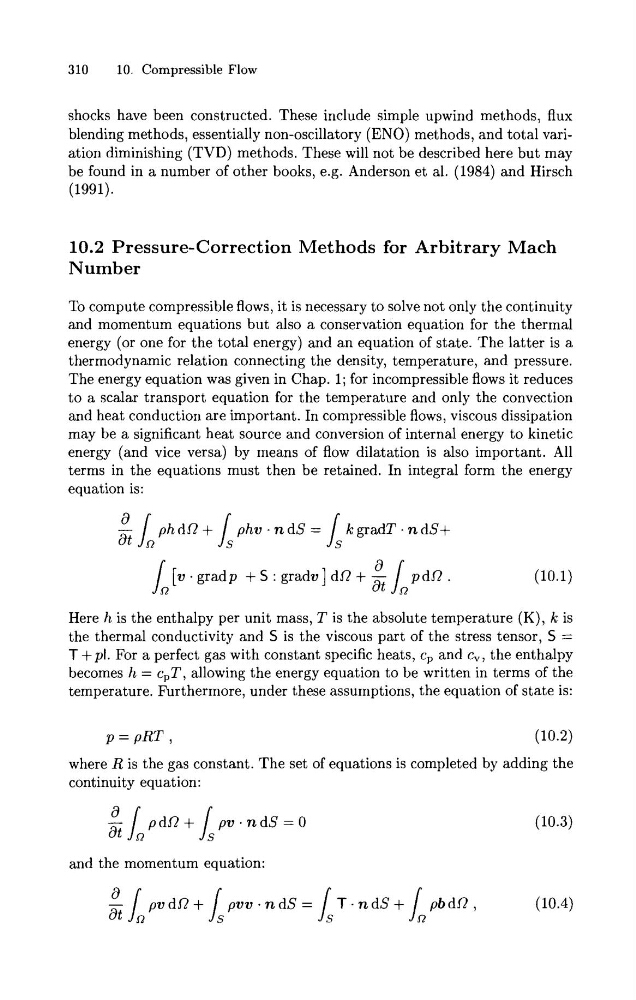
terms in the equations must then be retained. In integral form the energy
equation is:
Here h is the enthalpy per unit mass, T is the absolute temperature (K), k is
the thermal conductivity and S is the viscous part of the stress tensor, S =
T +pl. For a perfect gas with constant specific heats, c, and c,, the enthalpy
becomes h = c,T, allowing the energy equation to be written in terms of the
temperature. Furthermore, under these assumptions, the equation of state is:
where R is the gas constant. The set of equations is completed by adding the
continuity equation:
and the momentum equation:
10. Compressible Flow
shocks have been constructed. These include simple upwind methods, flux
blending methods, essentially non-oscillatory (ENO) methods, and total variation diminishing (TVD) methods. These will not be described here but may
be found in a number of other books, e.g. Anderson et al. (1984) and Hirsch
(1991).
10.2 Pressure-Correction Methods for Arbitrary Mach
Number
To compute compressible flows, it is necessary to solve not only the continuity
and momentum equations but also a conservation equation for the thermal
energy (or one for the total energy) and an equation of state. The latter is a
thermodynamic relation connecting the density, temperature, and pressure.
The energy equation was given in Chap. 1; for incompressible flows it reduces
to a scalar transport equation for the temperature and only the convection
and heat conduction are important. In compressible flows, viscous dissipation
may be a significant heat source and conversion of internal energy to kinetic
energy (and vice versa) by means of flow dilatation is also important. All
terms in the equations must then be retained. In integral form the energy
equation is:
Here h is the enthalpy per unit mass, T is the absolute temperature (K), k is
the thermal conductivity and S is the viscous part of the stress tensor, S =
T +pl. For a perfect gas with constant specific heats, c, and c,, the enthalpy
becomes h = c,T, allowing the energy equation to be written in terms of the
temperature. Furthermore, under these assumptions, the equation of state is:
where R is the gas constant. The set of equations is completed by adding the
continuity equation:
and the momentum equation: