

9.5 Reynolds Stress Models
305
The most complex models in common use today are Reynolds stress models which are based on dynamic equations for the Reynolds stress tensor
-
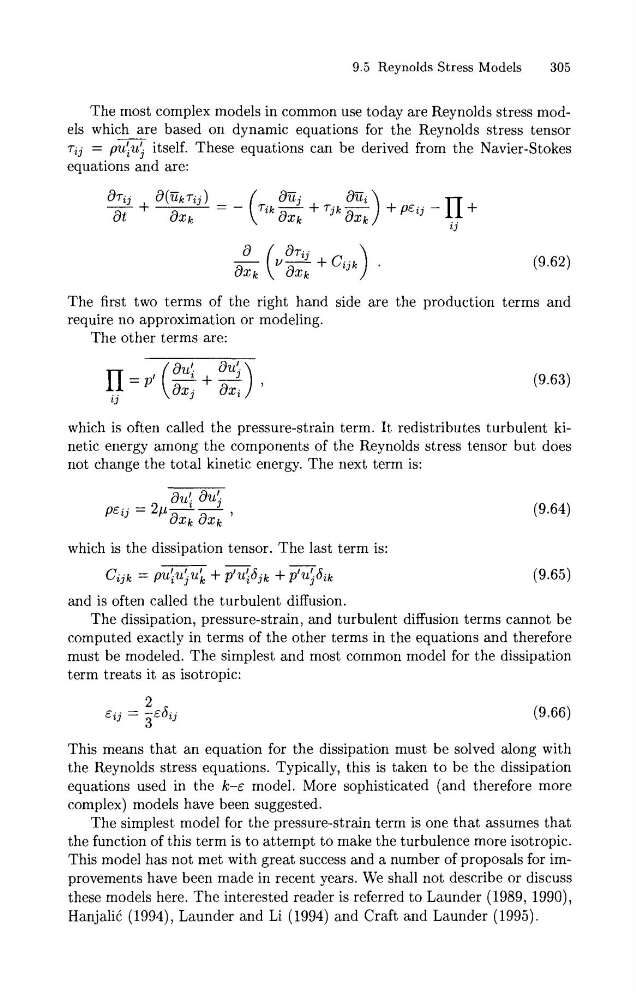
rij = pulu; itself. These equations can be derived from the Navier-Stokes
equations and are:
The first two terms of the right hand side are the production terms and
require no approximation or modeling.
The other terms are:
which is often called the pressure-strain term. It redistributes turbulent kinetic energy among the components of the Reynolds stress tensor but does
not change the total kinetic energy. The next term is:
which is the dissipation tensor. The last term is:
and is often called the turbulent diffusion.
The dissipation, pressure-strain, and turbulent diffusion terms cannot be
computed exactly in terms of the other terms in the equations and therefore
must be modeled. The simplest and most common model for the dissipation
term treats it as isotropic:
This means that an equation for the dissipation must be solved along with
the Reynolds stress equations. Typically, this is taken to be the dissipation
equations used in the k-E model. More sophisticated (and therefore more
complex) models have been suggested.
The simplest model for the pressure-strain term is one that assumes that
the function of this term is to attempt to make the turbulence more isotropic.
This model has not met with great success and a number of proposals for improvements have been made in recent years. We shall not describe or discuss
these models here. The interested reader is referred to Launder (1989, 1990),
HanjaliC (1994), Launder and Li (1994) and Craft and Launder (1995).
305
The most complex models in common use today are Reynolds stress models which are based on dynamic equations for the Reynolds stress tensor
-
rij = pulu; itself. These equations can be derived from the Navier-Stokes
equations and are:
The first two terms of the right hand side are the production terms and
require no approximation or modeling.
The other terms are:
which is often called the pressure-strain term. It redistributes turbulent kinetic energy among the components of the Reynolds stress tensor but does
not change the total kinetic energy. The next term is:
which is the dissipation tensor. The last term is:
and is often called the turbulent diffusion.
The dissipation, pressure-strain, and turbulent diffusion terms cannot be
computed exactly in terms of the other terms in the equations and therefore
must be modeled. The simplest and most common model for the dissipation
term treats it as isotropic:
This means that an equation for the dissipation must be solved along with
the Reynolds stress equations. Typically, this is taken to be the dissipation
equations used in the k-E model. More sophisticated (and therefore more
complex) models have been suggested.
The simplest model for the pressure-strain term is one that assumes that
the function of this term is to attempt to make the turbulence more isotropic.
This model has not met with great success and a number of proposals for improvements have been made in recent years. We shall not describe or discuss
these models here. The interested reader is referred to Launder (1989, 1990),
HanjaliC (1994), Launder and Li (1994) and Craft and Launder (1995).