

296
9. Turbulent Flows
and, as the right hand side of this equation can be calculated from quantities that will be computed, the development of the turbulent kinetic energy
equation is complete.
As mentioned above, another equation is required to determine the length
scale of the turbulence. The choice is not obvious and a number of equations
have been used for this purpose. The most popular one is based on the observations that the dissipation is needed in the energy equation and, in so-called
equilibrium turbulent flows, i.e., ones in which the rates of production and
destruction of turbulence are in near-balance, the dissipation, E , and k and
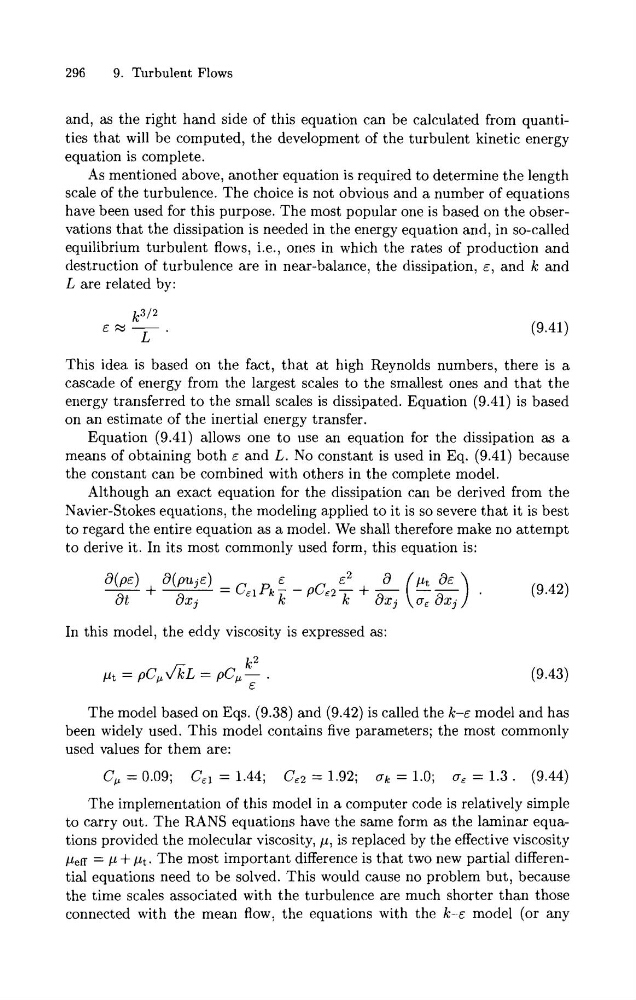
L are related by:
This idea is based on the fact, that at high Reynolds numbers, there is a
cascade of energy from the largest scales to the smallest ones and that the
energy transferred t o the small scales is dissipated. Equation (9.41) is based
on an estimate of the inertial energy transfer.
Equation (9.41) allows one t o use an equation for the dissipation as a
means of obtaining both E and L. No constant is used in Eq. (9.41) because
the constant can be combined with others in the complete model.
Although an exact equation for the dissipation can be derived from the
Navier-Stokes equations, the modeling applied to it is so severe that it is best
to regard the entire equation as a model. We shall therefore make no attempt
to derive it. In its most commonly used form, this equation is:
In this model, the eddy viscosity is expressed as:
The model based on Eqs. (9.38) and (9.42) is called the k-E model arid has
been widely used. This model contains five parameters; the most commonly
used values for them are:
The implementation of this model in a computer code is relatively simple
to carry out. The RANS equations have the same form as the laminar equations provided the molecular viscosity, p, is replaced by the effective viscosity
p , ~ . = p + pt. The most important difference is that two new partial differential equations need to be solved. This would cause no problem but, because
the time scales associated with the turbulence are much shorter than those
connected with the mean flow, the equations with the k-E model (or any
9. Turbulent Flows
and, as the right hand side of this equation can be calculated from quantities that will be computed, the development of the turbulent kinetic energy
equation is complete.
As mentioned above, another equation is required to determine the length
scale of the turbulence. The choice is not obvious and a number of equations
have been used for this purpose. The most popular one is based on the observations that the dissipation is needed in the energy equation and, in so-called
equilibrium turbulent flows, i.e., ones in which the rates of production and
destruction of turbulence are in near-balance, the dissipation, E , and k and
L are related by:
This idea is based on the fact, that at high Reynolds numbers, there is a
cascade of energy from the largest scales to the smallest ones and that the
energy transferred t o the small scales is dissipated. Equation (9.41) is based
on an estimate of the inertial energy transfer.
Equation (9.41) allows one t o use an equation for the dissipation as a
means of obtaining both E and L. No constant is used in Eq. (9.41) because
the constant can be combined with others in the complete model.
Although an exact equation for the dissipation can be derived from the
Navier-Stokes equations, the modeling applied to it is so severe that it is best
to regard the entire equation as a model. We shall therefore make no attempt
to derive it. In its most commonly used form, this equation is:
In this model, the eddy viscosity is expressed as:
The model based on Eqs. (9.38) and (9.42) is called the k-E model arid has
been widely used. This model contains five parameters; the most commonly
used values for them are:
The implementation of this model in a computer code is relatively simple
to carry out. The RANS equations have the same form as the laminar equations provided the molecular viscosity, p, is replaced by the effective viscosity
p , ~ . = p + pt. The most important difference is that two new partial differential equations need to be solved. This would cause no problem but, because
the time scales associated with the turbulence are much shorter than those
connected with the mean flow, the equations with the k-E model (or any