

9.4 RANS Models
295
In the simplest practical models, mixing-length models, k is determined
from the mean velocity field using the approximation q = Lduldy and L
is a prescribed function of the coordinates. Accurate prescription of L is
possible for simple flows but not for separated or highly three-dimensional
flows. Mixing-length models can therefore be applied only to relatively simple
flows; they are also known as zero-equation models.
The difficulty in prescribing the turbulence quantities suggests that one
might use partial differential equations to compute them. Since a minimum
description of turbulence requires a t least a velocity scale and a length scale,
a model which derives the needed quantities from two such equations is a
logical choice. In almost all such models, an equation for the turbulent kinetic
energy, k, determines the velocity scale. The exact equation for this quantity
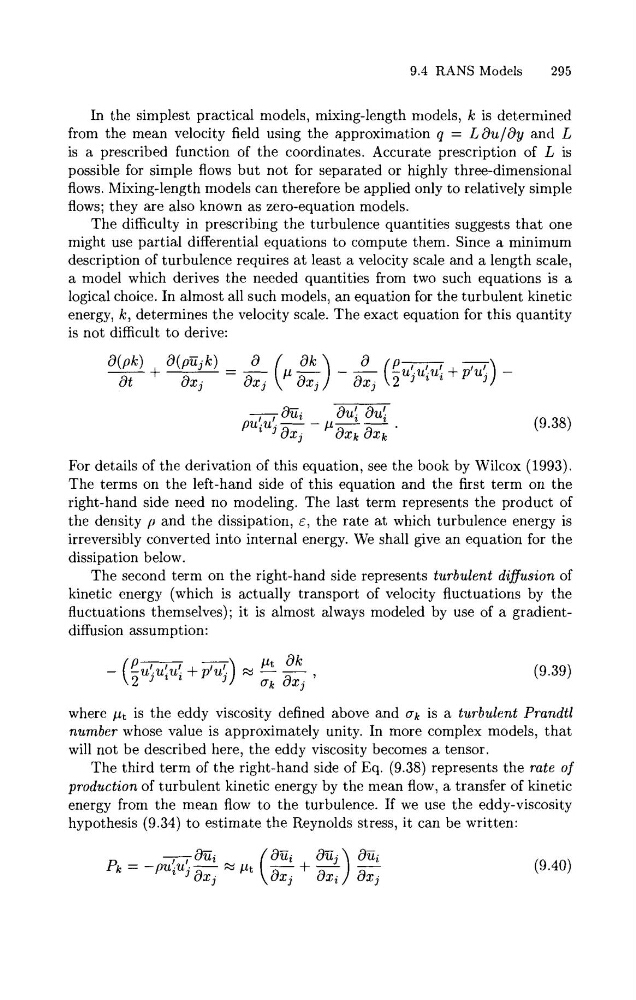
is not difficult to derive:
For details of the derivation of this equation, see the book by Wilcox (1993).
The terms on the left-hand side of this equation and the first term on the
right-hand side need no modeling. The last term represents the product of
the density p and the dissipation, E , the rate a t which turbulence energy is
irreversibly converted into internal energy. We shall give an equation for the
dissipation below.
The second term on the right-hand side represents turbulent diffusion of
kinetic energy (which is actually transport of velocity fluctuations by the
fluctuations themselves); it is almost always modeled by use of a gradientdiffusion assumption:
where pt is the eddy viscosity defined above and ak is a turbulent Prandtl
number whose value is approximately unity. In more complex models, that
will not be described here, the eddy viscosity becomes a tensor.
The third term of the right-hand side of Eq. (9.38) represents the rate of
production of turbulent kinetic energy by the mean flow, a transfer of kinetic
energy from the mean flow to the turbulence. If we use the eddy-viscosity
hypothesis (9.34) to estimate the Reynolds stress, it can be written:
295
In the simplest practical models, mixing-length models, k is determined
from the mean velocity field using the approximation q = Lduldy and L
is a prescribed function of the coordinates. Accurate prescription of L is
possible for simple flows but not for separated or highly three-dimensional
flows. Mixing-length models can therefore be applied only to relatively simple
flows; they are also known as zero-equation models.
The difficulty in prescribing the turbulence quantities suggests that one
might use partial differential equations to compute them. Since a minimum
description of turbulence requires a t least a velocity scale and a length scale,
a model which derives the needed quantities from two such equations is a
logical choice. In almost all such models, an equation for the turbulent kinetic
energy, k, determines the velocity scale. The exact equation for this quantity
is not difficult to derive:
For details of the derivation of this equation, see the book by Wilcox (1993).
The terms on the left-hand side of this equation and the first term on the
right-hand side need no modeling. The last term represents the product of
the density p and the dissipation, E , the rate a t which turbulence energy is
irreversibly converted into internal energy. We shall give an equation for the
dissipation below.
The second term on the right-hand side represents turbulent diffusion of
kinetic energy (which is actually transport of velocity fluctuations by the
fluctuations themselves); it is almost always modeled by use of a gradientdiffusion assumption:
where pt is the eddy viscosity defined above and ak is a turbulent Prandtl
number whose value is approximately unity. In more complex models, that
will not be described here, the eddy viscosity becomes a tensor.
The third term of the right-hand side of Eq. (9.38) represents the rate of
production of turbulent kinetic energy by the mean flow, a transfer of kinetic
energy from the mean flow to the turbulence. If we use the eddy-viscosity
hypothesis (9.34) to estimate the Reynolds stress, it can be written: