

9.3 Large Eddy Simulation (LES)
279
have anything to do with the grid size, h, other than the obvious condition
that A > h. Some authors do make such a connection and their nomenclature
has stuck. The models used to approximate the SGS Reynolds stress (9.9)
are called subgrid-scale (SGS) or subfilter-scale models.
The subgrid-scale Reynolds stress contains local averages of the small scale
field so models for it should be based on the local velocity field or, perhaps, on
the past history of the local fluid. The latter can be accomplished by using
a model that solves partial differential equations to obtain the parameters
needed to determine the SGS Reynolds stress.
9.3.1 Smagorinsky and Related Models
The earliest and most commonly used subgrid scale model is one proposed
by Smagorinsky (1963). It is an eddy viscosity model. All such models are
based on the notion that the principal effects of the SGS Reynolds stress
are increased transport and dissipation. As these phenomena are due to the
viscosity in laminar flows, it seems reasonable to assume that a reasonable
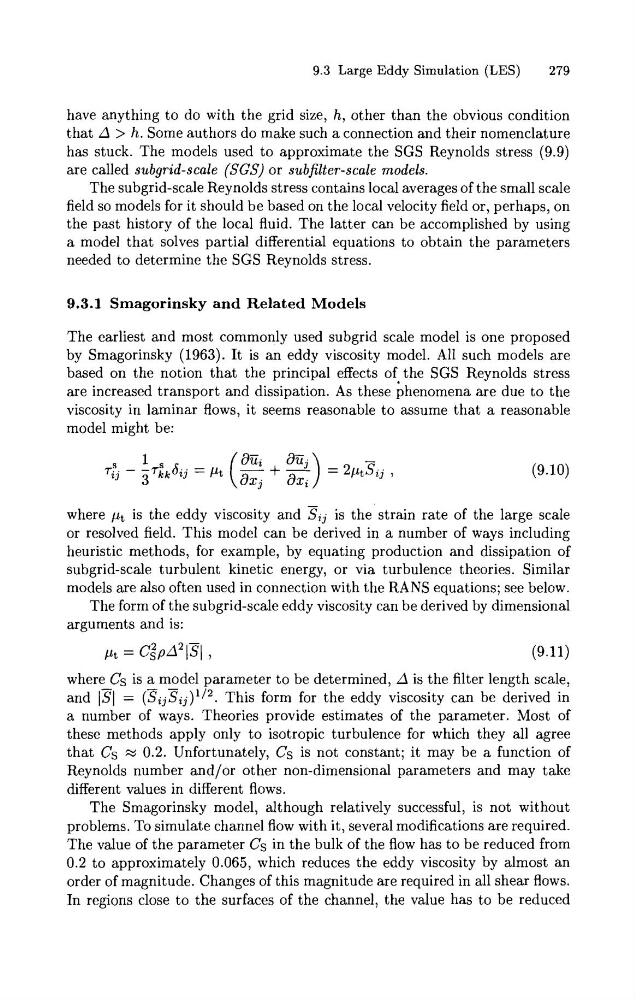
model might be:
where pt is the eddy viscosity and Stj is the strain rate of the large scale
or resolved field. This model can be derived in a number of ways including
heuristic methods, for example, by equating production and dissipation of
subgrid-scale turbulent kinetic energy, or via turbulence theories. Similar
models are also often used in connection with the RANS equations; see below.
The form of the subgrid-scale eddy viscosity can be derived by dimensional
arguments and is:
pt = c&A2131 ,
(9.11)
where Cs is a model parameter to be determined, A is the filter length scale,
- -
and 1 3 1 = ( S ~ ~ S ~ ~ ) ' / ~ .
This form for the eddy viscosity can be derived in
a number of ways. Theories provide estimates of the parameter. Most of
these methods apply only to isotropic turbulence for which they all agree
that Cs = 0.2. Unfortunately, Cs is not constant; it may be a function of
Reynolds number and/or other non-dimensional parameters and may take
different values in different flows.
The Smagorinsky model, although relatively successful, is not without
problems. To simulate channel flow with it, several modifications are required.
The value of the parameter Cs in the bulk of the flow has to be reduced from
0.2 to approximately 0.065, which reduces the eddy viscosity by almost an
order of magnitude. Changes of this magnitude are required in all shear flows.
In regions close to the surfaces of the channel, the value has to be reduced
279
have anything to do with the grid size, h, other than the obvious condition
that A > h. Some authors do make such a connection and their nomenclature
has stuck. The models used to approximate the SGS Reynolds stress (9.9)
are called subgrid-scale (SGS) or subfilter-scale models.
The subgrid-scale Reynolds stress contains local averages of the small scale
field so models for it should be based on the local velocity field or, perhaps, on
the past history of the local fluid. The latter can be accomplished by using
a model that solves partial differential equations to obtain the parameters
needed to determine the SGS Reynolds stress.
9.3.1 Smagorinsky and Related Models
The earliest and most commonly used subgrid scale model is one proposed
by Smagorinsky (1963). It is an eddy viscosity model. All such models are
based on the notion that the principal effects of the SGS Reynolds stress
are increased transport and dissipation. As these phenomena are due to the
viscosity in laminar flows, it seems reasonable to assume that a reasonable
model might be:
where pt is the eddy viscosity and Stj is the strain rate of the large scale
or resolved field. This model can be derived in a number of ways including
heuristic methods, for example, by equating production and dissipation of
subgrid-scale turbulent kinetic energy, or via turbulence theories. Similar
models are also often used in connection with the RANS equations; see below.
The form of the subgrid-scale eddy viscosity can be derived by dimensional
arguments and is:
pt = c&A2131 ,
(9.11)
where Cs is a model parameter to be determined, A is the filter length scale,
- -
and 1 3 1 = ( S ~ ~ S ~ ~ ) ' / ~ .
This form for the eddy viscosity can be derived in
a number of ways. Theories provide estimates of the parameter. Most of
these methods apply only to isotropic turbulence for which they all agree
that Cs = 0.2. Unfortunately, Cs is not constant; it may be a function of
Reynolds number and/or other non-dimensional parameters and may take
different values in different flows.
The Smagorinsky model, although relatively successful, is not without
problems. To simulate channel flow with it, several modifications are required.
The value of the parameter Cs in the bulk of the flow has to be reduced from
0.2 to approximately 0.065, which reduces the eddy viscosity by almost an
order of magnitude. Changes of this magnitude are required in all shear flows.
In regions close to the surfaces of the channel, the value has to be reduced