

278
9. Turbulent Flows
of the same flow. In general, because it is more accurate, DNS is the preferred method whenever it is feasible. LES is the preferred method for flows
in which the Reynolds number is too high or the geometry is too complex to
allow application of DNS.
It is essential t o define the quantities t o be computed precisely. We need
a velocity field that contains only the large scale components of the total
field. This is best produced by filtering the velocity field (Leonard, 1974); in
this approach, the large or resolved scale field, the one to be simulated, is
essentially a local average of the complete field. We shall use one-dimensional
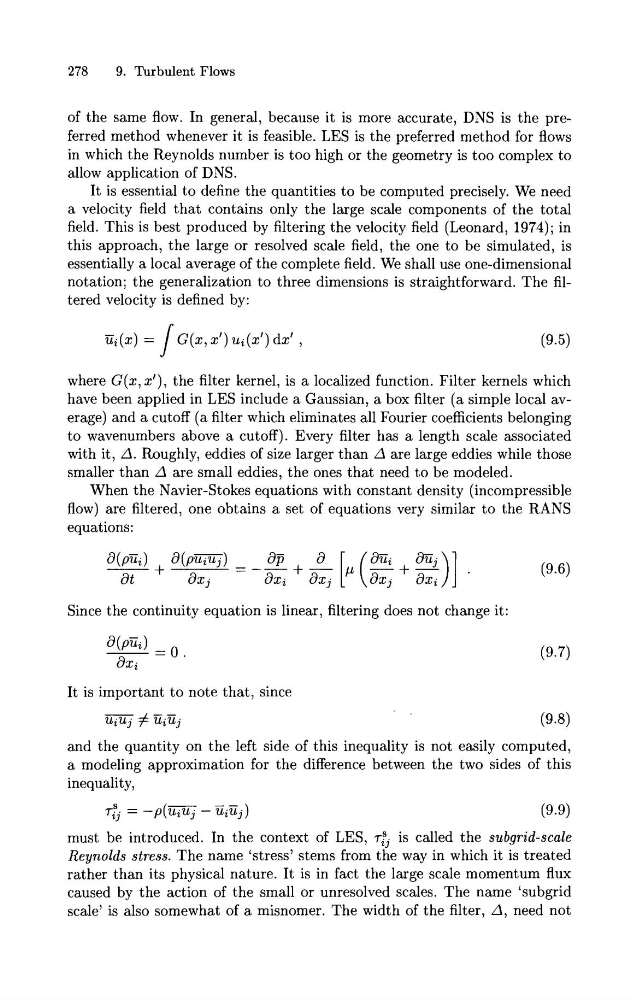
notation; the generalization to three dimensions is straightforward. The filtered velocity is defined by:
where G(x, x'), the filter kernel, is a localized function. Filter kernels which
have been applied in LES include a Gaussian, a box filter (a simple local average) and a cutoff (a filter which eliminates all Fourier coefficients belonging
to wavenumbers above a cutoff). Every filter has a length scale associated
with it, A. Roughly, eddies of size larger than A are large eddies while those
smaller than A are small eddies, the ones that need to be modeled.
When the Navier-Stokes equations with constant density (incompressible
flow) are filtered, one obtains a set of equations very similar to the RANS
equations:
Since the continuity equation is linear, filtering does not change it:
It is important t o note that, since
and the quantity on the left side of this inequality is not easily computed,
a modeling approximation for the difference between the two sides of this
inequality,
must be introduced. In the context of LES, r,sj is called the subgrid-scale
Reynolds stress. The name 'stress' stems from the way in which it is treated
rather than its physical nature. It is in fact the large scale momentum flux
caused by the action of the small or unresolved scales. The name 'subgrid
scale' is also somewhat of a misnomer. The width of the filter, A, need not
9. Turbulent Flows
of the same flow. In general, because it is more accurate, DNS is the preferred method whenever it is feasible. LES is the preferred method for flows
in which the Reynolds number is too high or the geometry is too complex to
allow application of DNS.
It is essential t o define the quantities t o be computed precisely. We need
a velocity field that contains only the large scale components of the total
field. This is best produced by filtering the velocity field (Leonard, 1974); in
this approach, the large or resolved scale field, the one to be simulated, is
essentially a local average of the complete field. We shall use one-dimensional
notation; the generalization to three dimensions is straightforward. The filtered velocity is defined by:
where G(x, x'), the filter kernel, is a localized function. Filter kernels which
have been applied in LES include a Gaussian, a box filter (a simple local average) and a cutoff (a filter which eliminates all Fourier coefficients belonging
to wavenumbers above a cutoff). Every filter has a length scale associated
with it, A. Roughly, eddies of size larger than A are large eddies while those
smaller than A are small eddies, the ones that need to be modeled.
When the Navier-Stokes equations with constant density (incompressible
flow) are filtered, one obtains a set of equations very similar to the RANS
equations:
Since the continuity equation is linear, filtering does not change it:
It is important t o note that, since
and the quantity on the left side of this inequality is not easily computed,
a modeling approximation for the difference between the two sides of this
inequality,
must be introduced. In the context of LES, r,sj is called the subgrid-scale
Reynolds stress. The name 'stress' stems from the way in which it is treated
rather than its physical nature. It is in fact the large scale momentum flux
caused by the action of the small or unresolved scales. The name 'subgrid
scale' is also somewhat of a misnomer. The width of the filter, A, need not