

262
8. Complex Geometries
oscillates between CIymin = -1.021 and G,,,, = 0.987. The drag coefficient
oscillates between Cd,min = 3.165 and Cd,,,, = 3.228. The convergence of
the drag coefficient as the grid is refined is shown in Fig. 8.18. The time step
was the same for all grids; there are 663 time steps per oscillation period
of the lift force. Calculations with larger time steps (twice and four times
larger) showed very little dependence of the result on the time step size for
any given grid; the spatial discretization errors are much larger than the
temporal discretization errors.
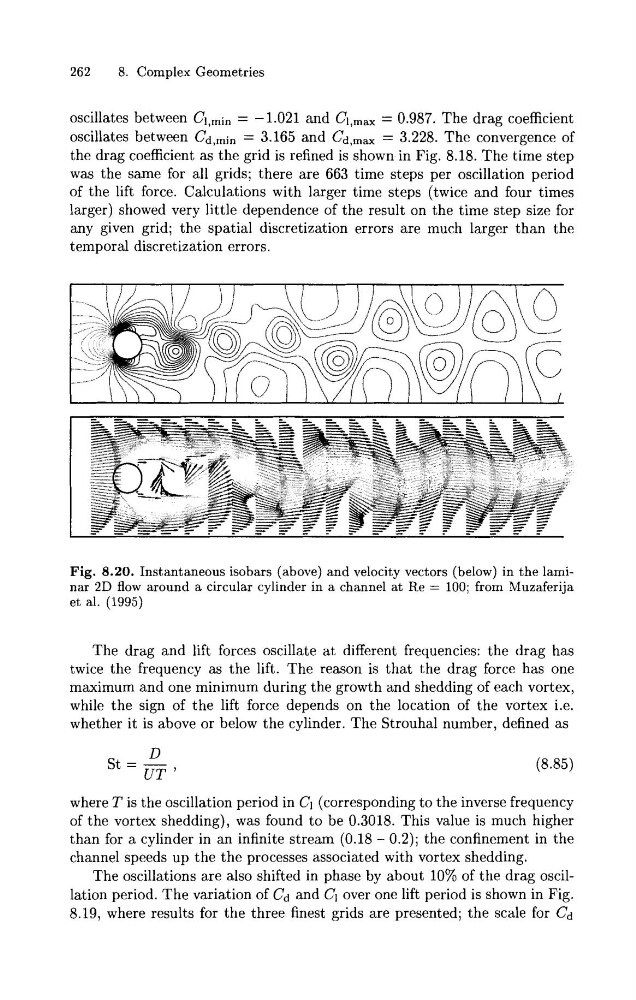
Fig. 8.20. Instantaneous isobars (above) and velocity vectors (below) in the laminar 2D flow around a circular cylinder in a channel at Re = 100; from Muzaferija
et al. (1995)
The drag and lift forces oscillate a t different frequencies: the drag has
twice the frequency as the lift. The reason is that the drag force has one
maximum and one minimum during the growth and shedding of each vortex,
while the sign of the lift force depends on the location of the vortex i.e.
whether it is above or below the cylinder. The Strouhal number, defined as
where T is the oscillation period in CI (corresponding to the inverse frequency
of the vortex shedding), was found to be 0.3018. This value is much higher
than for a cylinder in an infinite stream (0.18 - 0.2); the confinement in the
channel speeds up the the processes associated with vortex shedding.
The oscillations are also shifted in phase by about 10% of the drag oscillation period. The variation of Cd and 4 over one lift period is shown in Fig.
8.19, where results for the three finest grids are presented; the scale for Cd
8. Complex Geometries
oscillates between CIymin = -1.021 and G,,,, = 0.987. The drag coefficient
oscillates between Cd,min = 3.165 and Cd,,,, = 3.228. The convergence of
the drag coefficient as the grid is refined is shown in Fig. 8.18. The time step
was the same for all grids; there are 663 time steps per oscillation period
of the lift force. Calculations with larger time steps (twice and four times
larger) showed very little dependence of the result on the time step size for
any given grid; the spatial discretization errors are much larger than the
temporal discretization errors.
Fig. 8.20. Instantaneous isobars (above) and velocity vectors (below) in the laminar 2D flow around a circular cylinder in a channel at Re = 100; from Muzaferija
et al. (1995)
The drag and lift forces oscillate a t different frequencies: the drag has
twice the frequency as the lift. The reason is that the drag force has one
maximum and one minimum during the growth and shedding of each vortex,
while the sign of the lift force depends on the location of the vortex i.e.
whether it is above or below the cylinder. The Strouhal number, defined as
where T is the oscillation period in CI (corresponding to the inverse frequency
of the vortex shedding), was found to be 0.3018. This value is much higher
than for a cylinder in an infinite stream (0.18 - 0.2); the confinement in the
channel speeds up the the processes associated with vortex shedding.
The oscillations are also shifted in phase by about 10% of the drag oscillation period. The variation of Cd and 4 over one lift period is shown in Fig.
8.19, where results for the three finest grids are presented; the scale for Cd