

250
8. Complex Geometries
If the same approximation is applied at the other CV faces, and it is required
that the corrected mass fluxes satisfy the continuity equation:
we obtain the pressure-correction equation.
The last term on the right hand side of Eq. (8.59) leads to an extended
computational molecule in the pressure-correction equation. Since this term
is small when the non-orthogonality is not severe, it is common practice to
neglect it. When the solution converges, the pressure correction becomes zero
so the omission of this term does not affect the solution; however, it does affect
the convergence rate. For substantially non-orthogonal grids, one has to use
a smaller under-relaxation parameter a,, see Eq. (7.45).
When the above approximation is used, the pressure-correction equation
has the usual form; moreover, its coefficient matrix is symmetric so special
solvers for symmetric matrices can be used (e.g. the ICCG solver from the
conjugate gradients family, see Chap. 5 and directory s o l v e r s on publisher's
server).
The grid non-orthogonality can be taken into account in the pressurecorrection equation iteratively, i.e. by using the deferred-correction approach.
One solves first the equation for p' in which the non-orthogonality terms in
Eq. (8.59) are neglected. In the second step one corrects the error made in
the first step by adding another correction:
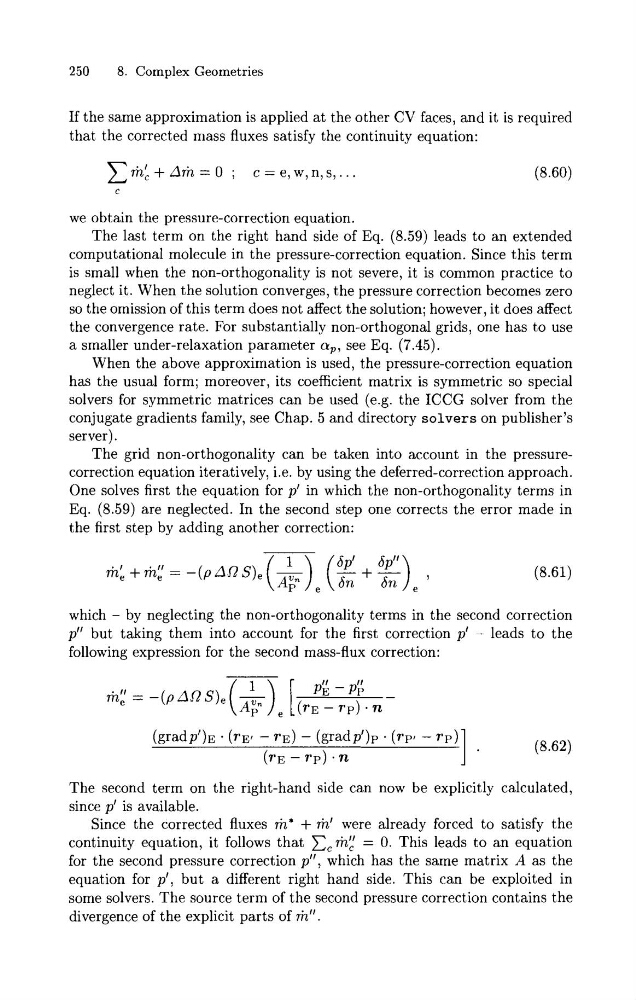
which - by neglecting the non-orthogonality terms in the second correction
p" but taking them into account for the first correction p' - leads to the
following expression for the second mass-flux correction:
The second term on the right-hand side can now be explicitly calculated,
since p' is available.
Since the corrected fluxes m* + m' were already forced to satisfy the
continuity equation, it follows that C , my = 0. This leads to an equation
for the second pressure correction p", which has the same matrix A as the
equation for p', but a different right hand side. This can be exploited in
some solvers. The source term of the second pressure correction contains the
divergence of the explicit parts of m".
8. Complex Geometries
If the same approximation is applied at the other CV faces, and it is required
that the corrected mass fluxes satisfy the continuity equation:
we obtain the pressure-correction equation.
The last term on the right hand side of Eq. (8.59) leads to an extended
computational molecule in the pressure-correction equation. Since this term
is small when the non-orthogonality is not severe, it is common practice to
neglect it. When the solution converges, the pressure correction becomes zero
so the omission of this term does not affect the solution; however, it does affect
the convergence rate. For substantially non-orthogonal grids, one has to use
a smaller under-relaxation parameter a,, see Eq. (7.45).
When the above approximation is used, the pressure-correction equation
has the usual form; moreover, its coefficient matrix is symmetric so special
solvers for symmetric matrices can be used (e.g. the ICCG solver from the
conjugate gradients family, see Chap. 5 and directory s o l v e r s on publisher's
server).
The grid non-orthogonality can be taken into account in the pressurecorrection equation iteratively, i.e. by using the deferred-correction approach.
One solves first the equation for p' in which the non-orthogonality terms in
Eq. (8.59) are neglected. In the second step one corrects the error made in
the first step by adding another correction:
which - by neglecting the non-orthogonality terms in the second correction
p" but taking them into account for the first correction p' - leads to the
following expression for the second mass-flux correction:
The second term on the right-hand side can now be explicitly calculated,
since p' is available.
Since the corrected fluxes m* + m' were already forced to satisfy the
continuity equation, it follows that C , my = 0. This leads to an equation
for the second pressure correction p", which has the same matrix A as the
equation for p', but a different right hand side. This can be exploited in
some solvers. The source term of the second pressure correction contains the
divergence of the explicit parts of m".