

230
8. Complex Geometries
One can also allow different shape functions to be used, depending on the
local grid topology. This would lead to a different number of neighbors in
computational molecules, but a solver that can deal with this complexity can
easily be devised (e.g. conjugate-gradient type solvers).
One can devise a finite difference method that does not need a grid a t all;
a set of discrete points adequately distributed over the solution domain is all
that is needed. One would then locate a certain number of near neighbors of
each point to which one could fit a suitable shape function; the shape function
could then be differentiated t o obtain approximations of the derivatives at
that point. Such a method cannot be fully conservative, but this is not a
problem if the points are sufficiently densely spaced.
It appears easier to distribute points in space than to create suitable
control volumes or elements of good quality. For example, one could first place
points on the surface, then add points a short distance away in the direction
normal to the surface. A second set of points could be regularly distributed
in the solution domain, with higher density near boundaries. Then the two
sets of points can be checked for overlap, and, where points are too close to
each other, they can be deleted or moved. Local refinement is very easy, one
needs merely insert more points between the existing ones.
The only tricky thing would be the derivation of a suitable pressure or
pressure-correction equation; however, this could be achieved following the
methods presented in the following sections. We hope to see methods of this
kind in future editions of this work.
The principles described above apply to all equations. The special features
of deriving the pressure or pressure-correction equation or implementing the
boundary conditions in FD methods on non-orthogonal grids will not be dealt
with here in detail, as the extension of techniques given so far is straightforward.
8.6 Finite Volume Methods
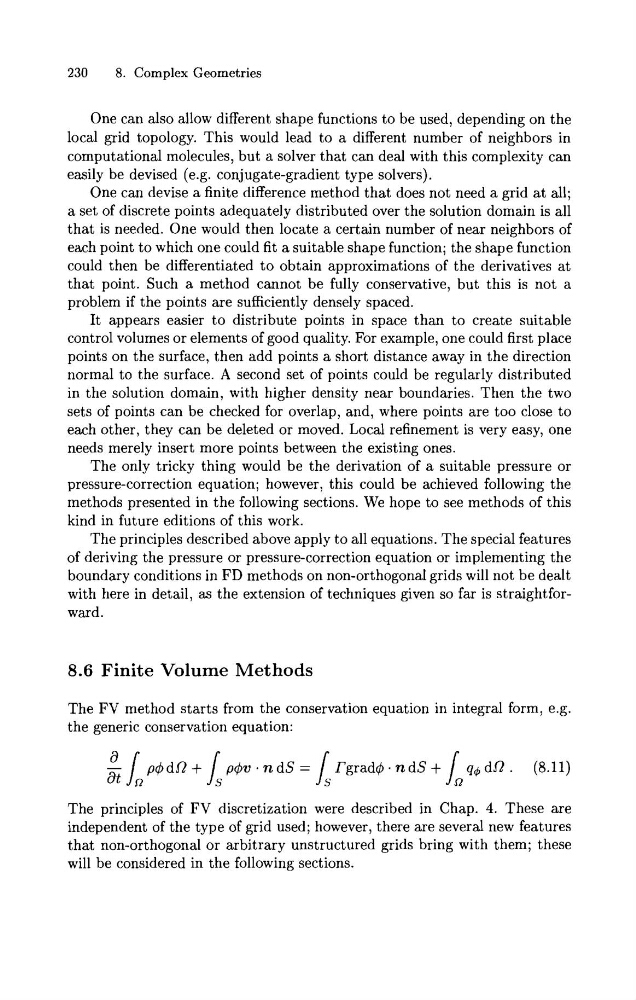
The FV method starts from the conservation equation in integral form, e.g.
the generic conservation equation:
The principles of FV discretization were described in Chap. 4. These are
independent of the type of grid used; however, there are several new features
that non-orthogonal or arbitrary unstructured grids bring with them; these
will be considered in the following sections.
8. Complex Geometries
One can also allow different shape functions to be used, depending on the
local grid topology. This would lead to a different number of neighbors in
computational molecules, but a solver that can deal with this complexity can
easily be devised (e.g. conjugate-gradient type solvers).
One can devise a finite difference method that does not need a grid a t all;
a set of discrete points adequately distributed over the solution domain is all
that is needed. One would then locate a certain number of near neighbors of
each point to which one could fit a suitable shape function; the shape function
could then be differentiated t o obtain approximations of the derivatives at
that point. Such a method cannot be fully conservative, but this is not a
problem if the points are sufficiently densely spaced.
It appears easier to distribute points in space than to create suitable
control volumes or elements of good quality. For example, one could first place
points on the surface, then add points a short distance away in the direction
normal to the surface. A second set of points could be regularly distributed
in the solution domain, with higher density near boundaries. Then the two
sets of points can be checked for overlap, and, where points are too close to
each other, they can be deleted or moved. Local refinement is very easy, one
needs merely insert more points between the existing ones.
The only tricky thing would be the derivation of a suitable pressure or
pressure-correction equation; however, this could be achieved following the
methods presented in the following sections. We hope to see methods of this
kind in future editions of this work.
The principles described above apply to all equations. The special features
of deriving the pressure or pressure-correction equation or implementing the
boundary conditions in FD methods on non-orthogonal grids will not be dealt
with here in detail, as the extension of techniques given so far is straightforward.
8.6 Finite Volume Methods
The FV method starts from the conservation equation in integral form, e.g.
the generic conservation equation:
The principles of FV discretization were described in Chap. 4. These are
independent of the type of grid used; however, there are several new features
that non-orthogonal or arbitrary unstructured grids bring with them; these
will be considered in the following sections.