

7.5 Solution Methods for the Navier-Stokes Equations
193
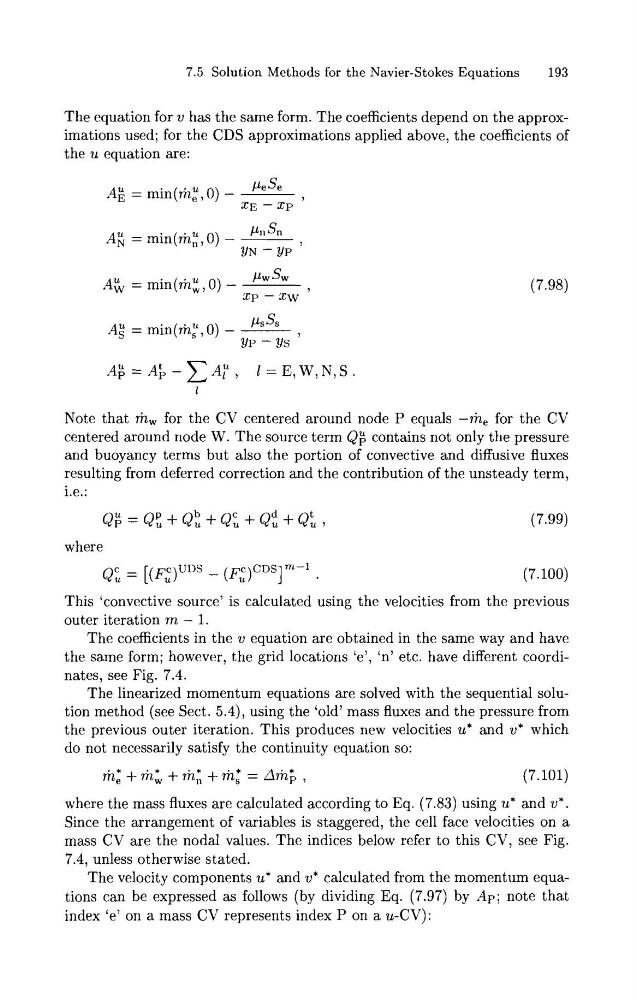
The equation for v has the same form. The coefficients depend on the approximations used; for the CDS approximations applied above, the coefficients of
the u equation are:
Note that mw for the CV centered around node P equals -me for the CV
centered around node W. The source term Qg contains not only the pressure
and buoyancy terms but also the portion of convective and diffusive fluxes
resulting from deferred correction and the contribution of the unsteady term,
1.e.:
where
c UDS -
Q: = [(m (F:)'~'] m-l .
This 'convective source' is calculated using the velocities from the previous
outer iteration m - 1.
The coefficients in the v equation are obtained in the same way and have
the same form; however, the grid locations 'e', 'n' etc. have different coordinates, see Fig. 7.4.
The linearized momentum equations are solved with the sequential solution method (see Sect. 5.4), using the 'old' mass fluxes and the pressure from
the previous outer iteration. This produces new velocities u* and v* which
do not necessarily satisfy the continuity equation so:
where the mass fluxes are calculated according to Eq. (7.83) using u* and v*.
Since the arrangement of variables is staggered, the cell face velocities on a
mass CV are the nodal values. The indices below refer to this CV, see Fig.
7.4, unless otherwise stated.
The velocity components u* and v* calculated from the momentum equations can be expressed as follows (by dividing Eq. (7.97) by Ap; note that
index 'e' on a mass CV represents index P on a u-CV):
193
The equation for v has the same form. The coefficients depend on the approximations used; for the CDS approximations applied above, the coefficients of
the u equation are:
Note that mw for the CV centered around node P equals -me for the CV
centered around node W. The source term Qg contains not only the pressure
and buoyancy terms but also the portion of convective and diffusive fluxes
resulting from deferred correction and the contribution of the unsteady term,
1.e.:
where
c UDS -
Q: = [(m (F:)'~'] m-l .
This 'convective source' is calculated using the velocities from the previous
outer iteration m - 1.
The coefficients in the v equation are obtained in the same way and have
the same form; however, the grid locations 'e', 'n' etc. have different coordinates, see Fig. 7.4.
The linearized momentum equations are solved with the sequential solution method (see Sect. 5.4), using the 'old' mass fluxes and the pressure from
the previous outer iteration. This produces new velocities u* and v* which
do not necessarily satisfy the continuity equation so:
where the mass fluxes are calculated according to Eq. (7.83) using u* and v*.
Since the arrangement of variables is staggered, the cell face velocities on a
mass CV are the nodal values. The indices below refer to this CV, see Fig.
7.4, unless otherwise stated.
The velocity components u* and v* calculated from the momentum equations can be expressed as follows (by dividing Eq. (7.97) by Ap; note that
index 'e' on a mass CV represents index P on a u-CV):