

192
7. Solution of the Navier-Stokes Equations
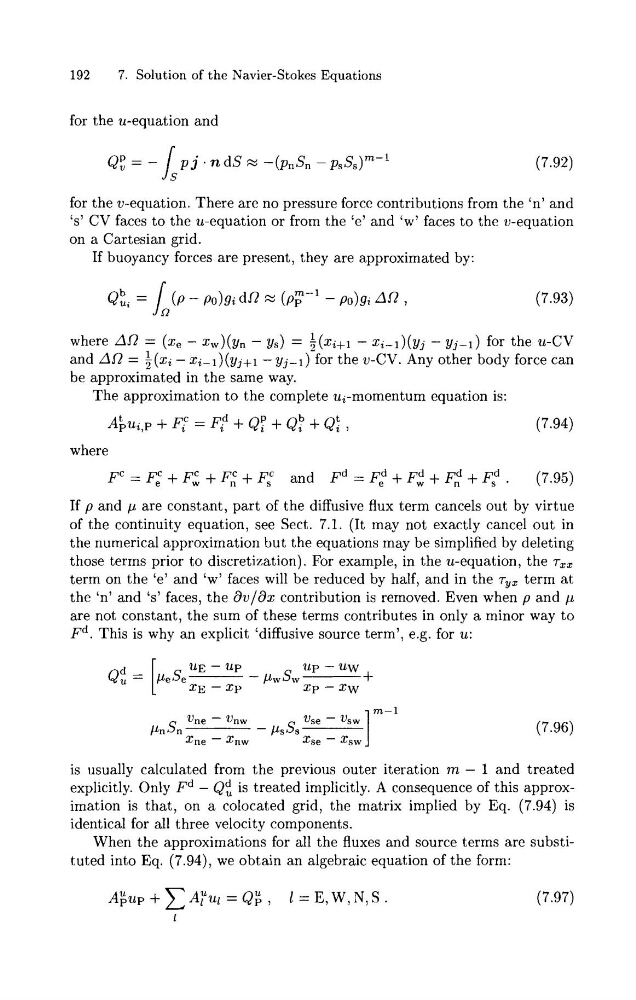
for the u-equation and
for the v-equation. There are no pressure force contributions from the 'n' and
's' CV faces to the u-equation or from the 'el and 'w' faces to the v-equation
on a Cartesian grid.
If buoyancy forces are present, they are approximated by:
where AR = (xe - xw)(yn - y,) = i(xi+l - ~ ~ - ~ ) ( y j
- yj-l) for the u-CV
and AR = :(xi - xi-l)(yj+l - yj-1) for the V-CV. Any other body force can
be approximated in the same way.
The approximation to the complete ui-momentum equation is:
A k ~ i , p + F; = F f + Qy + QP + Q: ,
(7.94)
where
FC=F,C+F:+F,C+F,C and F d = F , d + F $ + F , d + F , d .
(7.95)
If p and p are constant, part of the diffusive flux term cancels out by virtue
of the continuity equation, see Sect. 7.1. (It may not exactly cancel out in
the numerical approximation but the equations may be simplified by deleting
those terms prior to discretization). For example, in the u-equation, the T,,
term on the 'e' and 'w' faces will be reduced by half, and in the T,, term at
the 'n' and 's' faces, the dvldx contribution is removed. Even when p and , LL
are not constant, the sum of these terms contributes in only a minor way to
F d . This is why an explicit 'diffusive source term', e.g. for u:
is usually calculated from the previous outer iteration m - 1 and treated
explicitly. Only Fd - Qd, is treated implicitly. A consequence of this approximation is that, on a colocated grid, the matrix implied by Eq. (7.94) is
identical for all three velocity components.
When the approximations for all the fluxes and source terms are substituted into Eq. (7.94), we obtain an algebraic equation of the form:
7. Solution of the Navier-Stokes Equations
for the u-equation and
for the v-equation. There are no pressure force contributions from the 'n' and
's' CV faces to the u-equation or from the 'el and 'w' faces to the v-equation
on a Cartesian grid.
If buoyancy forces are present, they are approximated by:
where AR = (xe - xw)(yn - y,) = i(xi+l - ~ ~ - ~ ) ( y j
- yj-l) for the u-CV
and AR = :(xi - xi-l)(yj+l - yj-1) for the V-CV. Any other body force can
be approximated in the same way.
The approximation to the complete ui-momentum equation is:
A k ~ i , p + F; = F f + Qy + QP + Q: ,
(7.94)
where
FC=F,C+F:+F,C+F,C and F d = F , d + F $ + F , d + F , d .
(7.95)
If p and p are constant, part of the diffusive flux term cancels out by virtue
of the continuity equation, see Sect. 7.1. (It may not exactly cancel out in
the numerical approximation but the equations may be simplified by deleting
those terms prior to discretization). For example, in the u-equation, the T,,
term on the 'e' and 'w' faces will be reduced by half, and in the T,, term at
the 'n' and 's' faces, the dvldx contribution is removed. Even when p and , LL
are not constant, the sum of these terms contributes in only a minor way to
F d . This is why an explicit 'diffusive source term', e.g. for u:
is usually calculated from the previous outer iteration m - 1 and treated
explicitly. Only Fd - Qd, is treated implicitly. A consequence of this approximation is that, on a colocated grid, the matrix implied by Eq. (7.94) is
identical for all three velocity components.
When the approximations for all the fluxes and source terms are substituted into Eq. (7.94), we obtain an algebraic equation of the form: