

184
7. Solution of the Navier-Stokes Equations
a great deal of attention to be focused on development of methods for the
numerical solution of the compressible flow equations. Many such methods
have been developed. An obvious question is whether they can be adapted
to the solution of the incompressible flows. Clearly, we cannot cover the full
range of methods for compressible flow in this work; instead we shall focus on
how these methods may be adapted to incompressible flow and a description
of a few of the key properties of artificial compressibility methods.
The major difference between the equations of compressible flow and those
of incompressible flow is their mathematical character. The compressible flow
equations are hyperbolic which means that they have real characteristics
on which signals travel a t finite propagation speeds; this reflects the ability
of compressible fluids to support sound waves. By contrast, we have seen
that the incompressible equations have a mixed parabolic-elliptic character.
If methods for compressible flow are to be used to compute incompressible
flow, the character of the equations will need to be modified.
The difference in character can be traced to the lack of a time derivative
term in the incompressible continuity equation. The compressible version contains the time derivative of the density. So, the most straight-forward means
of giving the incompressible equations hyperbolic character is to append a
time derivative to the continuity equation. Since density is constant, adding
apldt, i.e. using the compressible equation, is not possible. Time derivatives
of velocity components appear in the momentum equations so they are not
logical choices. That leaves the time derivative of the pressure as the clear
choice.
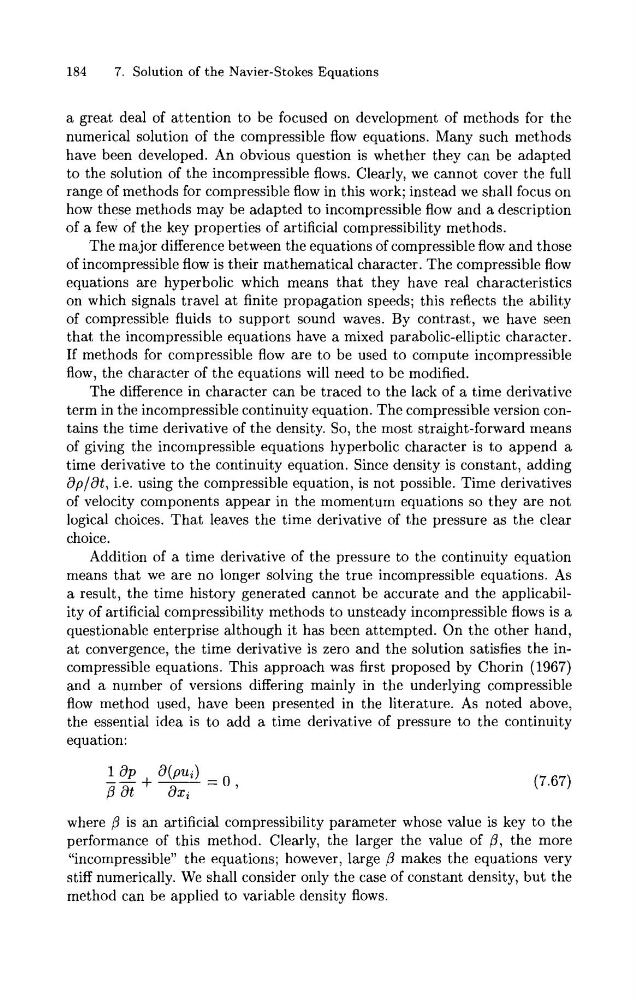
Addition of a time derivative of the pressure to the continuity equation
means that we are no longer solving the true incompressible equations. As
a result, the time history generated cannot be accurate and the applicability of artificial compressibility methods to unsteady incompressible flows is a
questionable enterprise although it has been attempted. On the other hand,
at convergence, the time derivative is zero and the solution satisfies the incompressible equations. This approach was first proposed by Chorin (1967)
and a number of versions differing mainly in the underlying compressible
presented in the literature. As noted above,
flow method used, have been
the essential idea is to add a
equation:
time derivative of pressure to the continuity
(7.67)
where 9 is an artificial compressibility parameter whose value is key to the
performance of this method. Clearly, the larger the value of p, the more
"incompressible" the equations; however, large /3 makes the equations very
stiff numerically. We shall consider only the case of constant density, but the
method can be applied to variable density flows.
7. Solution of the Navier-Stokes Equations
a great deal of attention to be focused on development of methods for the
numerical solution of the compressible flow equations. Many such methods
have been developed. An obvious question is whether they can be adapted
to the solution of the incompressible flows. Clearly, we cannot cover the full
range of methods for compressible flow in this work; instead we shall focus on
how these methods may be adapted to incompressible flow and a description
of a few of the key properties of artificial compressibility methods.
The major difference between the equations of compressible flow and those
of incompressible flow is their mathematical character. The compressible flow
equations are hyperbolic which means that they have real characteristics
on which signals travel a t finite propagation speeds; this reflects the ability
of compressible fluids to support sound waves. By contrast, we have seen
that the incompressible equations have a mixed parabolic-elliptic character.
If methods for compressible flow are to be used to compute incompressible
flow, the character of the equations will need to be modified.
The difference in character can be traced to the lack of a time derivative
term in the incompressible continuity equation. The compressible version contains the time derivative of the density. So, the most straight-forward means
of giving the incompressible equations hyperbolic character is to append a
time derivative to the continuity equation. Since density is constant, adding
apldt, i.e. using the compressible equation, is not possible. Time derivatives
of velocity components appear in the momentum equations so they are not
logical choices. That leaves the time derivative of the pressure as the clear
choice.
Addition of a time derivative of the pressure to the continuity equation
means that we are no longer solving the true incompressible equations. As
a result, the time history generated cannot be accurate and the applicability of artificial compressibility methods to unsteady incompressible flows is a
questionable enterprise although it has been attempted. On the other hand,
at convergence, the time derivative is zero and the solution satisfies the incompressible equations. This approach was first proposed by Chorin (1967)
and a number of versions differing mainly in the underlying compressible
presented in the literature. As noted above,
flow method used, have been
the essential idea is to add a
equation:
time derivative of pressure to the continuity
(7.67)
where 9 is an artificial compressibility parameter whose value is key to the
performance of this method. Clearly, the larger the value of p, the more
"incompressible" the equations; however, large /3 makes the equations very
stiff numerically. We shall consider only the case of constant density, but the
method can be applied to variable density flows.