

7.4 Other Methods
183
velocities are known. A more difficult problem is that neither vorticity nor
its derivatives at the boundary are usually known in advance. For example,
vorticity at a wall is equal to wwall = - ~ ~ ~ ~ ~ / p ,
where T,,I~ is the wall shear
stress, which is usually the quantity we seek to determine. Boundary values
of the vorticity may be calculated from the streamfunction by differentiation
using one-sided finite differences in the direction normal t o the boundary,
see Eq. (7.65). This approach usually slows down the convergence rate. The
vorticity is singular at sharp corners of the boundary and special care is
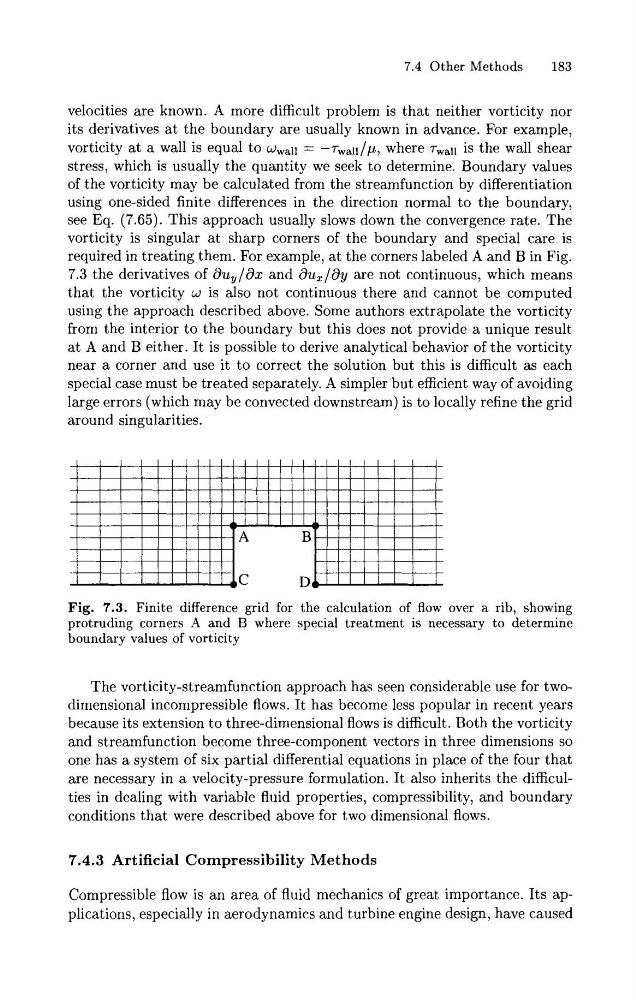
required in treating them. For example, at the corners labeled A and B in Fig.
7.3 the derivatives of au,/ax and au,/ay are not continuous, which means
that the vorticity w is also not continuous there and cannot be computed
using the approach described above. Some authors extrapolate the vorticity
from the interior to the boundary but this does not provide a unique result
at A and B either. It is possible to derive analytical behavior of the vorticity
near a corner and use it t o correct the solution but this is difficult as each
special case must be treated separately. A simpler but efficient way of avoiding
large errors (which may be convected downstream) is to locally refine the grid
around singularities.
Fig. 7.3. Finite difference grid for the calculation of flow over a rib, showing
protruding corners A and B where special treatment is necessary to determine
boundary values of vorticity
The vorticity-streamfunction approach has seen considerable use for twodimensional incompressible flows. It has become less popular in recent years
because its extension to three-dimensional flows is difficult. Both the vorticity
and streamfunction become three-component vectors in three dimensions so
one has a system of six partial differential equations in place of the four that
are necessary in a velocity-pressure formulation. It also inherits the difficulties in dealing with variable fluid properties, compressibility, and boundary
conditions that were described above for two dimensional flows.
7.4.3 Artificial Compressibility Methods
Compressible flow is an area of fluid mechanics of great importance. Its applications, especially in aerodynamics and turbine engine design, have caused
183
velocities are known. A more difficult problem is that neither vorticity nor
its derivatives at the boundary are usually known in advance. For example,
vorticity at a wall is equal to wwall = - ~ ~ ~ ~ ~ / p ,
where T,,I~ is the wall shear
stress, which is usually the quantity we seek to determine. Boundary values
of the vorticity may be calculated from the streamfunction by differentiation
using one-sided finite differences in the direction normal t o the boundary,
see Eq. (7.65). This approach usually slows down the convergence rate. The
vorticity is singular at sharp corners of the boundary and special care is
required in treating them. For example, at the corners labeled A and B in Fig.
7.3 the derivatives of au,/ax and au,/ay are not continuous, which means
that the vorticity w is also not continuous there and cannot be computed
using the approach described above. Some authors extrapolate the vorticity
from the interior to the boundary but this does not provide a unique result
at A and B either. It is possible to derive analytical behavior of the vorticity
near a corner and use it t o correct the solution but this is difficult as each
special case must be treated separately. A simpler but efficient way of avoiding
large errors (which may be convected downstream) is to locally refine the grid
around singularities.
Fig. 7.3. Finite difference grid for the calculation of flow over a rib, showing
protruding corners A and B where special treatment is necessary to determine
boundary values of vorticity
The vorticity-streamfunction approach has seen considerable use for twodimensional incompressible flows. It has become less popular in recent years
because its extension to three-dimensional flows is difficult. Both the vorticity
and streamfunction become three-component vectors in three dimensions so
one has a system of six partial differential equations in place of the four that
are necessary in a velocity-pressure formulation. It also inherits the difficulties in dealing with variable fluid properties, compressibility, and boundary
conditions that were described above for two dimensional flows.
7.4.3 Artificial Compressibility Methods
Compressible flow is an area of fluid mechanics of great importance. Its applications, especially in aerodynamics and turbine engine design, have caused