

180
7. Solution of the Navier-Stokes Equations
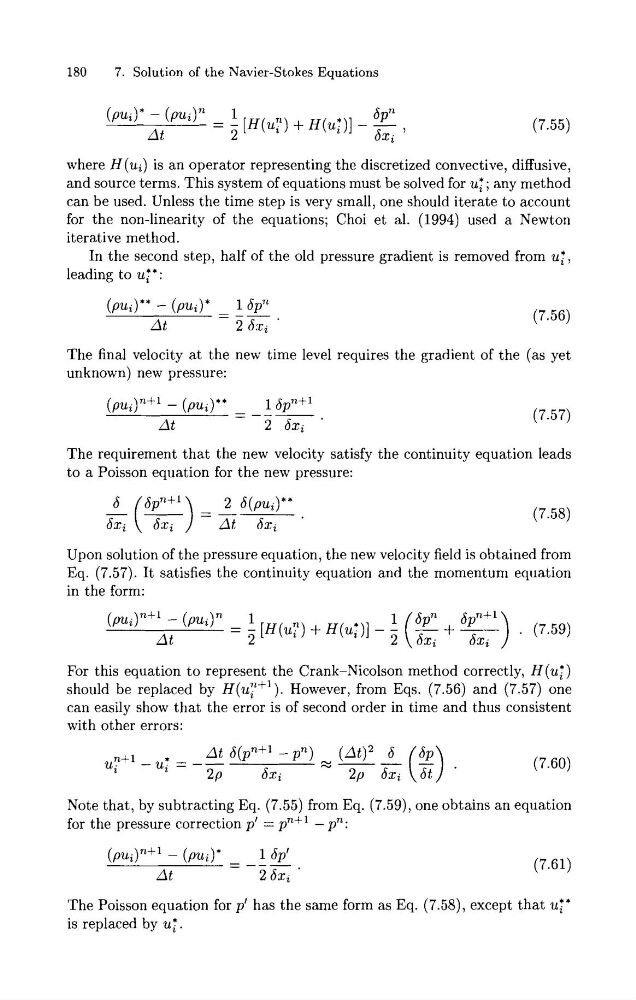
where H(ui) is an operator representing the discretized convective, diffusive,
and source terms. This system of equations must be solved for u f ; any method
can be used. Unless the time step is very small, one should iterate to account
for the non-linearity of the equations; Choi et al. (1994) used a Newton
iterative method.
In the second step, half of the old pressure gradient is removed from u f ,
leading to uf * :
The final velocity at the new time level requires the gradient of the (as yet
unknown) new pressure:
The requirement that the new velocity satisfy the continuity equation leads
to a Poisson equation for the new pressure:
Upon solution of the pressure equation, the new velocity field is obtained from
Eq. (7.57). It satisfies the continuity equation and the momentum equation
in the form:
For this equation t o represent the Crank-Nicolson method correctly, H(u,t)
should be replaced by H(U;+'). However, from Eqs. (7.56) and (7.57) one
can easily show that the error is of second order in time and thus consistent
with other errors:
Note that, by subtracting Eq. (7.55) from Eq. (7.59), one obtains an equation
for the pressure correction p' = pn+' - pn:
The Poisson equation for p' has the same form as Eq. (7.58), except that u:*
is replaced by uf .
7. Solution of the Navier-Stokes Equations
where H(ui) is an operator representing the discretized convective, diffusive,
and source terms. This system of equations must be solved for u f ; any method
can be used. Unless the time step is very small, one should iterate to account
for the non-linearity of the equations; Choi et al. (1994) used a Newton
iterative method.
In the second step, half of the old pressure gradient is removed from u f ,
leading to uf * :
The final velocity at the new time level requires the gradient of the (as yet
unknown) new pressure:
The requirement that the new velocity satisfy the continuity equation leads
to a Poisson equation for the new pressure:
Upon solution of the pressure equation, the new velocity field is obtained from
Eq. (7.57). It satisfies the continuity equation and the momentum equation
in the form:
For this equation t o represent the Crank-Nicolson method correctly, H(u,t)
should be replaced by H(U;+'). However, from Eqs. (7.56) and (7.57) one
can easily show that the error is of second order in time and thus consistent
with other errors:
Note that, by subtracting Eq. (7.55) from Eq. (7.59), one obtains an equation
for the pressure correction p' = pn+' - pn:
The Poisson equation for p' has the same form as Eq. (7.58), except that u:*
is replaced by uf .