

6.3 Application to the Generic Transport Equation
149
It also requires much more storage than the explicit scheme, since the entire
coefficient matrix A and the source vector have to be stored. The advantage is
the possibility of using a large time step, which may result in a more efficient
procedure despite the shortcomings.
This method is especially useful for solving steady flow problems. As
noted in the previous chapter, the solution of coupled non-linear equations
may require use of under-relaxation and nested (inner and outer) iterations,
see Sect. 5.4.2. There is a strong similarity between the algebraic equations
resulting from the use of under-relaxation when solving steady problems and
those resulting from implicit Euler scheme applied to unsteady equations.
Both under-relaxation and implicit time discretization result in an additional
source term and a contribution to the central coefficient Ap. The following
relation between the under-relaxation factor cub and time step At can be
derived by requiring that the contributions be same in both cases (see Eqs.
(5.70) and (6.46)):
In the iteration at the new time step, the best initial guess is the converged
solution at the preceding step. If the final steady state is the only result of
interest and the details of the development from the initial guess to the final
stage are not of importance, it might suffice to perform only one iteration
per time step. Then one does not have to store the old solution - it is needed
only to assemble the matrix and source terms. The major difference between
using pseudo-time marching and under-relaxation is that using the same time
step for all CVs is equivalent to using a variable under-relaxation factor;
conversely, use of a constant under-relaxation factor is equivalent to applying
a different time step to each control volume.
It is important to note that, if only one iteration is performed at each
time step, the scheme may not retain all of the stability of the implicit Euler
method. There may then be a limitation on the time step that can be employed (when under-relaxation is used in outer iterations, the choice of the
parameter a@ is also limited and certainly has to be smaller than unity).
Crank-Nicolson Method. The second order accuracy of the trapezoid rule
method and its relative simplicity suggest its application to partial differential
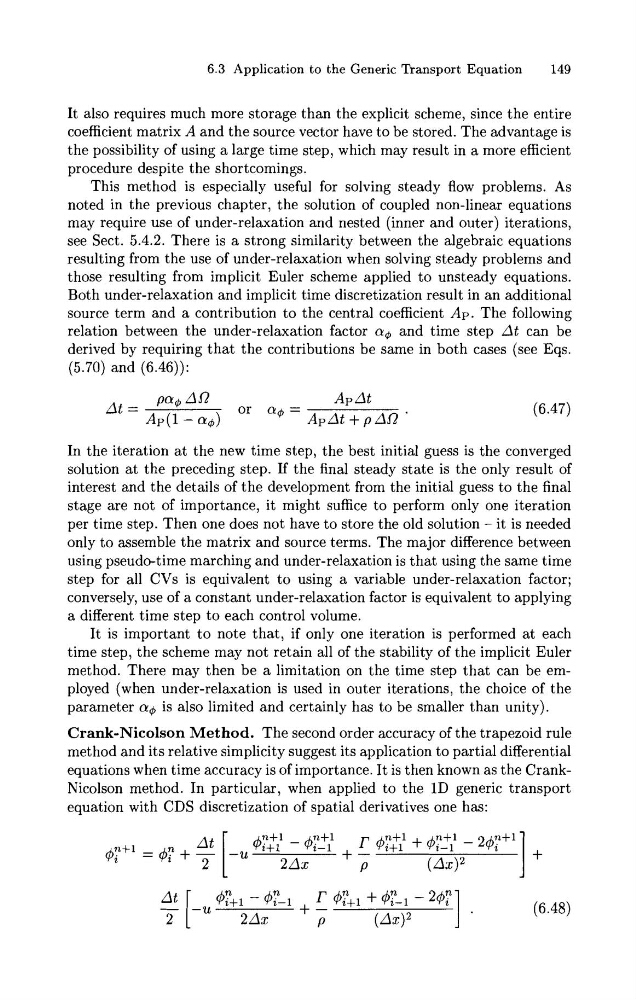
equations when time accuracy is of importance. It is then known as the CrankNicolson method. In particular, when applied to the 1D generic transport
equation with CDS discretization of spatial derivatives one has:
149
It also requires much more storage than the explicit scheme, since the entire
coefficient matrix A and the source vector have to be stored. The advantage is
the possibility of using a large time step, which may result in a more efficient
procedure despite the shortcomings.
This method is especially useful for solving steady flow problems. As
noted in the previous chapter, the solution of coupled non-linear equations
may require use of under-relaxation and nested (inner and outer) iterations,
see Sect. 5.4.2. There is a strong similarity between the algebraic equations
resulting from the use of under-relaxation when solving steady problems and
those resulting from implicit Euler scheme applied to unsteady equations.
Both under-relaxation and implicit time discretization result in an additional
source term and a contribution to the central coefficient Ap. The following
relation between the under-relaxation factor cub and time step At can be
derived by requiring that the contributions be same in both cases (see Eqs.
(5.70) and (6.46)):
In the iteration at the new time step, the best initial guess is the converged
solution at the preceding step. If the final steady state is the only result of
interest and the details of the development from the initial guess to the final
stage are not of importance, it might suffice to perform only one iteration
per time step. Then one does not have to store the old solution - it is needed
only to assemble the matrix and source terms. The major difference between
using pseudo-time marching and under-relaxation is that using the same time
step for all CVs is equivalent to using a variable under-relaxation factor;
conversely, use of a constant under-relaxation factor is equivalent to applying
a different time step to each control volume.
It is important to note that, if only one iteration is performed at each
time step, the scheme may not retain all of the stability of the implicit Euler
method. There may then be a limitation on the time step that can be employed (when under-relaxation is used in outer iterations, the choice of the
parameter a@ is also limited and certainly has to be smaller than unity).
Crank-Nicolson Method. The second order accuracy of the trapezoid rule
method and its relative simplicity suggest its application to partial differential
equations when time accuracy is of importance. It is then known as the CrankNicolson method. In particular, when applied to the 1D generic transport
equation with CDS discretization of spatial derivatives one has: