

5.8 Examples
129
5.8 Examples
In the previous chapter we presented solutions of some 2D problems without
discussing the methods of solution. We shall now show the performance of
various solvers for the case of scalar transport in a stagnation point flow; see
Sect. 4.7 for the description of problem and discretization techniques used to
derive the linear algebraic equations.
We consider the case with r = 0.01 and uniform grids with 20 x 20,40 x 40
and 80 x 80 CVs. The equation matrix A is not symmetric and, in case of
CDS discretization, it is not diagonally dominant. In a diagonally dominant
matrix, the element on the main diagonal satisfies the following condition:
It can be shown that a sufficient condition for convergence of iterative solution
methods is that the above relation be satisfied, and that inequality must apply
at least at one node. This condition is satisfied only by UDS discretization of
convective terms. While simple solvers like Jacobi and Gauss-Seidel usually
diverge when the above condition is violated, ILU, SIP and conjugate gradient
solvers are less sensitive to diagonal dominance of the matrix.
We considered five solvers:
Gauss-Seidel, denoted by GS;
Line Gauss-Seidel using TDMA on lines x = const., denoted by LGS-X;
Line Gauss-Seidel using TDMA on lines y = const., denoted by LGS-Y;
0 Line Gauss-Seidel using TDMA alternately on lines x = const. and y =
const., denoted by LGS-ADI;
0 Stone's ILU method, denoted by SIP.
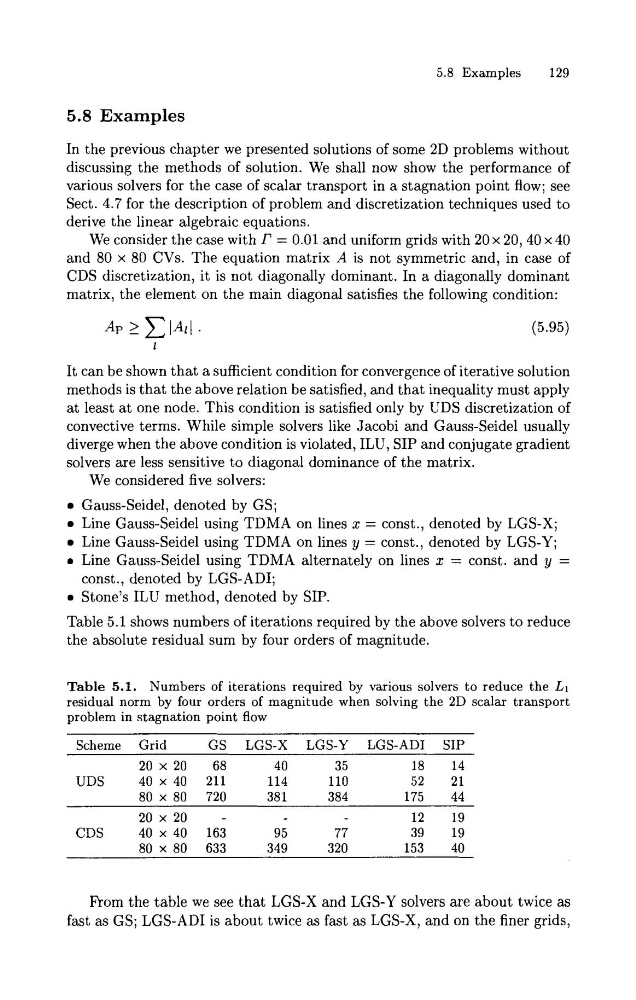
Table 5.1 shows numbers of iterations required by the above solvers to reduce
the absolute residual sum by four orders of magnitude.
Table 5.1. Numbers of iterations required by various solvers t o reduce the L1
residual norm by four orders of magnitude when solving the 2D scalar transport
problem in stagnation point flow
Scheme Grid
GS LGS-X LGS-Y LGS-AD1 SIP
20 x 20
68
40
35
18
14
UDS
40 x 40 211
114
110
52
21
80 x 80 720
38 1
384
175
44
20 x 20
-
12
19
CDS
40 x 40 163
95
77
39
19
80 x 80 633
349
320
153
40
From the table we see that LGS-X and LGS-Y solvers are about twice as
fast as GS; LGS-AD1 is about twice as fast as LGS-X, and on the finer grids,
129
5.8 Examples
In the previous chapter we presented solutions of some 2D problems without
discussing the methods of solution. We shall now show the performance of
various solvers for the case of scalar transport in a stagnation point flow; see
Sect. 4.7 for the description of problem and discretization techniques used to
derive the linear algebraic equations.
We consider the case with r = 0.01 and uniform grids with 20 x 20,40 x 40
and 80 x 80 CVs. The equation matrix A is not symmetric and, in case of
CDS discretization, it is not diagonally dominant. In a diagonally dominant
matrix, the element on the main diagonal satisfies the following condition:
It can be shown that a sufficient condition for convergence of iterative solution
methods is that the above relation be satisfied, and that inequality must apply
at least at one node. This condition is satisfied only by UDS discretization of
convective terms. While simple solvers like Jacobi and Gauss-Seidel usually
diverge when the above condition is violated, ILU, SIP and conjugate gradient
solvers are less sensitive to diagonal dominance of the matrix.
We considered five solvers:
Gauss-Seidel, denoted by GS;
Line Gauss-Seidel using TDMA on lines x = const., denoted by LGS-X;
Line Gauss-Seidel using TDMA on lines y = const., denoted by LGS-Y;
0 Line Gauss-Seidel using TDMA alternately on lines x = const. and y =
const., denoted by LGS-ADI;
0 Stone's ILU method, denoted by SIP.
Table 5.1 shows numbers of iterations required by the above solvers to reduce
the absolute residual sum by four orders of magnitude.
Table 5.1. Numbers of iterations required by various solvers t o reduce the L1
residual norm by four orders of magnitude when solving the 2D scalar transport
problem in stagnation point flow
Scheme Grid
GS LGS-X LGS-Y LGS-AD1 SIP
20 x 20
68
40
35
18
14
UDS
40 x 40 211
114
110
52
21
80 x 80 720
38 1
384
175
44
20 x 20
-
12
19
CDS
40 x 40 163
95
77
39
19
80 x 80 633
349
320
153
40
From the table we see that LGS-X and LGS-Y solvers are about twice as
fast as GS; LGS-AD1 is about twice as fast as LGS-X, and on the finer grids,