

128
5. Solution of Linear Equation Systems
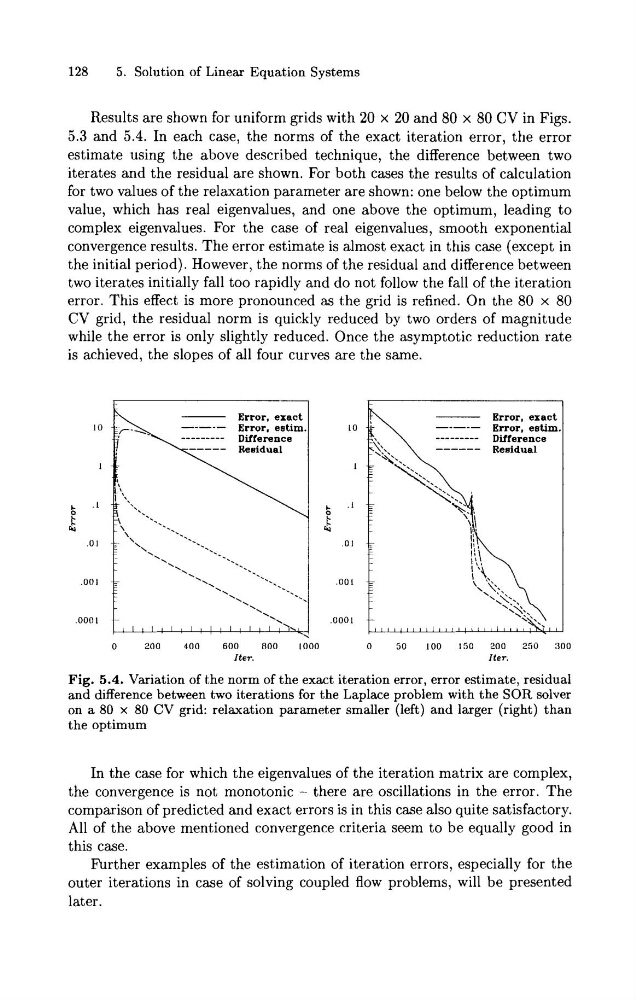
Results are shown for uniform grids with 20 x 20 and 80 x 80 CV in Figs.
5.3 and 5.4. In each case, the norms of the exact iteration error, the error
estimate using the above described technique, the difference between two
iterates and the residual are shown. For both cases the results of calculation
for two values of the relaxation parameter are shown: one below the optimum
value, which has real eigenvalues, and one above the optimum, leading t o
complex eigenvalues. For the case of real eigenvalues, smooth exponential
convergence results. The error estimate is almost exact in this case (except in
the initial period). However, the norms of the residual and difference between
two iterates initially fall too rapidly and do not follow the fall of the iteration
error. This effect is more pronounced as the grid is refined. On the 80 x 80
CV grid, the residual norm is quickly reduced by two orders of magnitude
while the error is only slightly reduced. Once the asymptotic reduction rate
is achieved, the slopes of all four curves are the same.
Error, exact
Error, estim.
'\
-.
\ \
-.
'\\\
-_ -.
' \ ' \
-.
-
' \
..
' \
-... ..
'\\
' \
'.
Error, exact
Error, estim
0
200
400
600
800
1000
0
50
100
150
200
250
300
Iter.
I t e r .
Fig. 5.4. Variation of the norm of the exact iteration error, error estimate, residual
and difference between two iterations for the Laplace problem with the SOR solver
on a 80 x 80 CV grid: relaxation parameter smaller (left) and larger (right) than
the optimum
In the case for which the eigenvalues of the iteration matrix are complex,
the convergence is not monotonic - there are oscillations in the error. The
comparison of predicted and exact errors is in this case also quite satisfactory.
All of the above mentioned convergence criteria seem to be equally good in
this case.
Further examples of the estimation of iteration errors, especially for the
outer iterations in case of solving coupled flow problems, will be presented
later.
5. Solution of Linear Equation Systems
Results are shown for uniform grids with 20 x 20 and 80 x 80 CV in Figs.
5.3 and 5.4. In each case, the norms of the exact iteration error, the error
estimate using the above described technique, the difference between two
iterates and the residual are shown. For both cases the results of calculation
for two values of the relaxation parameter are shown: one below the optimum
value, which has real eigenvalues, and one above the optimum, leading t o
complex eigenvalues. For the case of real eigenvalues, smooth exponential
convergence results. The error estimate is almost exact in this case (except in
the initial period). However, the norms of the residual and difference between
two iterates initially fall too rapidly and do not follow the fall of the iteration
error. This effect is more pronounced as the grid is refined. On the 80 x 80
CV grid, the residual norm is quickly reduced by two orders of magnitude
while the error is only slightly reduced. Once the asymptotic reduction rate
is achieved, the slopes of all four curves are the same.
Error, exact
Error, estim.
'\
-.
\ \
-.
'\\\
-_ -.
' \ ' \
-.
-
' \
..
' \
-... ..
'\\
' \
'.
Error, exact
Error, estim
0
200
400
600
800
1000
0
50
100
150
200
250
300
Iter.
I t e r .
Fig. 5.4. Variation of the norm of the exact iteration error, error estimate, residual
and difference between two iterations for the Laplace problem with the SOR solver
on a 80 x 80 CV grid: relaxation parameter smaller (left) and larger (right) than
the optimum
In the case for which the eigenvalues of the iteration matrix are complex,
the convergence is not monotonic - there are oscillations in the error. The
comparison of predicted and exact errors is in this case also quite satisfactory.
All of the above mentioned convergence criteria seem to be equally good in
this case.
Further examples of the estimation of iteration errors, especially for the
outer iterations in case of solving coupled flow problems, will be presented
later.