

72
2 Water at Rest and in Motion
~ _ _ _ _ ' - ~ _ - - - + - . . . - - - - - - - - - " ' z = f
~
I'~
Z
I
.. ,
tLY
I
. '
---------------t------------------X
- - - - -•• 1
O.
"
.
D
---------~~
.
p
p + /lp
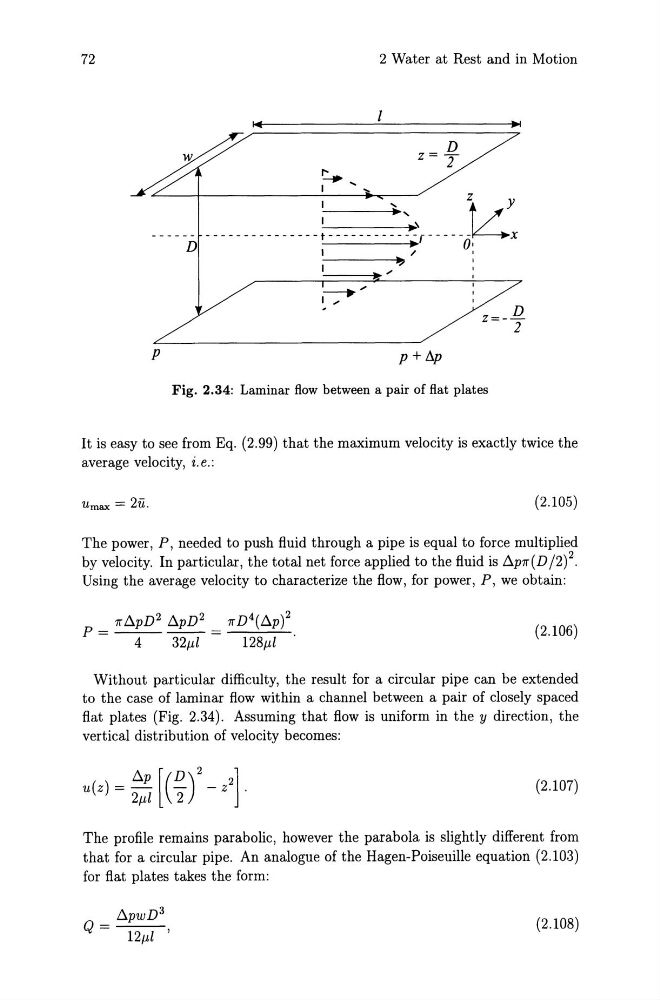
Fig. 2.34: Laminar flow between a pair of flat plates
It is easy to see from Eq. (2.99) that the maximum velocity is exactly twice the
average velocity, i. e.:
U max = 2u.
(2.105)
The power, P, needed to push fluid through a pipe is equal to force multiplied
by velocity. In particular, the total net force applied to the fluid is D.p1r(D/2)2.
Using the average velocity to characterize the flow, for power, P, we obtain:
(2.106)
Without particular difficulty, the result for a circular pipe can be extended
to the case of laminar flow within a channel between a pair of closely spaced
flat plates (Fig. 2.34). Assuming that flow is uniform in the y direction, the
vertical distribution of velocity becomes:
D.p [(D)2
2]
u(z)=2/.d
"2 -z .
(2.107)
The profile remains parabolic, however the parabola is slightly different from
that for a circular pipe. An analogue of the Hagen-Poiseuille equation (2.103)
for flat plates takes the form:
(2.108)
2 Water at Rest and in Motion
~ _ _ _ _ ' - ~ _ - - - + - . . . - - - - - - - - - " ' z = f
~
I'~
Z
I
.. ,
tLY
I
. '
---------------t------------------X
- - - - -•• 1
O.
"
.
D
---------~~
.
p
p + /lp
Fig. 2.34: Laminar flow between a pair of flat plates
It is easy to see from Eq. (2.99) that the maximum velocity is exactly twice the
average velocity, i. e.:
U max = 2u.
(2.105)
The power, P, needed to push fluid through a pipe is equal to force multiplied
by velocity. In particular, the total net force applied to the fluid is D.p1r(D/2)2.
Using the average velocity to characterize the flow, for power, P, we obtain:
(2.106)
Without particular difficulty, the result for a circular pipe can be extended
to the case of laminar flow within a channel between a pair of closely spaced
flat plates (Fig. 2.34). Assuming that flow is uniform in the y direction, the
vertical distribution of velocity becomes:
D.p [(D)2
2]
u(z)=2/.d
"2 -z .
(2.107)
The profile remains parabolic, however the parabola is slightly different from
that for a circular pipe. An analogue of the Hagen-Poiseuille equation (2.103)
for flat plates takes the form:
(2.108)