

56
2 Water at Rest and in Motion
sphere
10-1
10-1
Re = uDlv
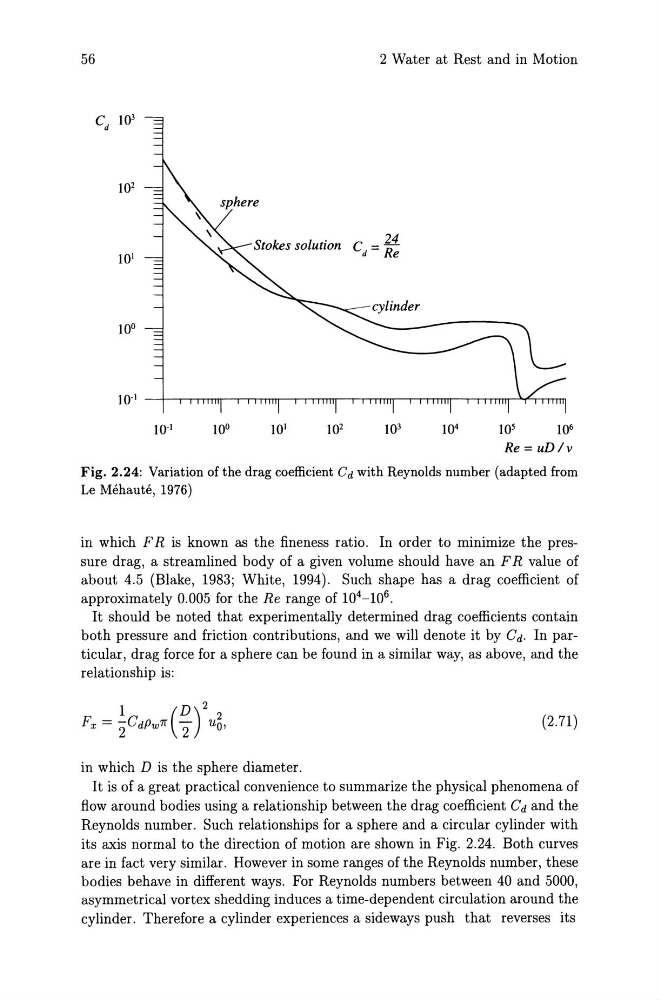
Fig. 2.24: Variation of the drag coefficient Cd with Reynolds number (adapted from
Le Mehaute, 1976)
in which F R is known as the fineness ratio. In order to minimize the pressure drag, a streamlined body of a given volume should have an F R value of
about 4.5 (Blake, 1983; White, 1994). Such shape has a drag coefficient of
approximately 0.005 for the Re range of 10 4 -10 6 .
It should be noted that experimentally determined drag coefficients contain
both pressure and friction contributions, and we will denote it by Cd. In particular, drag force for a sphere can be found in a similar way, as above, and the
relationship is:
(2.71)
in which D is the sphere diameter.
It is of a great practical convenience to summarize the physical phenomena of
flow around bodies using a relationship between the drag coefficient Cd and the
Reynolds number. Such relationships for a sphere and a circular cylinder with
its axis normal to the direction of motion are shown in Fig. 2.24. Both curves
are in fact very similar. However in some ranges of the Reynolds number, these
bodies behave in different ways. For Reynolds numbers between 40 and 5000,
asymmetrical vortex shedding induces a time-dependent circulation around the
cylinder. Therefore a cylinder experiences a sideways push that reverses its
2 Water at Rest and in Motion
sphere
10-1
10-1
Re = uDlv
Fig. 2.24: Variation of the drag coefficient Cd with Reynolds number (adapted from
Le Mehaute, 1976)
in which F R is known as the fineness ratio. In order to minimize the pressure drag, a streamlined body of a given volume should have an F R value of
about 4.5 (Blake, 1983; White, 1994). Such shape has a drag coefficient of
approximately 0.005 for the Re range of 10 4 -10 6 .
It should be noted that experimentally determined drag coefficients contain
both pressure and friction contributions, and we will denote it by Cd. In particular, drag force for a sphere can be found in a similar way, as above, and the
relationship is:
(2.71)
in which D is the sphere diameter.
It is of a great practical convenience to summarize the physical phenomena of
flow around bodies using a relationship between the drag coefficient Cd and the
Reynolds number. Such relationships for a sphere and a circular cylinder with
its axis normal to the direction of motion are shown in Fig. 2.24. Both curves
are in fact very similar. However in some ranges of the Reynolds number, these
bodies behave in different ways. For Reynolds numbers between 40 and 5000,
asymmetrical vortex shedding induces a time-dependent circulation around the
cylinder. Therefore a cylinder experiences a sideways push that reverses its