

2.6 Forces Imposed by Fluid Flow
55
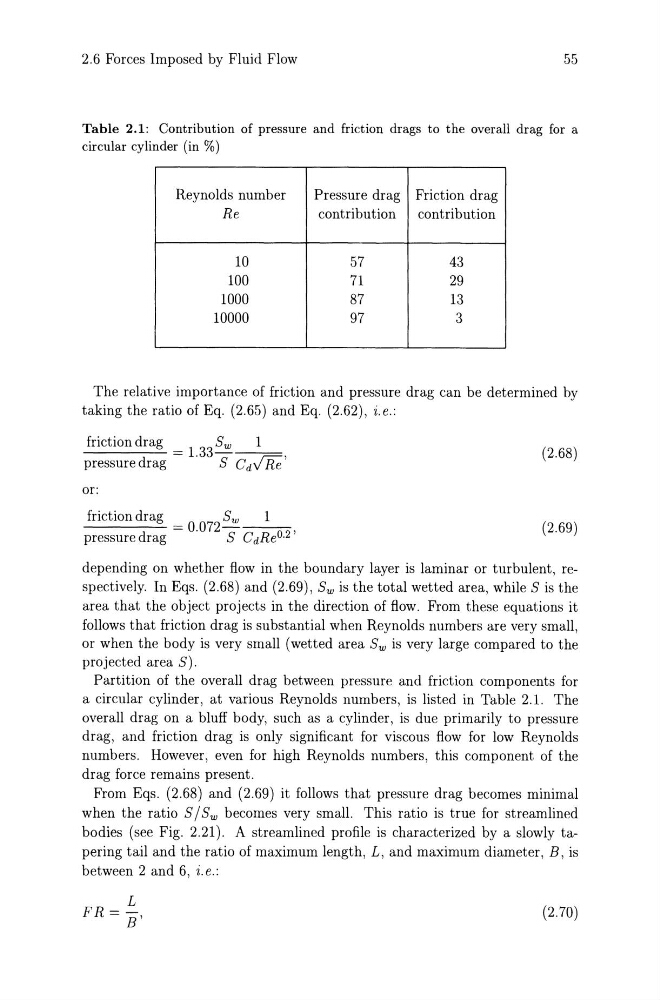
Table 2.1: Contribution of pressure and friction drags to the overall drag for a
circular cylinder (in %)
Reynolds number
Pressure drag Friction drag
Re
contribution contribution
10
57
43
100
71
29
1000
87
13
10000
97
3
The relative importance of friction and pressure drag can be determined by
taking the ratio of Eq. (2.65) and Eq. (2.62), i.e.:
friction drag
Sw
1
= 1.33~,
pressure drag
S CdV Re
(2.68)
or:
friction drag
Sw
1
----~ = 0.072
02'
pressure drag
S C dRe .
(2.69)
depending on whether flow in the boundary layer is laminar or turbulent, respectively. In Eqs. (2.68) and (2.69), Sw is the total wetted area, while S is the
area that the object projects in the direction of flow. From these equations it
follows that friction drag is substantial when Reynolds numbers are very small,
or when the body is very small (wetted area Sw is very large compared to the
projected area S).
Partition of the overall drag between pressure and friction components for
a circular cylinder, at various Reynolds numbers, is listed in Table 2.1. The
overall drag on a bluff body, such as a cylinder, is due primarily to pressure
drag, and friction drag is only significant for viscous flow for low Reynolds
numbers. However, even for high Reynolds numbers, this component of the
drag force remains present.
From Eqs. (2.68) and (2.69) it follows that pressure drag becomes minimal
when the ratio S / Sw becomes very small. This ratio is true for streamlined
bodies (see Fig. 2.21). A streamlined profile is characterized by a slowly tapering tail and the ratio of maximum length, L, and maximum diameter, B, is
between 2 and 6, i.e.:
L
FR=B'
(2.70)
55
Table 2.1: Contribution of pressure and friction drags to the overall drag for a
circular cylinder (in %)
Reynolds number
Pressure drag Friction drag
Re
contribution contribution
10
57
43
100
71
29
1000
87
13
10000
97
3
The relative importance of friction and pressure drag can be determined by
taking the ratio of Eq. (2.65) and Eq. (2.62), i.e.:
friction drag
Sw
1
= 1.33~,
pressure drag
S CdV Re
(2.68)
or:
friction drag
Sw
1
----~ = 0.072
02'
pressure drag
S C dRe .
(2.69)
depending on whether flow in the boundary layer is laminar or turbulent, respectively. In Eqs. (2.68) and (2.69), Sw is the total wetted area, while S is the
area that the object projects in the direction of flow. From these equations it
follows that friction drag is substantial when Reynolds numbers are very small,
or when the body is very small (wetted area Sw is very large compared to the
projected area S).
Partition of the overall drag between pressure and friction components for
a circular cylinder, at various Reynolds numbers, is listed in Table 2.1. The
overall drag on a bluff body, such as a cylinder, is due primarily to pressure
drag, and friction drag is only significant for viscous flow for low Reynolds
numbers. However, even for high Reynolds numbers, this component of the
drag force remains present.
From Eqs. (2.68) and (2.69) it follows that pressure drag becomes minimal
when the ratio S / Sw becomes very small. This ratio is true for streamlined
bodies (see Fig. 2.21). A streamlined profile is characterized by a slowly tapering tail and the ratio of maximum length, L, and maximum diameter, B, is
between 2 and 6, i.e.:
L
FR=B'
(2.70)