

40
2 Water at Rest and in Motion
(see Fig. 2.12). This layer is called the boundary layer. Depending on the
regime of motion, laminar and turbulent boundary layers are distinguished.
Any body of any shape, when immersed in a fluid stream, experiences forces
and moments from the flow. The Sect. 2.6 provides the basis for determination
of these forces for perfect as well as viscous fluids. In particular, it will be shown
how a balance of forces acting on the body moving in the fluid, determines the
'terminal velocity' for biological and non biological particles. However, a key
element for understanding the processes of interaction between a body and a
fluid is the boundary layer, from which our analysis is started.
2.5.2 Non-Slip Condition and Boundary Layer Thickness
Everyday experience provides a confirmation that the fluid in direct contact
with a solid surface does not slip in relation to that surface. This property of
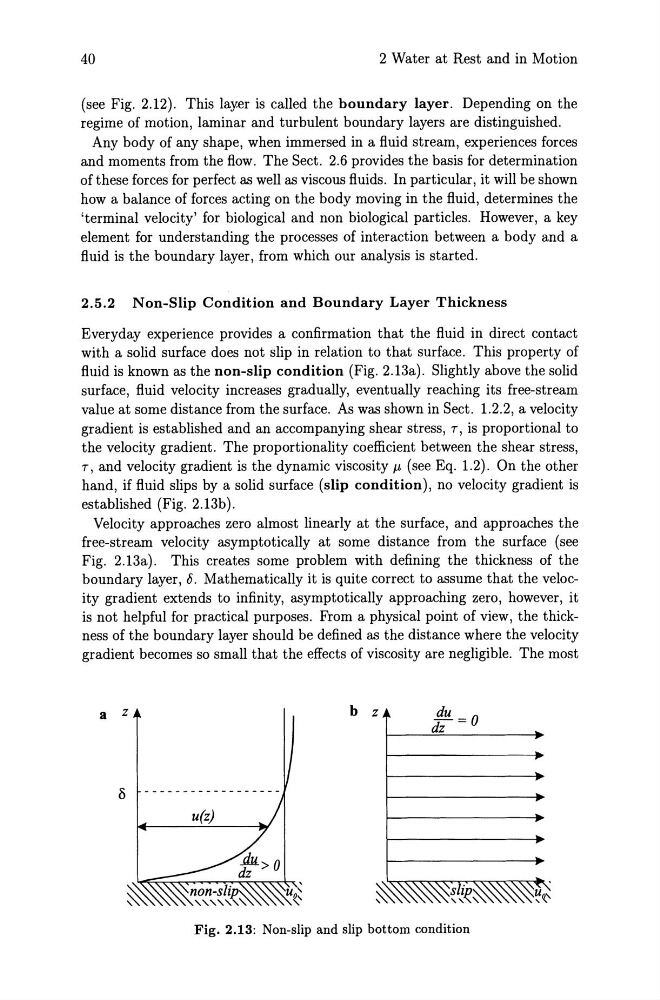
fluid is known as the non-slip condition (Fig. 2.13a). Slightly above the solid
surface, fluid velocity increases gradually, eventually reaching its free-stream
value at some distance from the surface. As was shown in Sect. 1.2.2, a velocity
gradient is established and an accompanying shear stress, 7, is proportional to
the velocity gradient. The proportionality coefficient between the shear stress,
7, and velocity gradient is the dynamic viscosity J1 (see Eq. 1. 2). On the other
hand, if fluid slips by a solid surface (slip condition), no velocity gradient is
established (Fig. 2.13b).
Velocity approaches zero almost linearly at the surface, and approaches the
free-stream velocity asymptotically at some distance from the surface (see
Fig. 2.13a). This creates some problem with defining the thickness of the
boundary layer, 8. Mathematically it is quite correct to assume that the velocity gradient extends to infinity, asymptotically approaching zero, however, it
is not helpful for practical purposes. From a physical point of view, the thickness of the boundary layer should be defined as the distance where the velocity
gradient becomes so small that the effects of viscosity are negligible. The most
a Z
b Z
du - 0
dz -
Fig. 2.13: Non-slip and slip bottom condition
2 Water at Rest and in Motion
(see Fig. 2.12). This layer is called the boundary layer. Depending on the
regime of motion, laminar and turbulent boundary layers are distinguished.
Any body of any shape, when immersed in a fluid stream, experiences forces
and moments from the flow. The Sect. 2.6 provides the basis for determination
of these forces for perfect as well as viscous fluids. In particular, it will be shown
how a balance of forces acting on the body moving in the fluid, determines the
'terminal velocity' for biological and non biological particles. However, a key
element for understanding the processes of interaction between a body and a
fluid is the boundary layer, from which our analysis is started.
2.5.2 Non-Slip Condition and Boundary Layer Thickness
Everyday experience provides a confirmation that the fluid in direct contact
with a solid surface does not slip in relation to that surface. This property of
fluid is known as the non-slip condition (Fig. 2.13a). Slightly above the solid
surface, fluid velocity increases gradually, eventually reaching its free-stream
value at some distance from the surface. As was shown in Sect. 1.2.2, a velocity
gradient is established and an accompanying shear stress, 7, is proportional to
the velocity gradient. The proportionality coefficient between the shear stress,
7, and velocity gradient is the dynamic viscosity J1 (see Eq. 1. 2). On the other
hand, if fluid slips by a solid surface (slip condition), no velocity gradient is
established (Fig. 2.13b).
Velocity approaches zero almost linearly at the surface, and approaches the
free-stream velocity asymptotically at some distance from the surface (see
Fig. 2.13a). This creates some problem with defining the thickness of the
boundary layer, 8. Mathematically it is quite correct to assume that the velocity gradient extends to infinity, asymptotically approaching zero, however, it
is not helpful for practical purposes. From a physical point of view, the thickness of the boundary layer should be defined as the distance where the velocity
gradient becomes so small that the effects of viscosity are negligible. The most
a Z
b Z
du - 0
dz -
Fig. 2.13: Non-slip and slip bottom condition