

2.5 Boundary Layer Flows
39
This type of equation is called the Reynolds equation. It is very similar to the
Navier-Stokes equation (2.22) . Except that most quantities are time-averaged
ones, the only real difference is the presence of the forces due to turbulent
fluctuations. It should be noted that terms Pwu,2, Pwu'v' and Pwu'w' have
the dimension of stresses, i. e. N 1m 2 , and are therefore called the Reynolds
stresses.
To simplify the solution of turbulence problems, the concept of 'isotropic
turbulence ' is frequently introduced. In isotropic turbulence, the mean value of
any function of the fluctuating velocity components and their space derivatives
does not depend on the direction, i.e.:
(2.45)
The concepts of the Reynolds stresses and isotropic turbulence are used in the
discussion of dispersion and mixing processes in Chaps. 8 and 13.
2.5 Boundary Layer Flows
2.5.1 Motivation
In the previous section we learnt how to study ocean waters depending on
their physical characteristics and the character of the flow itself. Hence, we
can distinguish between non-viscous and viscous fluids, steady and unsteady,
and rotational and irrotational flows. However, the ocean is not empty, but full
of various kind of living organisms and man-made structures, stationary, solid
and moving. In this section we discuss the interaction mechanisms between
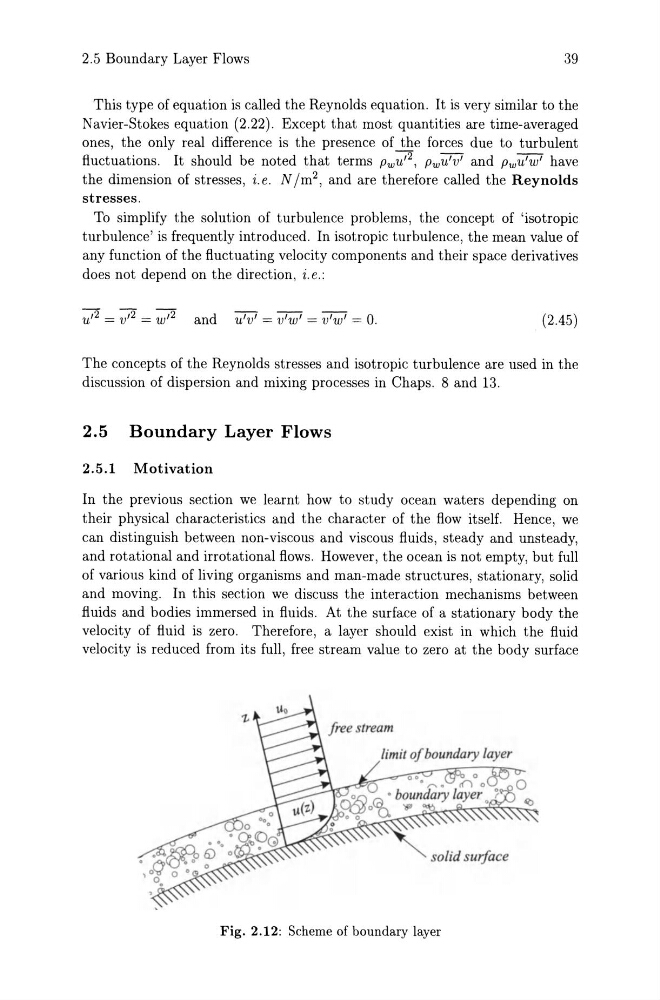
fluids and bodies immersed in fluids. At the surface of a stationary body the
velocity of fluid is zero. Therefore, a layer should exist in which the fluid
velocity is reduced from its full, free stream value to zero at the body surface
free stream
solid surface
Fig. 2.12: Scheme of boundary layer
39
This type of equation is called the Reynolds equation. It is very similar to the
Navier-Stokes equation (2.22) . Except that most quantities are time-averaged
ones, the only real difference is the presence of the forces due to turbulent
fluctuations. It should be noted that terms Pwu,2, Pwu'v' and Pwu'w' have
the dimension of stresses, i. e. N 1m 2 , and are therefore called the Reynolds
stresses.
To simplify the solution of turbulence problems, the concept of 'isotropic
turbulence ' is frequently introduced. In isotropic turbulence, the mean value of
any function of the fluctuating velocity components and their space derivatives
does not depend on the direction, i.e.:
(2.45)
The concepts of the Reynolds stresses and isotropic turbulence are used in the
discussion of dispersion and mixing processes in Chaps. 8 and 13.
2.5 Boundary Layer Flows
2.5.1 Motivation
In the previous section we learnt how to study ocean waters depending on
their physical characteristics and the character of the flow itself. Hence, we
can distinguish between non-viscous and viscous fluids, steady and unsteady,
and rotational and irrotational flows. However, the ocean is not empty, but full
of various kind of living organisms and man-made structures, stationary, solid
and moving. In this section we discuss the interaction mechanisms between
fluids and bodies immersed in fluids. At the surface of a stationary body the
velocity of fluid is zero. Therefore, a layer should exist in which the fluid
velocity is reduced from its full, free stream value to zero at the body surface
free stream
solid surface
Fig. 2.12: Scheme of boundary layer