

Appendix C Useful Theoretical Approaches and Formulas
497
C.5 Formulas of Small Amplitude Wave Theory
C.5.1 Unknown Quantities and Laplace Equation
In this section a short derivation of various parameters of surface waves is
provided, as this section is treated as a supplement to Sect. 4.2 in which only
final calculation formulas have been presented.
Consider a regular wave motion as shown in Fig. 4.2. At each point in the
water body (say point P), there are five unknown basic wave parameters; horizontal component of orbital velocity u(x, z, t), vertical component of orbital
velocity w(x, z, t), wave induced pressure p(x, z, t), surface displacement ((x, t)
and wavelength L. To simplify the evaluation of these five unknowns, some
specific properties of water and of water motion itself will be used. Firstly,
we use the fact that water is an incompressible fluid. Moreover, we assume
that waves are uniform in the y-direction (crest lines are perpendicular to the
plane 0, x, z). Therefore, wave motion becomes two-dimensional, satisfying the
following equation of mass conservation:
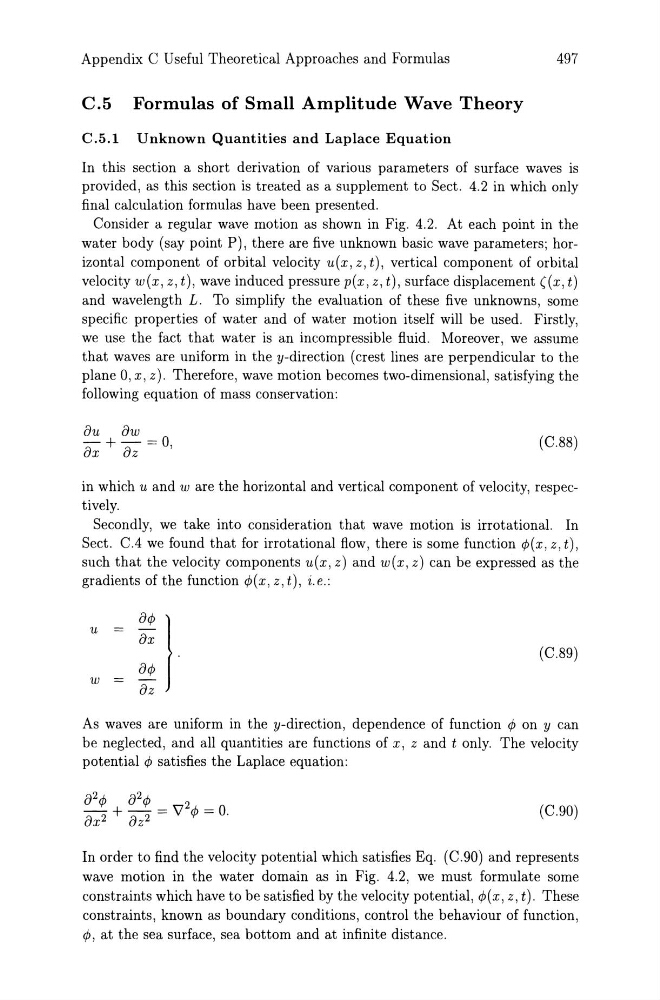
(C.SS)
in which u and ware the horizontal and vertical component of velocity, respectively.
Secondly, we take into consideration that wave motion is irrotational. In
Sect. C.4 we found that for irrotational flow, there is some function ¢(x, z, t),
such that the velocity components u(x, z) and w(x, z) can be expressed as the
gradients of the function ¢( x, z, t), i. e.:
=
~!}
8¢
w
oz
u
(C.S9)
As waves are uniform in the y-direction, dependence of function ¢ on y can
be neglected, and all quantities are functions of x, z and t only. The velocity
potential ¢ satisfies the Laplace equation:
(C.90)
In order to find the velocity potential which satisfies Eq. (C.90) and represents
wave motion in the water domain as in Fig. 4.2, we must formulate some
constraints which have to be satisfied by the velocity potential, ¢( x, z, t). These
constraints, known as boundary conditions, control the behaviour of function,
¢, at the sea surface, sea bottom and at infinite distance.
497
C.5 Formulas of Small Amplitude Wave Theory
C.5.1 Unknown Quantities and Laplace Equation
In this section a short derivation of various parameters of surface waves is
provided, as this section is treated as a supplement to Sect. 4.2 in which only
final calculation formulas have been presented.
Consider a regular wave motion as shown in Fig. 4.2. At each point in the
water body (say point P), there are five unknown basic wave parameters; horizontal component of orbital velocity u(x, z, t), vertical component of orbital
velocity w(x, z, t), wave induced pressure p(x, z, t), surface displacement ((x, t)
and wavelength L. To simplify the evaluation of these five unknowns, some
specific properties of water and of water motion itself will be used. Firstly,
we use the fact that water is an incompressible fluid. Moreover, we assume
that waves are uniform in the y-direction (crest lines are perpendicular to the
plane 0, x, z). Therefore, wave motion becomes two-dimensional, satisfying the
following equation of mass conservation:
(C.SS)
in which u and ware the horizontal and vertical component of velocity, respectively.
Secondly, we take into consideration that wave motion is irrotational. In
Sect. C.4 we found that for irrotational flow, there is some function ¢(x, z, t),
such that the velocity components u(x, z) and w(x, z) can be expressed as the
gradients of the function ¢( x, z, t), i. e.:
=
~!}
8¢
w
oz
u
(C.S9)
As waves are uniform in the y-direction, dependence of function ¢ on y can
be neglected, and all quantities are functions of x, z and t only. The velocity
potential ¢ satisfies the Laplace equation:
(C.90)
In order to find the velocity potential which satisfies Eq. (C.90) and represents
wave motion in the water domain as in Fig. 4.2, we must formulate some
constraints which have to be satisfied by the velocity potential, ¢( x, z, t). These
constraints, known as boundary conditions, control the behaviour of function,
¢, at the sea surface, sea bottom and at infinite distance.