

496
Appendix C Useful Theoretical Approaches and Formulas
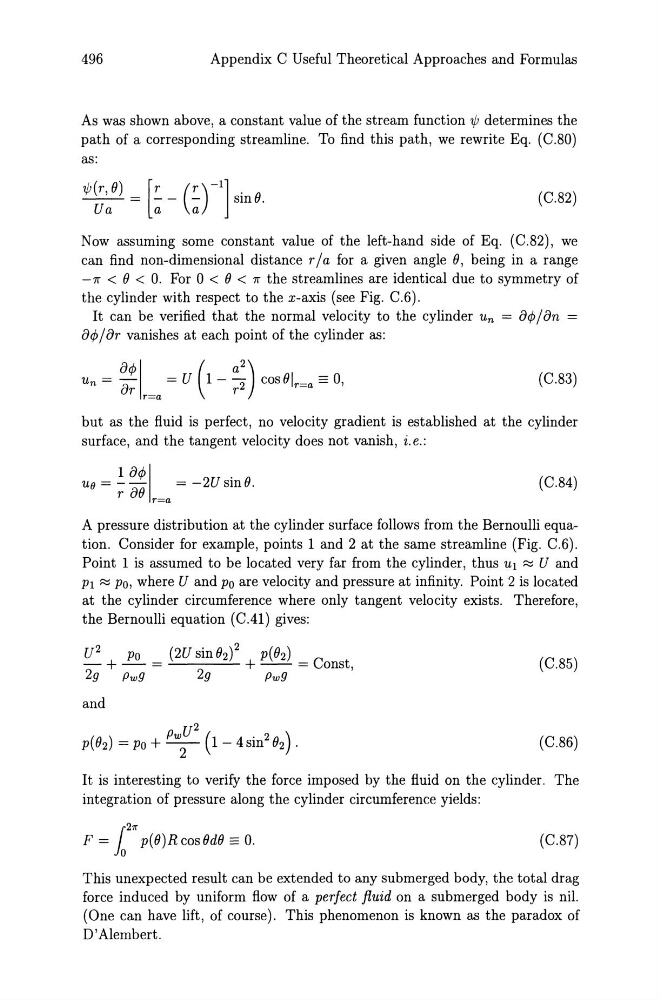
As was shown above, a constant value of the stream function ' IjJ determines the
path of a corresponding streamline. To find this path, we rewrite Eq. (C.80)
as:
(C.82)
Now assuming some constant value of the left-hand side of Eq. (C.82), we
can find non-dimensional distance r / a for a given angle 0, being in a range
-7r < 0 < O. For 0 < 0 < 7r the streamlines are identical due to symmetry of
the cylinder with respect to the x-axis (see Fig. C.6).
It can be verified that the normal velocity to the cylinder Un = aN an =
ocjJ / or vanishes at each point of the cylinder as:
ocjJl
(a
2 )
Un = or r=a = U 1- r2 cosOlr=a == 0,
(C.83)
but as the fluid is perfect, no velocity gradient is established at the cylinder
surface, and the tangent velocity does not vanish, i.e.:
UIJ=~BcjJl =-2UsinO.
r BO r=a
(C.84)
A pressure distribution at the cylinder surface follows from the Bernoulli equation. Consider for example, points 1 and 2 at the same streamline (Fig. C.6).
Point 1 is assumed to be located very far from the cylinder, thus Ul ~ U and
PI ~ Po, where U and Po are velocity and pressure at infinity. Point 2 is located
at the cylinder circumference where only tangent velocity exists. Therefore,
the Bernoulli equation (C.41) gives:
U 2 + Po = (2Usin02)2 + p(02) = Const
2g
Pwg
2g
Pwg
,
and
( )
PwU2 (
. 2 )
P O2 = Po + -2- 1 - 4 sm O2 .
(C.85)
(C.86)
It is interesting to verify the force imposed by the fluid on the cylinder. The
integration of pressure along the cylinder circumference yields:
{21r
F = io p(O)RcosOdO == O.
(C.87)
This unexpected result can be extended to any submerged body, the total drag
force induced by uniform flow of a perfect fluid on a submerged body is nil.
(One can have lift, of course). This phenomenon is known as the paradox of
D'Alembert.
Appendix C Useful Theoretical Approaches and Formulas
As was shown above, a constant value of the stream function ' IjJ determines the
path of a corresponding streamline. To find this path, we rewrite Eq. (C.80)
as:
(C.82)
Now assuming some constant value of the left-hand side of Eq. (C.82), we
can find non-dimensional distance r / a for a given angle 0, being in a range
-7r < 0 < O. For 0 < 0 < 7r the streamlines are identical due to symmetry of
the cylinder with respect to the x-axis (see Fig. C.6).
It can be verified that the normal velocity to the cylinder Un = aN an =
ocjJ / or vanishes at each point of the cylinder as:
ocjJl
(a
2 )
Un = or r=a = U 1- r2 cosOlr=a == 0,
(C.83)
but as the fluid is perfect, no velocity gradient is established at the cylinder
surface, and the tangent velocity does not vanish, i.e.:
UIJ=~BcjJl =-2UsinO.
r BO r=a
(C.84)
A pressure distribution at the cylinder surface follows from the Bernoulli equation. Consider for example, points 1 and 2 at the same streamline (Fig. C.6).
Point 1 is assumed to be located very far from the cylinder, thus Ul ~ U and
PI ~ Po, where U and Po are velocity and pressure at infinity. Point 2 is located
at the cylinder circumference where only tangent velocity exists. Therefore,
the Bernoulli equation (C.41) gives:
U 2 + Po = (2Usin02)2 + p(02) = Const
2g
Pwg
2g
Pwg
,
and
( )
PwU2 (
. 2 )
P O2 = Po + -2- 1 - 4 sm O2 .
(C.85)
(C.86)
It is interesting to verify the force imposed by the fluid on the cylinder. The
integration of pressure along the cylinder circumference yields:
{21r
F = io p(O)RcosOdO == O.
(C.87)
This unexpected result can be extended to any submerged body, the total drag
force induced by uniform flow of a perfect fluid on a submerged body is nil.
(One can have lift, of course). This phenomenon is known as the paradox of
D'Alembert.