

490
Appendix C Useful Theoretical Approaches and Formulas
where Vr and v¢ are velocity components in the directions of increasing rand
¢, respectively.
The solution of equations (C.49) in terms of components Vr and v¢ takes the
form (Fung, 1997):
in which:
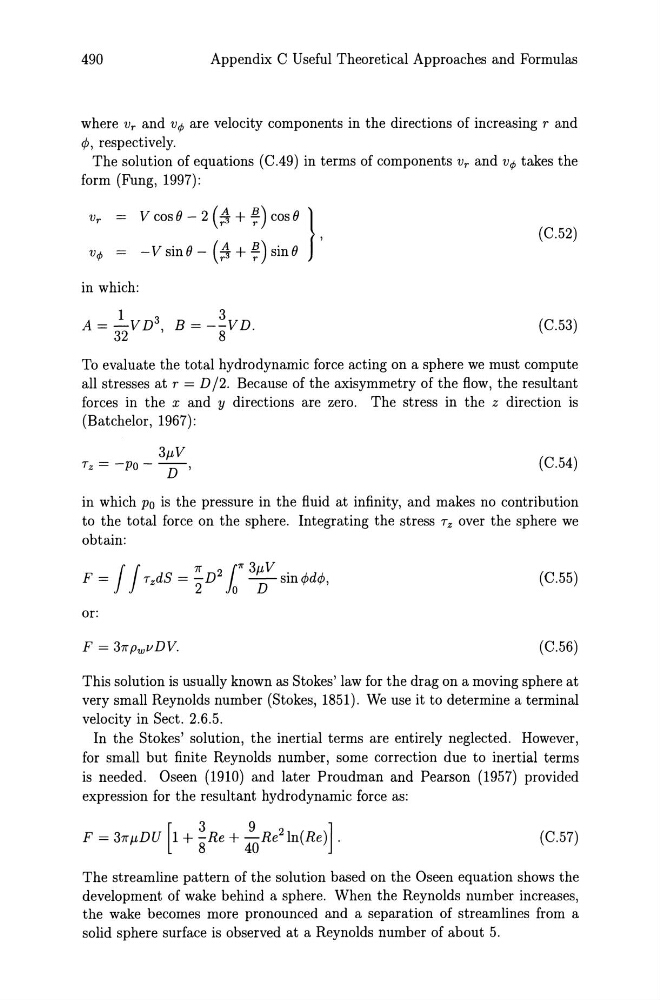
v cos B-2 (;4 + ~) cos B },
- V sin B - (;4 + ~) sin B
(C.52)
(C. 53)
To evaluate the total hydrodynamic force acting on a sphere we must compute
all stresses at r = D /2. Because of the axisymmetry of the flow, the resultant
forces in the x and y directions are zero. The stress in the z direction is
(Batchelor, 1967):
3,.N
T z = -Po- fl'
(C.54)
in which Po is the pressure in the fluid at infinity, and makes no contribution
to the total force on the sphere. Integrating the stress T z over the sphere we
obtain:
(C.55)
or:
(C.56)
This solution is usually known as Stokes' law for the drag on a moving sphere at
very small Reynolds number (Stokes, 1851). We use it to determine a terminal
velocity in Sect. 2.6.5.
In the Stokes' solution, the inertial terms are entirely neglected. However,
for small but finite Reynolds number, some correction due to inertial terms
is needed. Oseen (1910) and later Proudman and Pearson (1957) provided
expression for the resultant hydrodynamic force as:
(C.57)
The streamline pattern of the solution based on the Oseen equation shows the
development of wake behind a sphere. When the Reynolds number increases,
the wake becomes more pronounced and a separation of streamlines from a
solid sphere surface is observed at a Reynolds number of about 5.
Appendix C Useful Theoretical Approaches and Formulas
where Vr and v¢ are velocity components in the directions of increasing rand
¢, respectively.
The solution of equations (C.49) in terms of components Vr and v¢ takes the
form (Fung, 1997):
in which:
v cos B-2 (;4 + ~) cos B },
- V sin B - (;4 + ~) sin B
(C.52)
(C. 53)
To evaluate the total hydrodynamic force acting on a sphere we must compute
all stresses at r = D /2. Because of the axisymmetry of the flow, the resultant
forces in the x and y directions are zero. The stress in the z direction is
(Batchelor, 1967):
3,.N
T z = -Po- fl'
(C.54)
in which Po is the pressure in the fluid at infinity, and makes no contribution
to the total force on the sphere. Integrating the stress T z over the sphere we
obtain:
(C.55)
or:
(C.56)
This solution is usually known as Stokes' law for the drag on a moving sphere at
very small Reynolds number (Stokes, 1851). We use it to determine a terminal
velocity in Sect. 2.6.5.
In the Stokes' solution, the inertial terms are entirely neglected. However,
for small but finite Reynolds number, some correction due to inertial terms
is needed. Oseen (1910) and later Proudman and Pearson (1957) provided
expression for the resultant hydrodynamic force as:
(C.57)
The streamline pattern of the solution based on the Oseen equation shows the
development of wake behind a sphere. When the Reynolds number increases,
the wake becomes more pronounced and a separation of streamlines from a
solid sphere surface is observed at a Reynolds number of about 5.