

488
Appendix C Useful Theoretical Approaches and Formulas
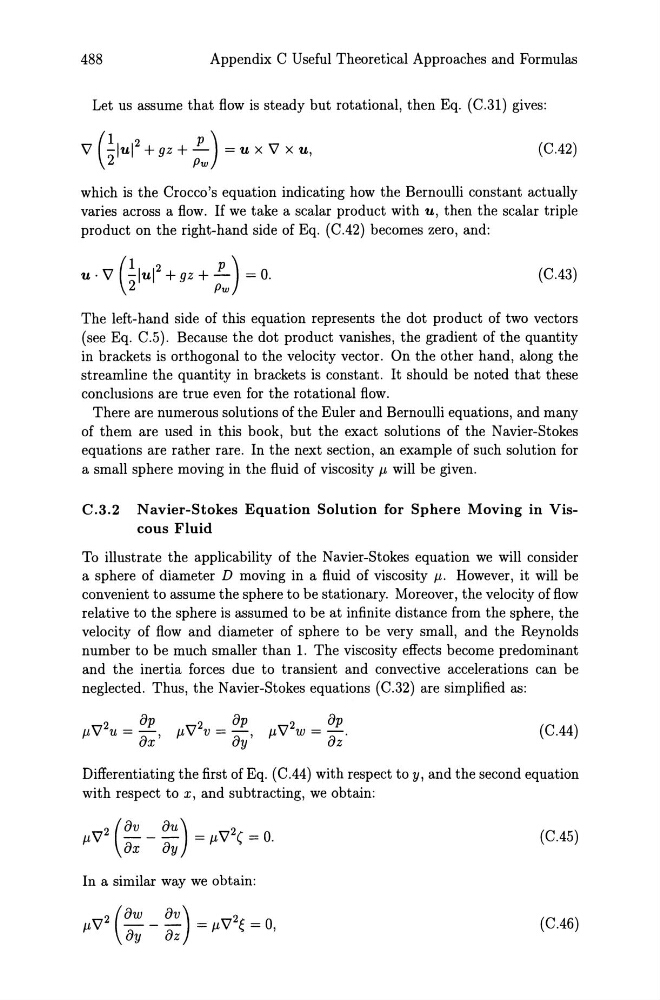
Let us assume that flow is steady but rotational, then Eq. (C.31) gives:
( 1 2
p)
Y' -lui + gz + - = u x Y' x u,
2
Pw
(C.42)
which is the Crocco's equation indicating how the Bernoulli constant actually
varies across a flow. If we take a scalar product with u, then the scalar triple
product on the right-hand side of Eq. (C.42) becomes zero, and:
u . Y' -lui + gz + - = O.
( 1 2
P )
2
Pw
(C.43)
The left-hand side of this equation represents the dot product of two vectors
(see Eq. C.5). Because the dot product vanishes, the gradient of the quantity
in brackets is orthogonal to the velocity vector. On the other hand, along the
streamline the quantity in brackets is constant. It should be noted that these
conclusions are true even for the rotational flow.
There are numerous solutions of the Euler and Bernoulli equations, and many
of them are used in this book, but the exact solutions of the N avier-Stokes
equations are rather rare. In the next section, an example of such solution for
a small sphere moving in the fluid of viscosity J.t will be given.
C.3.2 Navier-Stokes Equation Solution for Sphere Moving in Viscous Fluid
To illustrate the applicability of the Navier-Stokes equation we will consider
a sphere of diameter D moving in a fluid of viscosity J.t. However, it will be
convenient to assume the sphere to be stationary. Moreover, the velocity of flow
relative to the sphere is assumed to be at infinite distance from the sphere, the
velocity of flow and diameter of sphere to be very small, and the Reynolds
number to be much smaller than 1. The viscosity effects become predominant
and the inertia forces due to transient and convective accelerations can be
neglected. Thus, the Navier-Stokes equations (C.32) are simplified as:
2
op
J.tY' u = ox'
2
op
2
op
J.tY' v = oy' J.tY' w = oz'
(C.44)
Differentiating the first of Eq. (C.44) with respect to y, and the second equation
with respect to x, and subtracting, we obtain:
2 (OV ou) 2
J.tY' - - - =J.tY'(=O.
ox oy
(C.45)
In a similar way we obtain:
2 (OW Ov) _ n2 t - 0
J.tY' - - - -J.ty ,,- ,
oy OZ
(C.46)
Appendix C Useful Theoretical Approaches and Formulas
Let us assume that flow is steady but rotational, then Eq. (C.31) gives:
( 1 2
p)
Y' -lui + gz + - = u x Y' x u,
2
Pw
(C.42)
which is the Crocco's equation indicating how the Bernoulli constant actually
varies across a flow. If we take a scalar product with u, then the scalar triple
product on the right-hand side of Eq. (C.42) becomes zero, and:
u . Y' -lui + gz + - = O.
( 1 2
P )
2
Pw
(C.43)
The left-hand side of this equation represents the dot product of two vectors
(see Eq. C.5). Because the dot product vanishes, the gradient of the quantity
in brackets is orthogonal to the velocity vector. On the other hand, along the
streamline the quantity in brackets is constant. It should be noted that these
conclusions are true even for the rotational flow.
There are numerous solutions of the Euler and Bernoulli equations, and many
of them are used in this book, but the exact solutions of the N avier-Stokes
equations are rather rare. In the next section, an example of such solution for
a small sphere moving in the fluid of viscosity J.t will be given.
C.3.2 Navier-Stokes Equation Solution for Sphere Moving in Viscous Fluid
To illustrate the applicability of the Navier-Stokes equation we will consider
a sphere of diameter D moving in a fluid of viscosity J.t. However, it will be
convenient to assume the sphere to be stationary. Moreover, the velocity of flow
relative to the sphere is assumed to be at infinite distance from the sphere, the
velocity of flow and diameter of sphere to be very small, and the Reynolds
number to be much smaller than 1. The viscosity effects become predominant
and the inertia forces due to transient and convective accelerations can be
neglected. Thus, the Navier-Stokes equations (C.32) are simplified as:
2
op
J.tY' u = ox'
2
op
2
op
J.tY' v = oy' J.tY' w = oz'
(C.44)
Differentiating the first of Eq. (C.44) with respect to y, and the second equation
with respect to x, and subtracting, we obtain:
2 (OV ou) 2
J.tY' - - - =J.tY'(=O.
ox oy
(C.45)
In a similar way we obtain:
2 (OW Ov) _ n2 t - 0
J.tY' - - - -J.ty ,,- ,
oy OZ
(C.46)